

This month marks five years since the Bangladesh government began official relocations of Rohingya refugees to Bhasan Char. I wrote a piece for DVB, The Unravelling of Bhasan Char, which looks back at the island not as a humanitarian experiment but as a political project. You can read it here:
This anniversary comes at a revealing moment. Over the past year, two developments have quietly confirmed what many have argued for a long time. The interim government has decided to halt further relocations to the island, and the World Bank has produced an assessment showing that by virtually every metric - livelihoods, sustainability, market access, long-term viability - Bhasan Char is indefensible. Taken together, these developments amount to a tacit admission: the project has failed, even by the standards of those who once promoted it.
Bangladeshi Academics - something in the water?
And yet, despite this, a particular genre of writing continues to circulate. It is careful, sympathetic, academic work that documents harm in good detail while stopping just short of naming the project for what it is. This raises a basic question that I want to ask here - on what basis do some Bangladeshi academics still want to keep Bhasan Char alive as policy? What compels them to keep writing around the problem rather than confronting it?
Take Sanjeeb Hossain’s work. By his own account, he has studied the Rohingya situation since 2020, travelled to Bhasan Char twice, and engaged continuously with refugees for five years. Yet the most striking feature of his writing is how little of his own evidence supports the continued existence of Bhasan Char as anything other than a failed containment site. What he ends up doing, subtly but consistently, is diagnosing structural violence while prescribing administrative tinkering.
In his narrative, Bhasan Char appears as a place where refugees feel “disappointed and betrayed,” a space cut off from labour markets, an example of ad hoc governance, and a location where rights exist largely as theatre. Education is hollow, livelihoods are illusory, justice is arbitrary, and mobility is tightly controlled. And yet, after all this, Bhasan Char somehow remains on the table as part of a “solution.”
Instead of following his own findings to their political conclusion, that Bhasan Char is structurally designed to fail as a rights-bearing space, he retreats into the comfort of policy language. He talks of model laws, compacts, empowerment frameworks, and rights-based approaches. This is the academic equivalent of saying that the prison is harmful, isolating and rights-denying, so we should keep it and try to run it better.
What he never asks is just as revealing. He does not ask why Bhasan Char was built in the first place. He avoids what it means to create an offshore containment zone inside one’s own sovereign territory. He does not confront whether a space engineered for isolation and deterrence can ever be repurposed for rights-based inclusion. He does not examine who benefits politically from keeping the island alive as an option. He sidesteps how Bhasan Char fits neatly into Bangladesh’s long-standing practice of relocating “undesirable” populations to marginal land, whether through chars, cluster villages or projects like Ashrayan. And he does not grapple with what happens to Rohingya autonomy when their lives are made dependent on “compacts” negotiated between elites in Dhaka, London, Oslo and Geneva.
The same evasive logic appears even more starkly in the work produced by his colleagues, Al Muktadir Elahi Esmam and Nafisa Tabassum, in their piece Field Notes: The Uncertain Shores of Bhasanchar. What they have produced is not neutral scholarship. It is a masterclass in documenting injustice while carefully declining to name it as such. That refusal is not accidental. It is methodological, political and, frankly, unethical.
Their article records forced immobility, restricted exit, surveillance, informal taxation through bribes for movement, gender-based violence without effective justice, arbitrary magisterial power, isolation from markets, punishment through geography and indefinite confinement. Having assembled every element of a carceral regime, it then pauses to ask whether Bhasan Char is truly a “prison island”. This is not intellectual caution. This is intellectual cowardice.
The opening of the text tells you everything you need to know about how the violence will be handled. Sunset, buffaloes, greenery, excitement, phones held up to capture the romance of arrival. The first act is not analysis but touristic softening. By the time coercion appears, it has already been neutralised by tone. Confinement becomes “remoteness”. Bribery becomes an “economy of access.” Indefinite detention becomes “no known departure date.” Arbitrary justice becomes “the disposition of the CiC.” Surveillance becomes “security presence.” Escape becomes “attempts to leave.”
This is how violence is made palatable in policy discourse - by dissolving it into ambience.
The piece performs three functions simultaneously. It neutralises critique by pre-emptively softening it. It makes Bhasan Char legible to donors as complex but manageable. And it preserves the island as a policy object rather than naming it as a political crime. It is no accident that this work emerges from the same ecosystem that produces model laws and “alternative approaches.” You cannot sell reform if you acknowledge that the structure itself is illegitimate.
BRAC–CPJ Research Ecosystem
Sanjeeb Hossain and his colleagues are based at the Centre for Peace and Justice at BRAC University, an institution founded by BRAC and embedded within its wider development “solutions ecosystem.” While BRAC University is legally a separate academic institution, its research culture, funding networks and field access are deeply shaped by BRAC’s operational footprint and donor relationships. BRAC itself has an established presence on Bhasan Char, providing services on the island while navigating what its own leadership has described as an aid-policy limbo.
In that context, scholarship that frames Bhasan Char as flawed but reformable does not simply reflect academic caution. It reflects the structural limits of critique within an ecosystem that must continue to operate, negotiate, and be funded inside the very architecture it studies. In such settings, naming containment as a political crime is not an academic risk, it is an institutional impossibility.
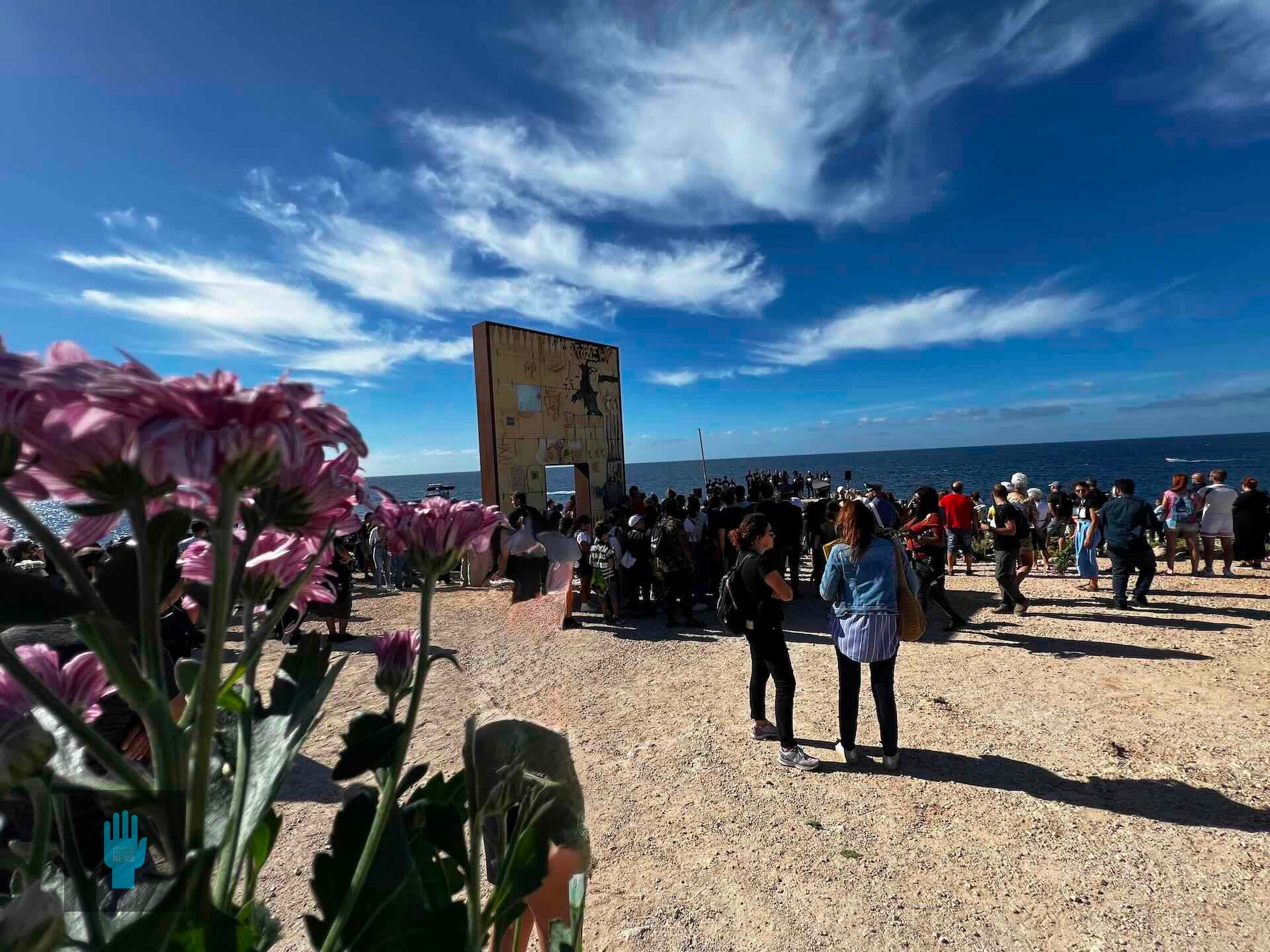
This is precisely the logic I challenge in my longer essay, which places Bhasan Char alongside Manus Island and Lampedusa — not as anomalies, but as part of a global architecture of containment that warehouses surplus populations while wrapping coercion in humanitarian language. Bhasan Char does not need better governance, better metrics or more careful academic prose. It needs to be recognised for what it is. That is, a political project of exclusion that has already failed, even if some academics remain unwilling to say so.
DEDICATION
In 2012, I travelled to Sicily to see a friend - a filmmaker, my Sicilian/German brother - who had drawn me into the quiet work of helping spring an Eritrean man from a Libyan prison ( a story for another day…) One morning, he and his wife, Roman Herzog and Heike Brunkhorst, took a walk along their local beach. The sea was calm. The light was good. And scattered along the shore were shoes - dozens of them, mismatched, waterlogged, abandoned. It took a few moments before the meaning settled in. They were not rubbish, not flotsam.
They were what remained of people who had drowned just offshore, their bodies taken by the sea, their shoes returned by the tide. For a time, there was nothing there to mark them. No names, no plaque, no sign that anyone had noticed. So they gathered stones and built a small memorial on the sand. It was simple, almost fragile, but it mattered. At the time, it was the only such memorial in Italy, despite the thousands who had died that way.
In September 2017, a boat sank in the Bay of Bengal. I came across the bodies of children laid out along Marine Drive. Their deaths were sudden, public, and exposed - their small forms turned into spectacle before they were allowed dignity. That sight has never left me. The smallness of their forms, the way the road carried on around them.
The following year, I wrote to the Prime Minister’s office (Sheikh Hasina) to ask whether a small memorial could be built at that very spot - something modest, something made of stone, privately financed, simply to acknowledge that these people had lived and that their deaths were not abstract. I was told, through a secretary, that the proposal had been rejected. No reason was given.
Some deaths are reduced to numbers. Some are meant to pass without a marker and without a place for the living to remember. My essay in DVB English is written for those Rohingya who were lost at sea, whose numbers will never be known, and for whom even a stone has proven too much to ask.