

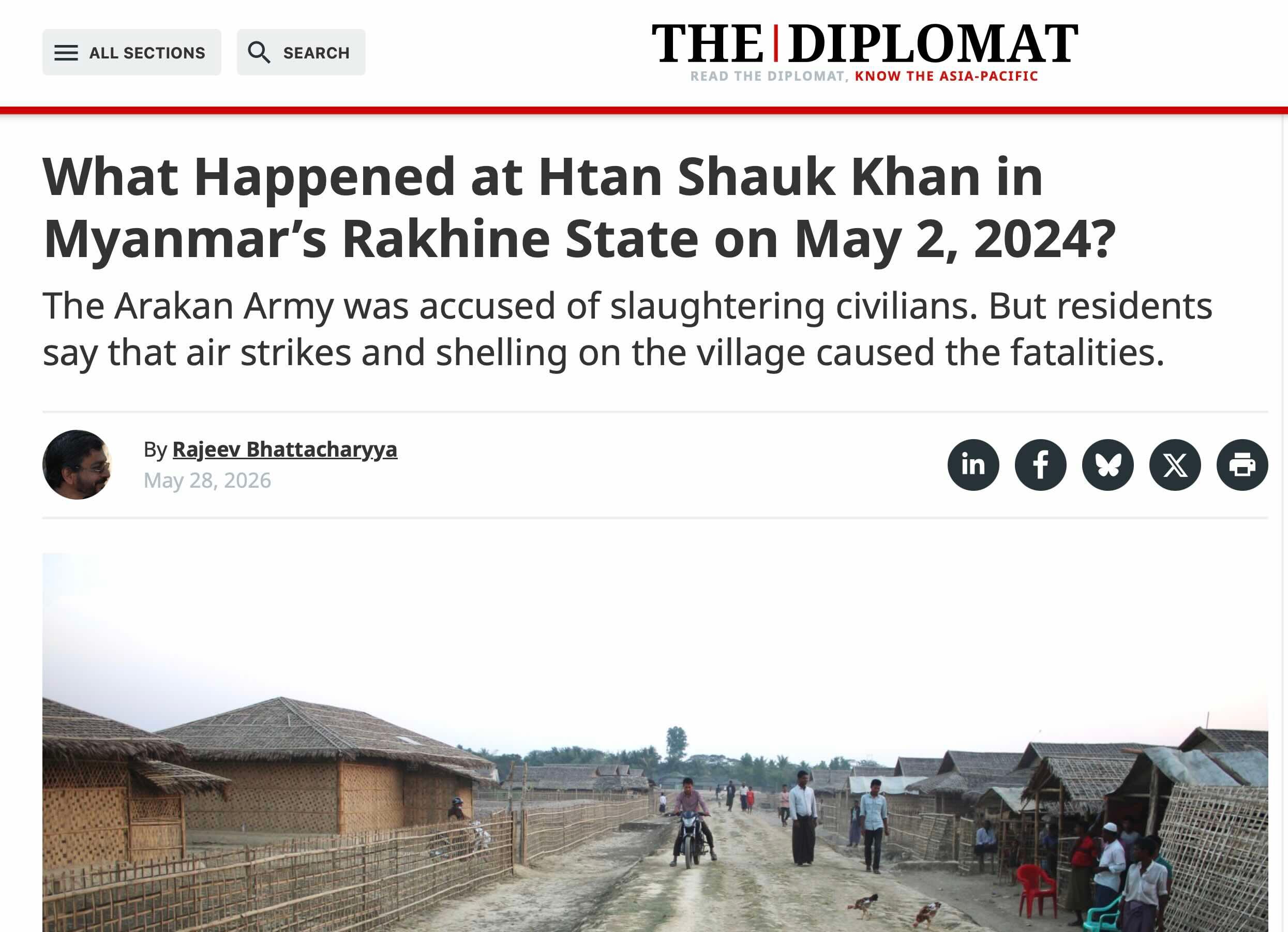
A recent piece in The Diplomat by Rajeev Bhattacharyya attempts to cast doubt on a major Human Rights Watch (HRW) investigation into the horrific massacre at Htan Shauk Khan village in Myanmar’s Rakhine State. Where HRW uncovered a systematic slaughter of over 170 Rohingya civilians, Bhattacharyya offers a revisionist narrative that conveniently washes the hands of the rebel Arakan Army (AA). But don't be fooled by the veneer of objective journalism - this isn't an independent investigation; it’s a masterclass in laundering rebel propaganda.
Let’s look at where the author is getting his “facts.” He relies entirely on interviews conducted smack in the middle of AA-controlled territory. The people he’s chatting to are sitting in “New Htan Shauk Khan,” not safely across the border in Bangladesh or anywhere outside the AA’s reach. That is a massive, gaping flaw. Survivors face outright coercion, restrictions, and intimidation. You can’t just rock up to a zone run by an armed group, ask the locals under their thumb if everything’s alright, and take their word as gospel. That is not a minor methodological issue with this article. It is a very large hole.
The village chief (Mohammad Juloddin) is an administrator running a village under AA rule. Expecting a village chief or local residents living under an armed rebel group to look a foreign journalist in the eye and say, “Yes, the people running this area massacred 170 of our neighbours” is laughably naive. If HRW says survivors face coercion, this is exactly what it looks like.
The sample size here is an absolute pittance. We are talking about exactly three residents. Three! And the author expects us to weigh that against HRW’s mountain of actual evidence, which includes extensive survivor testimony, named victim lists, satellite imagery, and forensic analysis. Pitting three monitored locals against a massive forensic data trail isn’t journalism. I don’t know what it is. Well, i do. It’s called copy pasting AA propaganda.
And then there is the blatant one-sided framing. The whole piece is AA-friendly. The author goes out of his way to foreground ARSA presence, alleged collaboration with the Myanmar military, forced conscription, and airstrikes. Why? Because every single one of these elements serves as a convenient shield to build up the AA’s defence narrative. It’s not an objective investigation; it’s a calculated attempt to shift the blame.
Rajeev Bhattacharyya’s narrative cleanly absolves the AA of any operational wrongdoing. It attributes 100% of the destruction to the Myanmar military’s airstrikes and chaos, perfectly aligning with the AA’s public defence that they are “liberating” the population from the junta.
Worst of all, the piece reproduces the toxic narrative that the people who fled to Bangladesh were mostly just ARSA functionaries, sympathisers, or military collaborators. This isn’t just a bad take; it’s a deeply consequential, malicious claim. By painting the refugees with that brush, the author conveniently delegitimises the exact witnesses who are most likely to blow the whistle on the AA’s own atrocities. It tells readers, in effect, that the people beyond the AA’s reach are suspect, while the people still living under AA control are reliable.
Bhattacharya even posts a picture of himself sittingg next to his interviewees. This is an active, heavily surveilled conflict zone. Posting such an image is an absolute schoolboy error in investigative journalism. It breaches fundamental ethical and safety protocols on two major fronts:
Human Rights Watch, Fortify Rights, and the UN have explicitly detailed how the Arakan Army has restricted, intimidated, and forced surviving Rohingya in these exact resettlement areas to provide false, exonerating testimony. By posing for a photo with the village chief and residents, Rajeev isn’t showing “transparency”; he is documenting the exact scene of the performance.
Those interviewees know that the moment Rajeev packs up his camera and leaves, they still have to live under the absolute rule of the AA. In that photograph, the subjects are essentially being asked to sign their names to a defence narrative with an armed group watching. Showing their faces in a high-stakes war crimes dispute is wildly irresponsible.
The photo functions as an AA Receipt. When independent investigative bodies like Myanmar Witness used satellite data and forensic imagery to geolocate the mass graves in Htan Shauk Khan, they explicitly documented the AA’s strategy. Their reports show that the AA has systematically organised tightly chaperoned media visits and staged interviews at these exact spots to counter the international fallout of the massacre.
By publishing that photo, Rajeev essentially signals that he walked right into a pre-packaged, heavily managed “red zone,” sat down with the administrators the AA put in place, and dutifully took notes. It transforms the journalist from an independent investigator into a prop. Pasting a photo of himself in the middle of it just proves he was happy to be part of the choreography.
The piece finishes with a completely hollow, pseudo-intellectual disclaimer about how “information is often tweaked, even weaponised, to create narratives.” The irony is staggering. Bhattacharyya is doing exactly what he warns against: weaponising a highly controlled, tiny sample size of state-monitored voices to create an AA-friendly narrative, all the while pretending to be an objective observer.
Join my WhatsApp Channel for news, documents, videos and images.