

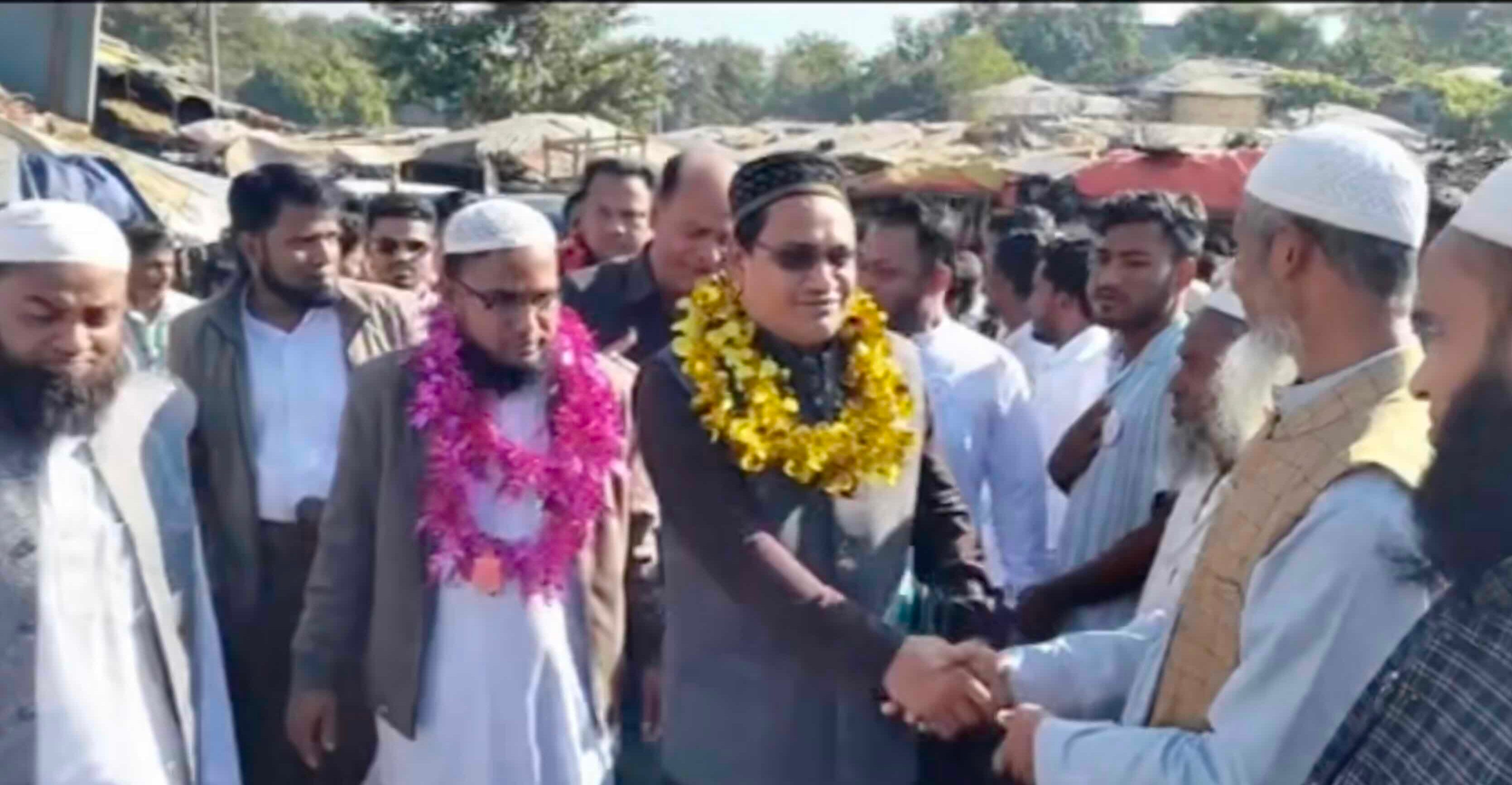
In recent weeks, Dil Mohammed has been touring Rohingya camps in Cox’s Bazar, moving from camp to camp, addressing large gatherings, and positioning himself once again as a central figure in refugee camp life. The video below shows one such visit, including walkabouts through narrow camp lanes and a public address delivered from a decorated stage before a large audience.
This visibility comes after an uneven year for Dil Mohammed. Although he was unable to stand in the most recent camp elections, he has not withdrawn from public life. Instead, he appears to have adapted. He remains present, visible, and vocal, while reframing his role less as an elected representative and more as a moral guide and disciplinarian.
What the video documents is a carefully staged assertion of authority. In the footage, Dil Mohammed is dressed in a style closely associated with Bangladeshi political figures: white kurta and pyjama, black waistcoat, and a cap, at times wearing sunglasses. He is garlanded, greeted warmly, and filmed acknowledging supporters with raised hands and handshakes as he walks through the camp.
Video: Jamtoli Camp, 20th December, 2025.
The visual language is deliberate. The choreography, supporters lining narrow lanes, cameras following his movement, repeated greetings clearly signal leadership and recognition even without formal office.
The accompanying praise song reinforces this message. In its lyrics, Dil Mohammed is credited with bringing peace to the camps and restoring unity among what are described as the “four groups” - a reference to the so-called four brothers alliance. The song frames him as a figure who ended internal conflict, claiming that “brothers were fighting among themselves” before his intervention brought an end to that infighting allowing people to sleep well. Viewers are encouraged to pray for him and for his organisation, the Rohingya Committee for Peace and Repatriation (RCPR).
This is by no means incidental background audio. It is message.
Mass choreography
The footage repeatedly cuts between intimate walkabouts and expansive crowd scenes. A large, decorated venue is shown, with a raised platform stretching across the frame, occupied by multiple seated figures. Floral arrangements, banners, and fabric decorations cover the space from ceiling to stage. Wide shots emphasise scale showing a packed audience seated closely together, rows extending far beyond the camera’s initial frame. The message is visual as much as verbal - this is a figure who commands attendance, organisation, and space.
Such scenes matter in a camp environment where visibility itself is a form of power. To assemble, address, and be filmed before such numbers is to demonstrate capacity and reach.


Morality Preacher
The speech he delivers during such visits reinforces that authority.
According to a recent RCPR summary circulated after a 27 December 2025 address in Camp 10, Dil Mohammed’s key messages included:
Emphasis on regular prayer and religious discipline as foundations of social harmony
Clear instruction that Rohingya refugees must not participate in Bangladeshi elections or leave the camps for election-related activities
Warnings against fire hazards, narcotics, noise, and a range of criminal activities
Prohibitions on violence, intimidation, and actions that create fear
Instructions to avoid fishing in border rivers due to safety risks
Calls for parents to prioritise children’s education
Explicit condemnation of abuse against women and girls, including forced or unfair marriages, underage marriage, and arbitrary divorce
Taken together, these points amount to a set of rules for how people in the camps should behave. They echo the language used by authorities to maintain order. Through this, Dil Mohammed casts himself as someone who sets and enforces standards of behaviour in the camps.
That claim is sharply at odds with Dil Mohammed’s past. He is a convicted criminal and a former Myanmar military informant, long associated in Rohingya testimony with smuggling and extortion. He has also been accused of rape.
Recent Controversy
This renewed visibility coincides with a series of incidents that place these camp tours in a far sharper light. On 10 December 2025, Rohingya sources reported that Dil Mohammed met in Balukhali Camp 09 with leaders linked to armed groups, including figures associated with RSO, ARO, and ARSA. Following that meeting, five shops were reportedly locked and shut down. The shop owners were accused of purchasing clothing from the Arakan Army and of supporting its commercial activities.
Separate reporting by Maungdaw Daily News alleges that, on 10 December 2025, six Rohingya businessmen in Balukhali Camp 9 were forced to pay 20 lakh taka to Dil Mohammed after being summoned and told they “must contribute” to ongoing activities. The report further states that Dil Mohammed has previously been accused by multiple Rohingya sources of large-scale extortion, forced recruitment, and intimidation in Maungdaw before fleeing to Bangladesh, and that similar patterns of coercion are now re-emerging inside the refugee camps.
Taken together, these reports and videos show that the camp tour is not about outreach or moral guidance. It is an assertion of control. Public speeches about discipline and unity are accompanied by the shutting of shops, the extraction of money, and the punishment of those accused of disloyalty.
In another visit, this time to Camp 6 on the 13th of the lunar month, the accompanying video lyrics go further. It likens Dil Mohammed to “the full moon on the fourteenth night,” claiming again that without his efforts the four Rohingya armed groups, the so-called four brothers, would not have come together in unity.
In the Islamic lunar calendar, the fourteenth night coincides with the period when the moon is full, part of the mid-month “White Days” (13th–15th), a time commonly associated with increased religious observance, including fasting and prayer. To invoke it in this way is therefore not incidental. It places Dil Mohammed symbolically at the moral and spiritual centre of the community, presenting him not just as a political broker but as a unifying and providential figure.
Religious symbolism is being mobilised to frame unity not as a negotiated outcome but as a gift bestowed by a singular leader. Seen in this light, the footage is less about one individual and more about a broader dynamic inside the camps.
The issue, then, is not whether these metaphors resonate. They are clearly designed to. The question is what kind of media machinery is producing and circulating them. These videos, songs, captions, and slogans do not emerge spontaneously. They point to an organised operation that carefully aligns religious reference, political messaging, and crowd choreography to project unity, demand obedience, and recast coercive power as moral leadership.
This raises a deeper problem: how such parallel authority structures are allowed to operate inside the camps, how they are accommodated by those tasked with protection and governance, and what this means for the political life of Rohingya refugees.
In summary, what this material shows is not simply a refugee camp tour but a coordinated effort to shape how authority is understood inside the camps. Through repeated events and messaging, political power is presented as moral guidance, while dissent is framed as disorder. Or sacrilege.
Further Reading
How One Man is Shaping Rohingya Repatriation Rhetoric
OIC Envoy meets Rohingya armed group affiliates
Dil Mohammed: The smuggler shaping a war in Arakan
Rohingya Refugee News has previously reported on Dil Mohammed’s role in smuggling networks, armed group politics, and camp governance dynamics. For further context, see: Dil Mohammed Smuggler