

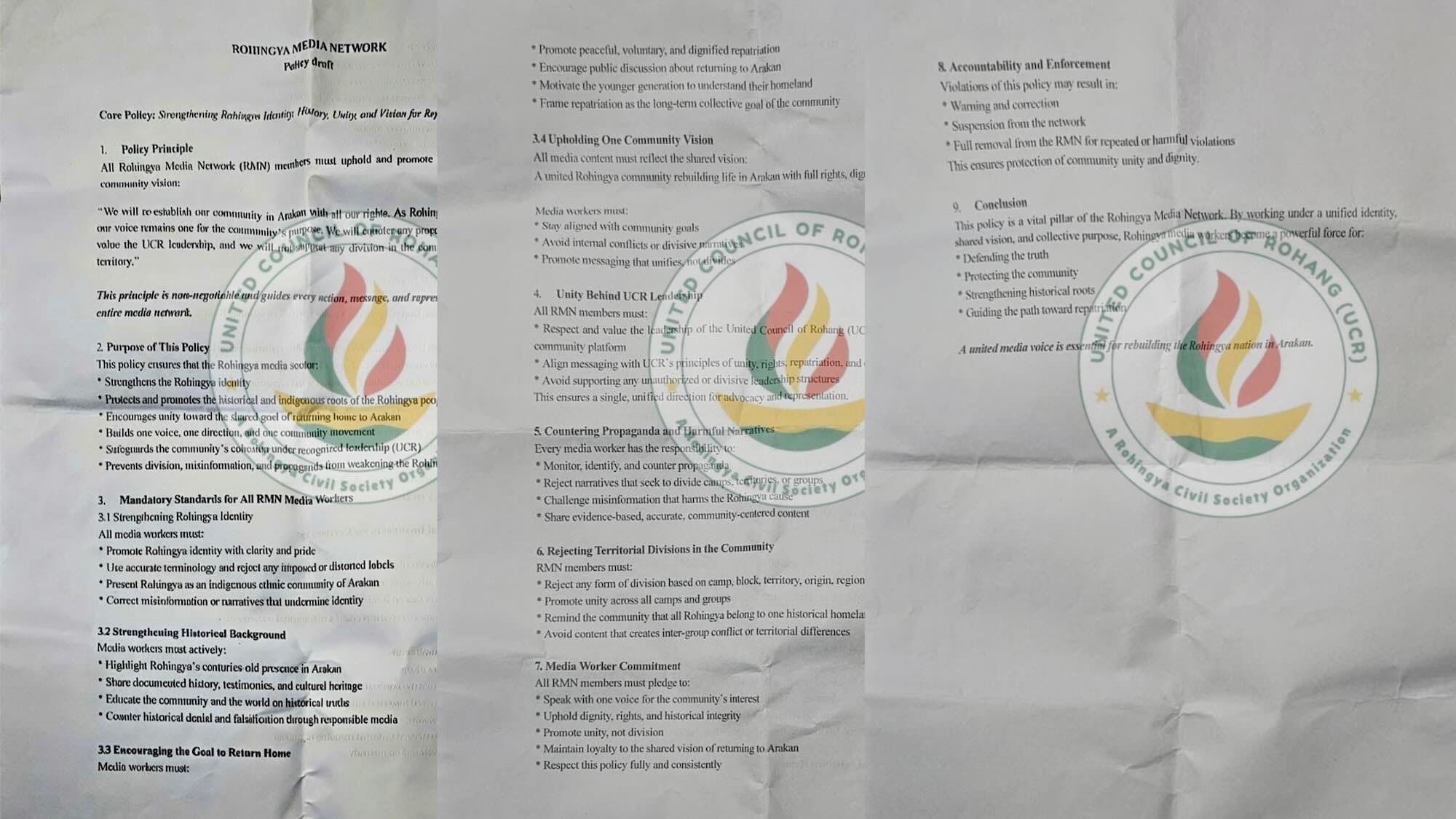
The “Rohingya Media Network (RMN) Policy draft” pretends to be a foundational document for community cohesion, yet it is, in reality, a blueprint for centralised narrative control. Far from establishing a true network of photographers, journalists and content creators, this document demands absolute loyalty to the United Council of Rohang (UCR),

The document's intent is clear and unambiguous. It is to replace independent reporting with a “non-negotiable” single voice aligned with UCR leadership, the RRRC system behind it, and a tightly controlled repatriation narrative that leaves no room for dissent or debate or pluralism inside the Rohingya camps.
“This principle is non-negotiable and guides every action, message, and representation across the entire media network.”
This is the principle at the heart of the document. And what is it? That all media workers must value the UCR leadership and must not support any division in the community. There is no room for critique or deviation.
The document continues:
“All RMN members must:
Respect and value the leadership of the United Council of Rohang (UCR) as the representative community platform.”“Align messaging with UCR’s principles of unity, rights, repatriation, and collective dignity.”
“Avoid supporting any unauthorized or divisive leadership structures.”
It is here that the RMN completely jettisons any claim to journalistic neutrality, and binds the media network to a single political entity - the UCR. So in a nutshell and not to beat about the bush, what is described in the three pages is absolutely not a media network but a one-party communications wing. Under the guise of unity and shared vision, the policy mandates total allegiance to a single leadership structure, and by extension, to the government system that backs it.
“Media workers must:
Stay aligned with community goals.
Avoid internal conflicts or divisive narratives.
Promote messaging that unifies, not divides.”
Who defines the “community goals”? Who decides what counts as “divisive”? In this framework, any reporting on disagreements, exclusions, or corruption becomes suspect. Any independent journalism becomes a threat.
This becomes even clearer in the section on propaganda:
“Reject narratives that seek to divide camps, territories, or groups.” “Challenge misinformation that harms the Rohingya cause.” “Avoid content that creates inter-group conflict or territorial differences.”
Translated: do not report on anything that might complicate the UCR’s narrative of unity. Do not expose internal dissent. Do not mention the fact that some camps boycotted the UCR elections. Do not acknowledge that many Rohingya support resettlement. Do not cover the tensions between appointed and excluded representatives.
Meanwhile, the document demands that all media workers:
“Speak with one voice for the community’s interest.” “Maintain loyalty to the shared vision of returning to Arakan.” “Respect this policy fully and consistently.”
I am repeating myself but this is the language of a controlled political apparatus. Not journalism.
And what happens if someone breaks these rules?
“Violations of this policy may result in:
Warning and correction.
Suspension from the network.
Full removal from the RMN for repeated or harmful violations.”
So much for freedom of thought or expression!
Diaspora?
Some of the very same organisations that established themselves abroad claiming to promote Rohingya voice, dignity, and representation are now participating in or supporting the UCR. They have scrambled in recent months to gain positions of influence in the camps. Several of their senior members are now embedded in the leadership structures around the UCR, including the media wing. And yet they have said nothing.
Their silence amounts to a quiet endorsement. For all their rhetoric about freedom, they now lend legitimacy to a system that demands total conformity and punishes deviation. Some may even view this document as an achievement - a way to speak with one voice, to avoid “confusion” or “division.” But what it really achieves is the silencing of Rohingya plurality and dissent.
Why all this matters
The dishonesty around the Rohingya Media Network begins even before it is launched. When I asked one of its organisers, Abdullah, whether RMN was part of UCR or independent, he insisted it was independent. He said, “We are going to establish an independent media network around the camp. Bring all the media workers from camp, in order to make Rohingya voices stronger!”
Yet a UCR president, Khin Maung, told me directly that the it was the UCR media team that was dealing with RMN. Abdullah himself recently signed a public statement as part of the UCR’s media wing. It was a statement that admonished a Bangladeshi outlet for interviewing “ordinary refugees” and demanded that journalists consult only with “legitimate leadership bodies,” meaning the UCR.
Having already acted as an enforcer of UCR messaging, he now claims that RMN, a network built on mandatory loyalty to UCR principles, is somehow independent of it. This is a complete misrepresentation of RMN. I guess the aim is probably to present RMN as a community-led initiative while its foundational document hardwires obedience to UCR authority.
At its heart, this three-page policy document treats media as a tool of control. It replaces the landscape of grassroots reporting and open debate with a structure of obedience - obedience to the UCR, the annointed/localised voice of RRRC. It trains young Rohingya media workers not to ask questions, not to investigate, but to comply.
That is the real problem. At a time when the Rohingya need critical reporting and open discussion more than ever, this media network offers them only slogans, rules, and loyalty tests.
It is not a media network. It is a muzzle. And a propaganda mouthpiece.