

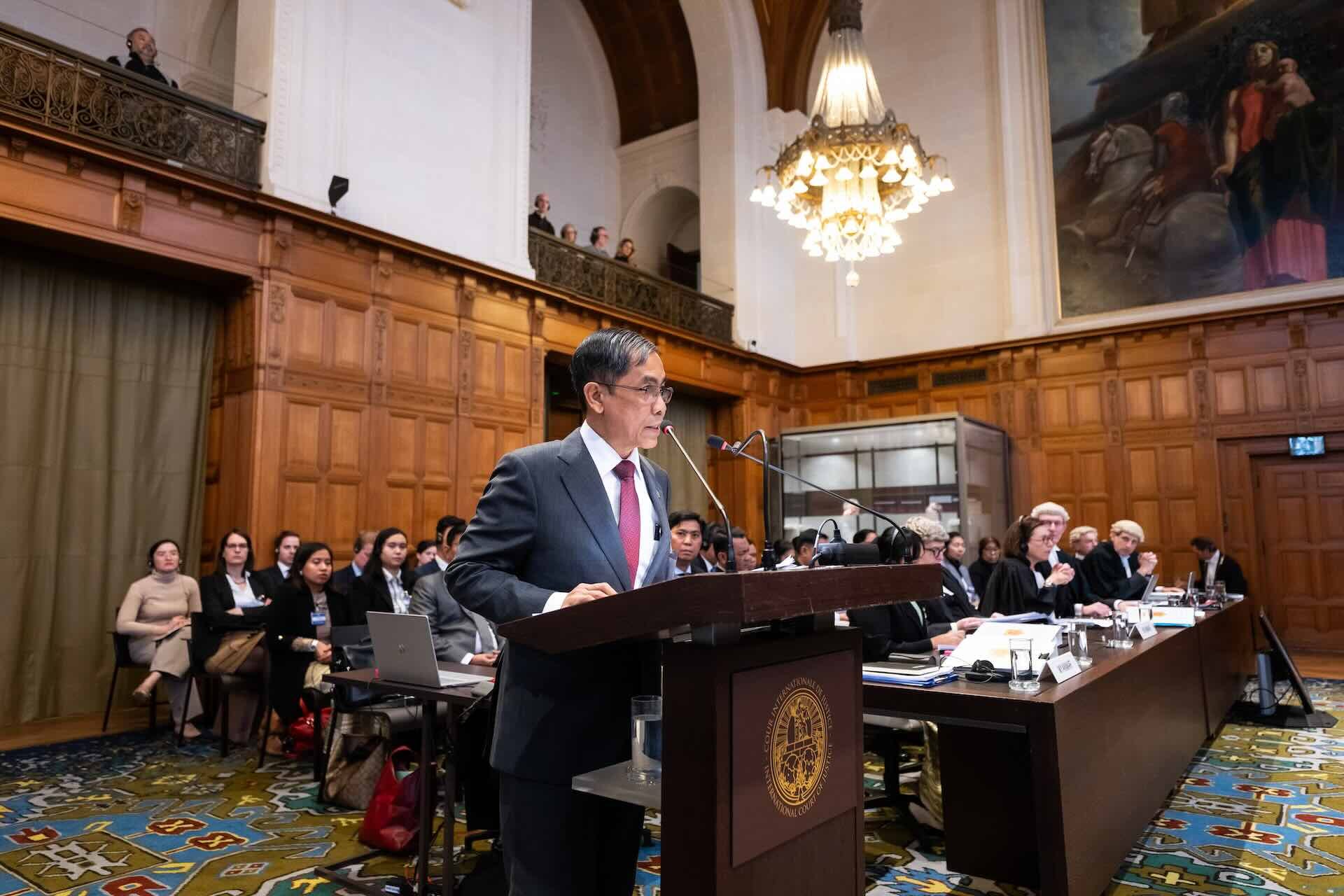
On Friday 16 January 2026, Myanmar’s agent Ko Ko Hlaing opened his address at the International Court of Justice by painting the Rohingya genocide case as an “indelible stain” on his nation. The stain, in his telling, was not the army’s conduct but the accusation itself, that someone had dared to file a case about it.
That move set the tone. It was emotional blackmail dressed up as patriotism. If you condemn the perpetrators, you are “smearing the nation”; if you name the crime, you are “attacking the people.” It was the junta’s oldest trick - using the people as a human shield.
The Gambia’s evidence, he argued, was “rudimentary and partisan,” the product of unreliable UN fact-finders. What Myanmar had carried out, he insisted, was not genocide but a counter-terrorism operation - a neat word for a campaign that involved death, mass displacement, burned villages, and the total dismantling of a people.
It was a performance of offended innocence. How dare you bring “emotional language” into a genocide case? How dare you mention mass rape when we have PowerPoint slides about terrorism? And then, as always, he defended the state’s refusal to recognise the Rohingya identity. Myanmar’s own official narrative continues to speak of “Bengalis” and devotes a lot of energy to litigating the “origins” of the word “Rohingya,” as if the problem is what you call the victims, not what was done to them.
And he made the erasure explicit. The victims, he said, should be referred to as “Bengalis.” The term, which Rohingya survivors hear as a slur of expulsion and erasure, was used deliberately and repeatedly, as though Myanmar could argue its way out of genocide by denying the group ever existed. By refusing to name the victims, Ko Ko Hlaing was confirming the very "hate campaign" that Philippe Sands and The Gambia argue was the foundation of the genocide.
The irony is that the Court has already done the naming for them. In its 23 January 2020 provisional measures order, the ICJ repeatedly uses the term “Rohingya,” finds that “the Rohingya in Myanmar appear to constitute a protected group”, and notes that Myanmar has not presented “concrete measures” aimed at recognising and ensuring the Rohingya’s right to exist as a protected group under the Genocide Convention.
So when Ko Ko Hlaing insists on “Bengali” in open court, it isn’t a neutral word choice. By openly defying the Court's own terminology, the junta is being antagonistic toward the judicial process.
It may get applause at home, where “Bengali” is the nationalist crowd-pleaser, but in an international courtroom, it is self-sabotage. Every “Bengali” he drops is a gift to The Gambia’s legal team because it proves the intent to erase the group’s identity. It makes the junta look unrepentant, dogmatic, and still committed to erasure. And that, in turn, hands The Gambia exactly what it needs, i.e. proof that the same institution accused of genocide is still unable and unwilling to break the mindset that fuels the atrocities, let alone stop the cycle.
The Gambia’s team, of course, saw all this coming and laid the trap in advance. Their core reply is simple. It is unreasonable to explain mass violence against civilians, including the burning of villages and attacks on women, children, and the elderly, as merely “combating terrorism.” And legally, Myanmar faces a deeper problem. If it offers a story that does not plausibly fit the evidence, the Court is not obliged to invent a better one on its behalf. That’s the logic international law scholar Adil Ahmad Haque was underlining last week.
Now let’s talk about a bit more about Ko Ko Hlaing, Myanmar’s Minister for International Cooperation and current Minister for Glossing Over Mass Atrocities
This is not his first rodeo. Nor his second. Nor, indeed, his first genocide.
Because Myanmar did not send to The Hague a cautious diplomat or a lawyerly technocrat. It sent a career regime explainer, a man whose public reputation, as The Irrawaddy has detailed, was forged not in the gentle arts of international cooperation, but in the harder task of making the indefensible sound like a misunderstanding.
This is the official who became notorious during the 2014 electricity crisis for advising people, in effect, to stop complaining and light candles, a remark that helped earn him the nickname “Candle Ko Ko Hlaing.”
He also has experience in disaster management. Well, of a kind. After Cyclone Nargis, he reportedly achieved the rare feat of responding to mass death (circa 138,000) with lifestyle tips. The Irrawaddy recounts how his writing provoked outrage by suggesting the devastated could catch “frogs and fish” and didn’t need international aid’s “chocolate bars.”
So yes, being Myanmar’s “Agent” is a poisoned chalice. It brought ignominy to Aung San Suu Kyi when she came to The Hague in 2019 to defend the state’s conduct. She is now imprisoned after the 2021 coup, a reminder that the junta consumes even its most useful symbols. What will the role bring for Ko Ko Hlaing? Possibly the same thing his candle advice brought - visibility and humiliation. Only this time, it will be global.
This, then, is the man now leading Myanmar’s legal defence at the ICJ. And hovering at the edge of the scene, passing round statements about “truth and justice,” is the wider propaganda ecosystem, pumping out press releases and social-media sludge.
You can see it in real time. My X timeline has witnessed it: genocide denial, dressed up as patriotism, boosted like a public service announcement.
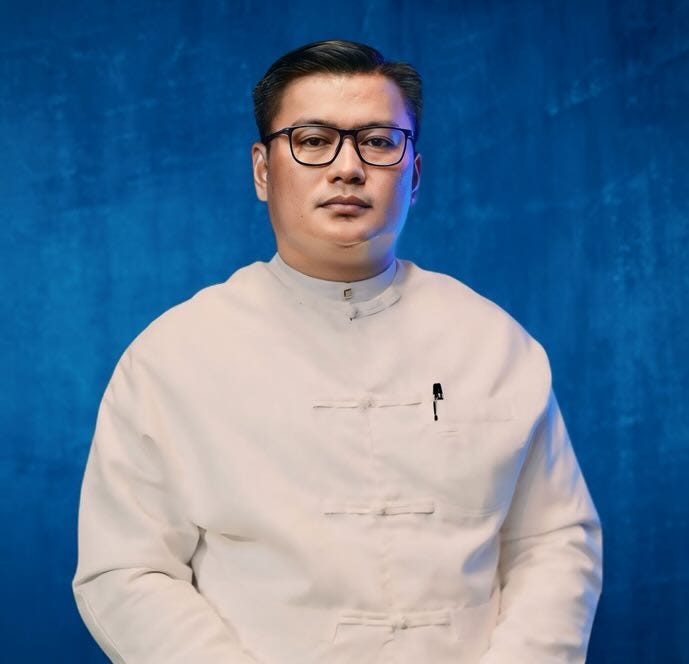
One of the louder nodes in that machine is the Myanmar Narrative Think Tank, which presents itself as defending the state’s “truth” at the ICJ. It isn’t some free-floating “civil society” outfit; it is part of the regime’s message system, staffed by the same familiar faces. It is led by another Ko Ko, and one of its listed directors is Naing Swe Oo, described by Justice For Myanmar’s spokesperson Yadanar Maung as a figure tied to the junta who has “actively supported and attempted to whitewash the military’s genocidal campaign.” Myanmar watchers will know him as Founder and Executive Director of the infamous Thayninga Institute of Strategic Studies. Birds of a feather stick together, and MNTT is the flock. It is a “think tank” built to repackage denial as patriotism and to keep the Rohingya trapped inside the state’s preferred label.
They even wheeled out an American expat “expert” - Rick Heizman from San Francisco - remember him? - to deliver a meandering and nonsensical monologue that reads like a Facebook comment thread. He actually sounds like Donald Trump. He calls the 25 August 2017 ARSA attacks “the world’s largest terrorist attack” (he says bigger than 9/11) and inflates it into “100,000 assailants,” then goes on to claim he has phones, computers, “700 videos”, tapped calls from an “ISIS commander,” and a Pakistani general. He is basically a one-man evidence warehouse who somehow never cites anything verifiable. It’s exactly the Myanmar approach in miniature: drown the public record in confident numbers, conspiratorial anecdotes, and recycled talking points until the noise itself becomes the message.
Think of Heizman as Ko Ko Hlaing’s unofficial witness. It is the junta’s message in an American accent. In court, Ko Ko Hlaing pushed the same absurd script, just with a suit and a lectern and not sitting in the bush like Heizman. Distrust the UN, invoke ARSA, repeat “counter-terrorism,” refuse “Rohingya,” and insist on “Bengali.” Denial as terminology; erasure as state policy.
But this is where the act starts to fail. The ICJ is not a Facebook group and it is not a candlelit living room where you can win by talking louder than the facts. “Counterterrorism” is not an incantation that makes mass rape and village burnings disappear. It is a claim that must explain the totality of what happened, and Ko Ko Hlaing only managed to offer a story that collapses under its own weight.
In court, Ko Ko Hlaing’s defence of the state was as effective as his electricity advice. The junta should start buying candles now. The dark is coming.
Join my WhatsApp Channel for news, documents, videos and images.