

My DVB piece today looks at the language now taking hold in Malaysia’s anti-Rohingya debate - disease metaphors, neighbourhood exclusion, calls for expulsion, and the renewed talk of shooting refugee boats before they reach shore. But behind that rhetoric, there is also a ground-level story.
Rohingya contacts in Malaysia describe a community under growing pressure. In recent weeks, they say, several Rohingya schools have been closed or fined. Vehicles have been seized. People have been beaten on the street. Families have been forced out of rental homes. Others report being denied treatment or pushed out of government hospitals and clinics when they cannot produce full payment upfront. These are the daily humiliations: shelter, movement, schooling, work and healthcare all becoming more precarious at once.
There are also reports of confusion, resentment and competition around UNHCR documentation and third-country resettlement. Rohingya refugees say protection is slow and uneven, while better-connected or better-educated people from other communities appear able to navigate the system more easily. I am treating some of these claims with caution because they need further checking. But the deeper point remains - the most vulnerable Rohingya, the poor, undocumented, illiterate and socially isolated, are the ones least able to protect themselves in this climate.
In the DVB piece, I focus on the ideas being floated in Malaysia. I focus on how refugees are turned into disease, how exclusion is repackaged as civic duty, and how violence at sea is made to sound like sovereignty. Posters and speeches matter because they prepare the ground for what happens next. Once a people are described as a cancer, denying them a home, a job, a clinic or a place in a classroom begins to look like treatment.
One frustration with the DVB version- the full poster was not embedded in the body of the article. Only a cropped detail was used as the hero image. I understand there may have been technical constraints, but this does the reader a disservice. The poster is not decoration. It is the evidence.
The whole point is to see how the design works - the cancer headline, the germ icon, the four instructions denying housing, vehicles, trade and employment, and the closing appeal to “shared responsibility”. Taken together, the poster shows how anti-Rohingya exclusion is being packaged as public safety and patriotic duty.
So I am publishing the full poster here, with a full translation below.
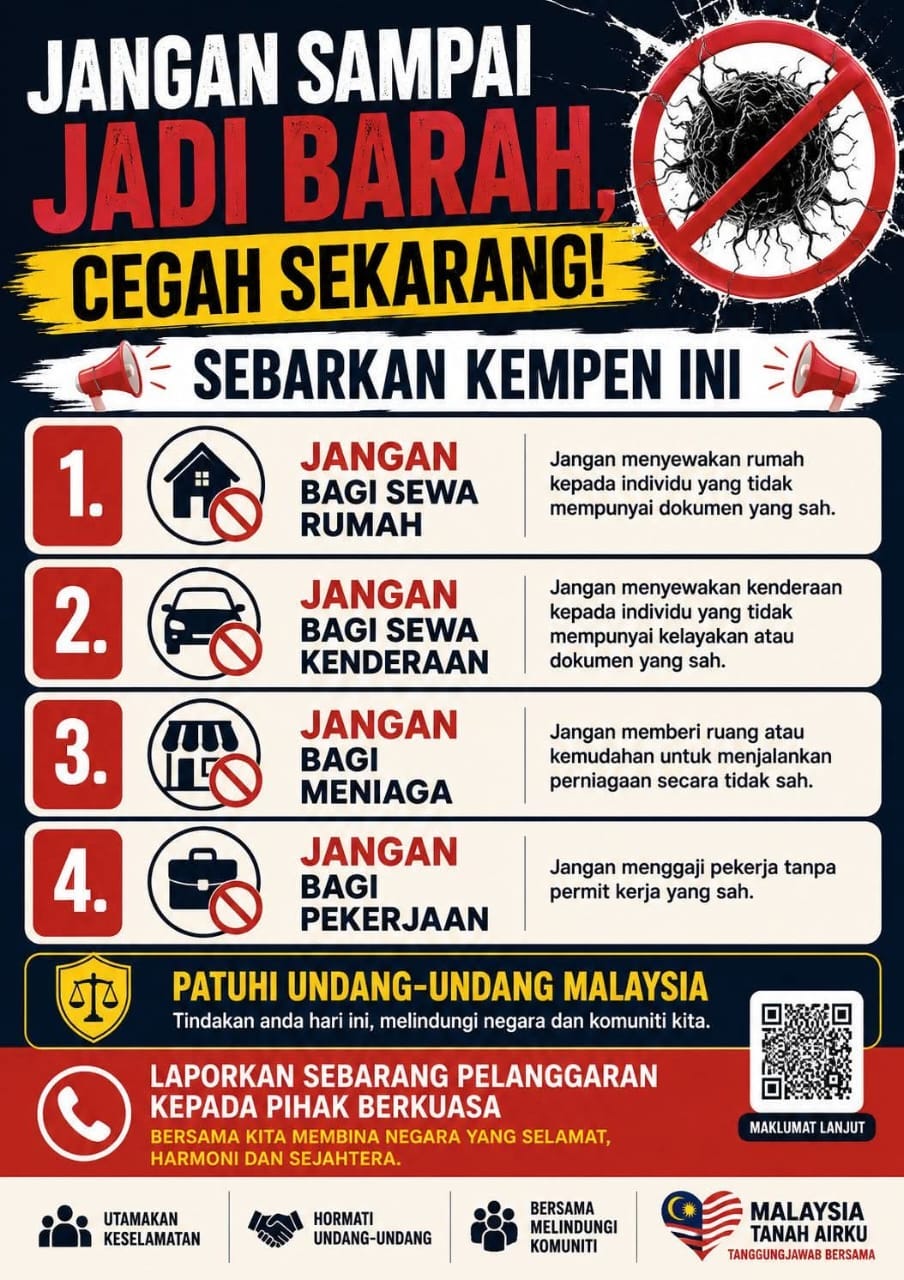
Translation:
Do not let it become a cancer - prevent it now!
Spread this campaign
Do not rent out houses
Do not rent houses to individuals who do not have valid documents.
Do not rent out vehicles
Do not rent vehicles to individuals who do not have valid qualifications or valid documents.
Do not allow them to trade/do business
Do not provide space or facilities for running a business illegally.
Do not give employment
Do not employ workers without valid work permits.
Obey Malaysian law
Your action today protects our country and our community.
Report any violations to the authorities.
Together we build a safe, harmonious and prosperous country.
Bottom slogans:
Prioritise safety
Respect the law
Together protect the community
Malaysia, my homeland - a shared responsibility
Join my WhatsApp Channel for news, documents, videos and images.