

As most of you know, I have been writing about Dil Mohammed, the arbitrarily detained community leader from No Man’s Land. One of the people I quoted recently posted an image of Dil Mohammed with his wife on Facebook together with some text about his detention and the UN’s demands. Beneath that post was a comment that made me freeze. It came from an educated Rohingya youth - someone who works for an NGO, someone who knows the politics, someone who is informed and articulate. He is from No Man’s Land himself. And what did he choose to write? “Put a sticker on the wife’s face,” or something close to that. Of all the things he could have commented on - Dil Mohammed’s months in arbitrary detention, the UN demanding his release and compensation - he chose to object to the visibility of a woman’s face. When I pushed him on it, he sent me a stream of laughing emojis. He genuinely could not understand why this might be a serious matter.
A few days later, Dr Ambia Parveen, former ERC chair, sent me a disgraceful post that had been circulating about a young Rohingya woman activist. Advocate Razia Sultana sent me another example - a full, unvarnished display of aggressive misogyny from someone who clearly thought this kind of policing was righteous work. Then on LinkedIn, I saw a post by a well-known women’s rights activist speaking plainly about patriarchy. When I commented in her support, a misogynist jumped straight in, as if the mere sight of solidarity was an affront.
I am not active on Facebook except to occasionally post an article, so I am usually sheltered from this particular swamp. But I asked friends in the camps what had been happening lately with these high-profile women activists. The material they sent back was staggering. Videos, screenshots, AI-generated sermons, captions dripping with shame and judgement. Tattoos, sexuality, uncovered hair, any mention of LGBTQ rights - all turned into proof of moral decay. The tone was unmistakable. This was Andrew Tate-style male chauvinism dressed up in religious vocabulary.
Many of these men repost conservative Saudi scholars or South Asian “influencers” who churn out AI videos warning women of divine punishment for disobedience. One clip declared that no matter how pious a woman may be, if she speaks sharply to her husband she will be condemned to eternal damnation. Another poster praised Qutub Shah Madani’s post in which he lists his achievements and concludes with the barbed declaration: “And all of this is possible without compromising Islamic values, trading with the Deen of Allah, working for a malicious NGO and without being a feminist and/or an LGBTian.” This mentality is not fringe. It is shaping online culture. And from that culture, the Rohingya men who participate in it do not hold back.
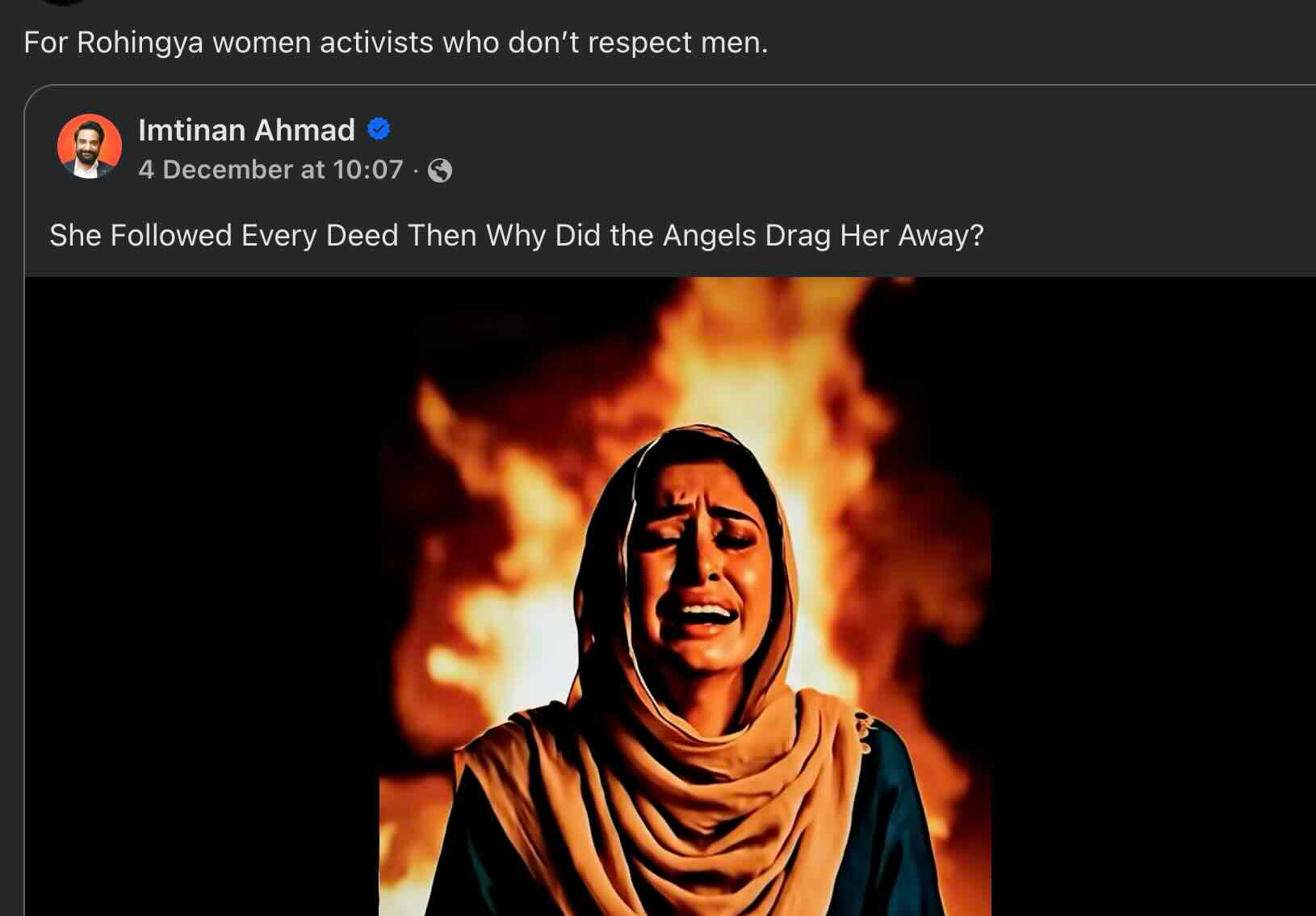
Some examples, unedited:
“Yasmin Ullah from Canada. You are a shit. Be polite and learn some manners how to respect men.”
“Boycott promoting LGBTQ.”
One commenter lectured a woman:
“Try to wear hijab in all program, meetings and anywhere else you go due to we are Muslims so we have to maintain Islam rules and regulation and if you don’t follow Islam, our people hate you. So try to understand.”
Another wrote:
“Sisters, we are trying hard to respect you as our own blood, but your actions are making us upset. Islam clearly tells you to wear hijab, avoid unnecessary social media showing, and not talk to non-mahram. Please stop disrespecting our religion and culture.”
(A non-mahram is someone one could theoretically marry.)
Some borrow the language of Western “men’s rights” warriors:
“While the world is celebrating Human Rights Day, here I am still fighting for Men’s Rights not against the world, but against a few women in our community who think we’re their personal punching bags. Human rights may be global, but man’s dignity needs local protection.”
And another:
“I have a message for those shameless girls who proudly call themselves activists. Many of them roam social media claiming to be ‘wise’ and pretending to work for women’s progress. They travel the world saying they are fighting for women’s higher education, while they themselves remain lost in ignorance — not even understanding the meaning of LGBT, nor the limits set by Islam. Yet they boldly attribute lies to Allah and promote ideas that contradict faith and Shariah, just to please Western ideology and secure their own interests. Allah… created human beings in only two forms — male and female — and He made each a source of benefit for the other.”
One man declared flatly:
“Women leadership will destroy our community one day. Feminism is a dangerous move and our younger generation learning from it.”
This is not theology. It is fear - fear of women in public life, fear of losing control, fear of a future they cannot dictate.
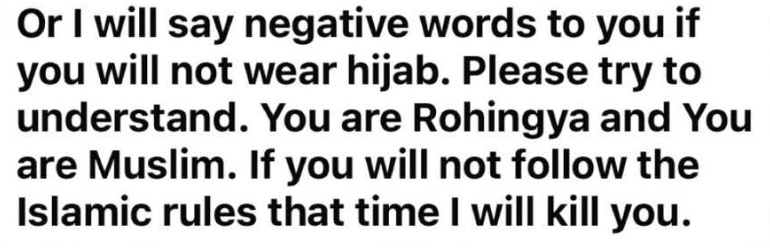
It does not stop at moralising. There are threats:
“If you will not follow Islamic rules that time I will kill you.”
The young women activists in question have not been intimidated. At least not yet. They continue their work, they speak, they organise, they push through the insults and the surveillance and the mockery. But they are tired of being the only ones confronting this ugliness.
Yasmin Ullah wrote:
“To the Rohingya leadership, I kindly suggest that if you would only send us well wishes while we continue to get attacked and targeted by hateful comments, please keep your well-wishes.
If you would like to take a stand against, I need you to stop being a coward. Start talking about it OUT LOUD. IN PUBLIC.
Otherwise, you’re just trying to hide behind all of these cracks in the culture that torment women. Especially women who live a life of service.
We don’t need silent allyship.”
She is right. And the silence is part of the problem.
How to make sense of this?
So how do we make sense of this explosion of misogyny? To begin with, patriarchy intensifies under conditions of insecurity. When communities experience threat, displacement, and humiliation, male identity often contracts around controlling women - their clothing, speech, mobility, public presence. It is a way of recovering lost sovereignty by exercising the only power left. This is not unique to Rohingya men, and it does not require Islam. It is masculinity under strain, performing authority where authority has collapsed.
Displacement has stripped Rohingya men of the traditional roles that once gave them status - providers, protectors, decision-makers, owners of land and community space. In the camps they are unemployed, monitored, dependent on aid, and largely powerless. When structural power evaporates, symbolic control becomes everything. Women’s behaviour becomes the battleground on which injured masculinity tries to reassert itself. Hence the obsession with hijab, modesty, “proper Rohingya culture,” and the constant policing of women’s digital presence.
Social media intensifies all of this. Platforms give women visibility, voice, and autonomy outside male gatekeeping. They expose men to new value systems they cannot control. For some, the very sight of Rohingya women speaking directly to international audiences, the UN, NGOs, to each other feels like an existential threat.
And an identity shaped through victimhood makes this worse. When a people feel continuously erased, they cling to whatever markers they believe protect communal authenticity. Controlling women becomes a way to defend a fragile boundary. Aid structures also play a role: NGOs, majhis, camp elders, and informal powerbrokers are overwhelmingly male, and the international system keeps empowering them. Women who bypass them are seen as breaking ranks.
But none of this excuses the violence, the bullying, or the attempts to silence women. These attacks shame the community and undermine its struggle for dignity and rights. They make the Rohingya look small at exactly the moment they need to appear mature and unified. More importantly, they teach young Rohingya boys that their masculinity depends on policing and demeaning women. That is a poison that will outlast every refugee camp and every political negotiation.
The Rohingya women activists at the centre of this storm are not backing down. They should not have to fight this alone. If the Rohingya leadership, formal or self-appointed, cannot defend its women against misogynists in their own ranks, then all their speeches about rights and justice ring hollow. A community fighting for recognition cannot afford to erase half its people.
The men doing this may think they are defending culture, but what they are actually defending is their own insecurity. And if they truly care about the Rohingya struggle, they should stop targeting the women who are carrying so much of its weight.
Finally, the platforms hosting the misogynistic content (yes, as usual, we are talking about Facebook) must be engaged by rights bodies and NGOs to prioritise the safety of high-profile women activists for removal of threats and organised harassment campaigns.
Thank you for shining a light on something that too many people are pushing under the carpet out of fear. Calling this behaviour out in the way you did is so important. Yes, there are reasons it happens and we can philosophize all day about why men do what they do and why those who are oppressed oppress others. But in the end, they are harming others. They need to be outed. Thank you for doing it and doing it in a way the shines a light on them as well as the women who are fighting to help all Rohingya (including these men) to have a better life.