

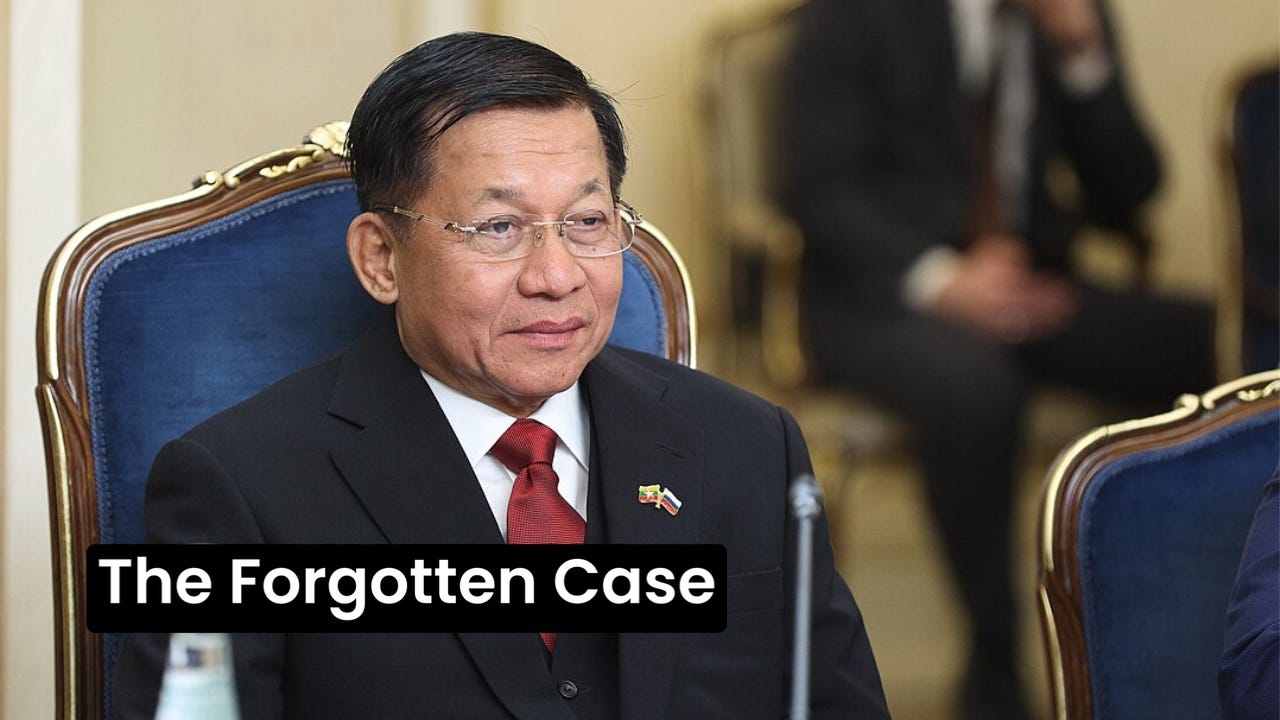
One year after the International Criminal Court’s prosecutor applied for an arrest warrant against Myanmar’s military leader, Senior General Min Aung Hlaing, the court remains effectively paralysed. No warrant has been publicly issued. No decision has been announced. No explanation has been offered.
A newly released ICC filing shows that this silence has left Rohingya survivors feeling “hopeless” and “discriminated against,” with some openly questioning whether international justice is meant for them at all.

The document, a routine Registry report on outreach activities dated 16 December 2025, contains unusually stark warnings from lawyers representing Rohingya victims. According to the filing, prolonged inaction is eroding trust in the ICC and diminishing victims’ confidence in its ability to deliver justice.
“Other situations move. Ours does not.”
The core grievance articulated by victims’ legal teams is not abstract. It is comparative.
In their communication to the ICC, the Legal Representatives of Victims (LRVs) explicitly contrast their situation with others before the court, including Afghanistan and Palestine, where Pre-Trial Chambers have publicly announced arrest warrants or decisions. In those cases, public judicial acts have functioned as signals that justice, however constrained, is at least moving.
In the Rohingya case, by contrast, the Prosecutor’s November 2024 application for an arrest warrant has been followed by silence. More than a year on, victims have no indication whether judges have acted, delayed, or declined to decide.
For survivors who have waited since 2017, and long before, this disparity has become corrosive. As the filing records show, some now feel their need for justice is treated as “less important” than other cases. Others interpret the silence as discriminatory. Hope, the lawyers warn, is collapsing.
The “Twelfth Registry Report” contains several haunting and blunt quotes from Rohingya survivors, many of whom express a profound sense of betrayal and despair.
“It seems it’s not happening because we are Rohingya and Muslim, this is why they are not issuing an arrest warrant. They are discriminating against us.”
On the erosion of faith in justice:
“Over time, it has been hard to maintain our belief in the justice system, because we haven’t seen anything telling us that justice is moving forward.”
Strong jurisdiction and yet…
This stagnation is particularly striking given the legal foundations of the Rohingya case. Unlike situations where ICC jurisdiction is politically or legally contested, the court’s authority here rests on one of its clearest jurisdictional pathways - the crime of forced deportation from Myanmar into Bangladesh, a state party to the Rome Statute. That jurisdictional finding was affirmed by ICC judges in 2018 and 2019 and is anchored in extensively documented crimes, including the 2017 massacre at Tula Toli (Min Gyi).
In other words, this is not a marginal or speculative case. It is one of the court’s most solidly grounded situations, combining clear jurisdiction, abundant evidence, and well-documented patterns of violence.
Yet paradoxically, it is precisely this case that has been allowed to drift.
Outreach
Faced with growing frustration, the ICC’s response is not judicial movement but outreach.
The same filing reveals that the ICC is preparing a “stakeholders’ visit” to The Hague and proposing the creation of a group of so-called “Ambassadors of Justice” — individuals who would be brought to the court, briefed on its work, and tasked with disseminating information back to the refugees.
This is clearly expectation management. When legal progress stalls, does communication expand? And crucially, the people selected for these roles are unlikely to be those most affected by the crimes under investigation.
Who are these “Ambassadors of Justice”?
These ambassadors will almost certainly not be Rohingya survivors from villages like Tula Toli, or refugees living under surveillance and restriction in the camps of Cox’s Bazar.
The “Ambassadors of Justice” are far more likely to be drawn from the Rohingya diaspora residing in the United Kingdom, Europe, or North America than from the camps themselves. These individuals are typically already embedded within NGO frameworks, advocacy organisations, or civil society networks that maintain a friendly relationship with the ICC. Consequently, they will be English-speaking, document-literate, and media-trained interlocutors who can effectively navigate the Court’s institutional language. Ultimately, the selection process favours those deemed “constructive,” “responsible,” and “safe” by the Registry.
This creates a familiar hierarchy for Rohingya refugee management - victims filtered through representatives, curated into ambassadors, and redeployed as messengers.
Outreach is not inherently illegitimate. Victims have a right to information. Communities deserve explanation. However, Rohingya victims are not asking for visits, briefings, or symbolic inclusion. They are asking for visible legal movement in a case the ICC itself has said falls squarely within its mandate.
One year on, the question is whether the ICC is willing to act on it.
Chris Gunness and the danger of “nuance”
This anxiety is echoed by Christopher Gunness, director of the Myanmar Accountability Project, who this week warned that the ICC risks irrelevance if it continues to delay action on Myanmar. Writing in The Independent (paywalled) as the one-year anniversary of the arrest warrant request passed in silence, Gunness described the delay as unprecedented and corrosive to the court’s credibility among Rohingya refugees and communities inside Myanmar.
Gunness also draws attention to a growing tendency to frame armed power in Rakhine through a stabilisation or “nuanced” lens, citing recent commentary, including a report by the Transnational Institute, that presents the Arakan Army primarily as a governing authority. He does not endorse governance narratives that dilute accountability. Rather, he invokes them as a warning. In the absence of decisive judicial action, realism and stabilisation frameworks will rush in to fill the vacuum left by justice.
For many Rohingya, this shift is deeply unsettling. Having endured systematic violence at the hands of the Myanmar state, they now watch as assessments of another armed actor soften the language of harm in the name of realism. Without judicial movement, such narratives risk sidelining Rohingya fears and grievances, absorbing them into policy debates about governance while accountability quietly disappears from view.
Gunness is right to argue that impunity must be broken if Myanmar is to change. But impunity does not survive only through guns and money. It survives through hesitation, that is, when courts hold back and when institutions soften the language of harm in the name of realism.