


My new Dhaka Tribune article makes one thing clear - this sinking was not a failure at sea. It was a failure on land. Bangladesh’s policy framework has constructed a system of containment rather than protection, where nearly 1.2 million Rohingya are confined to camps with restricted movement, no formal right to work, and shrinking aid. Within that system, leaving is not an aberration. It is a predictable outcome. When you remove lawful mobility, economic agency, and physical security, movement does not disappear. It becomes irregular, dangerous, and criminalised.
The role of UNHCR in this ecosystem is no less troubling. Protection, in principle, is its core mandate. Yet here is a case where a refugee documented threats, named perpetrators, and formally requested intervention and still found no effective protection. The response, instead, reverts to familiar language about “protracted displacement” and “durable solutions.” That language may be institutionally convenient, but it obscures the immediate question - what does protection mean if it cannot function at the point where a refugee says, clearly, “I am not safe”?
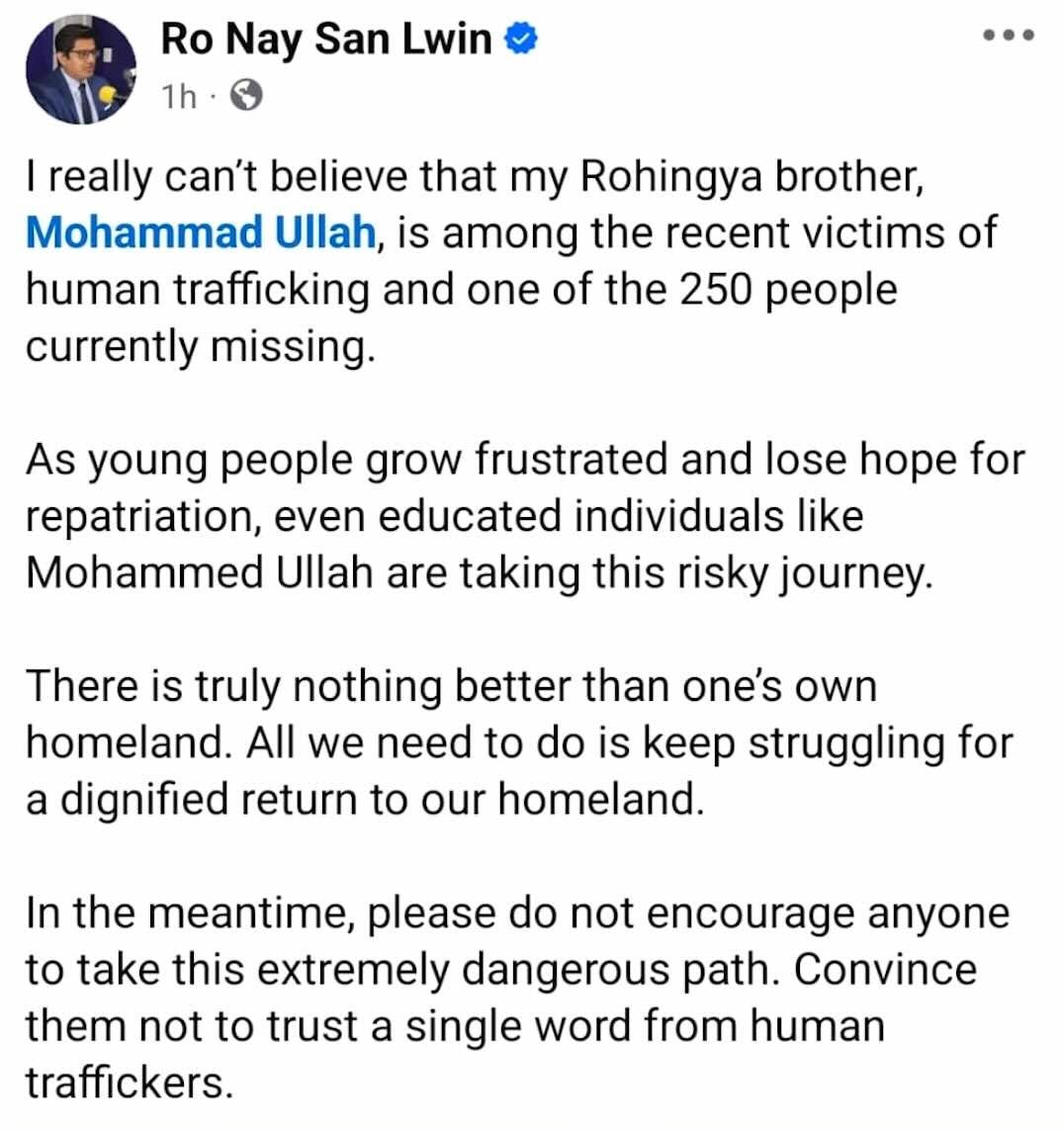
Then there is the politics of diaspora commentary. Ro Nay San Lwin urges Rohingya not to take dangerous journeys and to struggle for “dignified return.” Additionally, he says not to trust traffickers. This is presented as advice. It is, in fact, a non-insight. Of course, traffickers cannot be trusted. That is precisely why their continued relevance demands explanation.
People do not board these boats because they believe traffickers are benevolent. They board them because the alternatives have been foreclosed. When movement is restricted, work is prohibited, aid is shrinking, and protection cannot be relied upon, the choice is not between safety and risk. It is between different forms of risk. In that context, warning people about traffickers does not address the problem. It avoids it.
No credible conditions for return exist. Rakhine remains unstable, fragmented, and unsafe. To tell people not to leave without confronting these realities is not leadership. It is distance speaking to confinement. It is not guidance. It is the repetition of the obvious while ignoring the conditions that make the obvious irrelevant.
So the script repeats. Blame the traffickers. Arrest a few intermediaries. Call it justice. Meanwhile, the underlying system remains intact - containment without rights, protection without enforcement, and advice without consequence. As long as that structure persists, boats will continue to leave. And each time they sink, the explanations will be ready but the causes will remain untouched.
Join my WhatsApp Channel for news, documents, videos and images.