

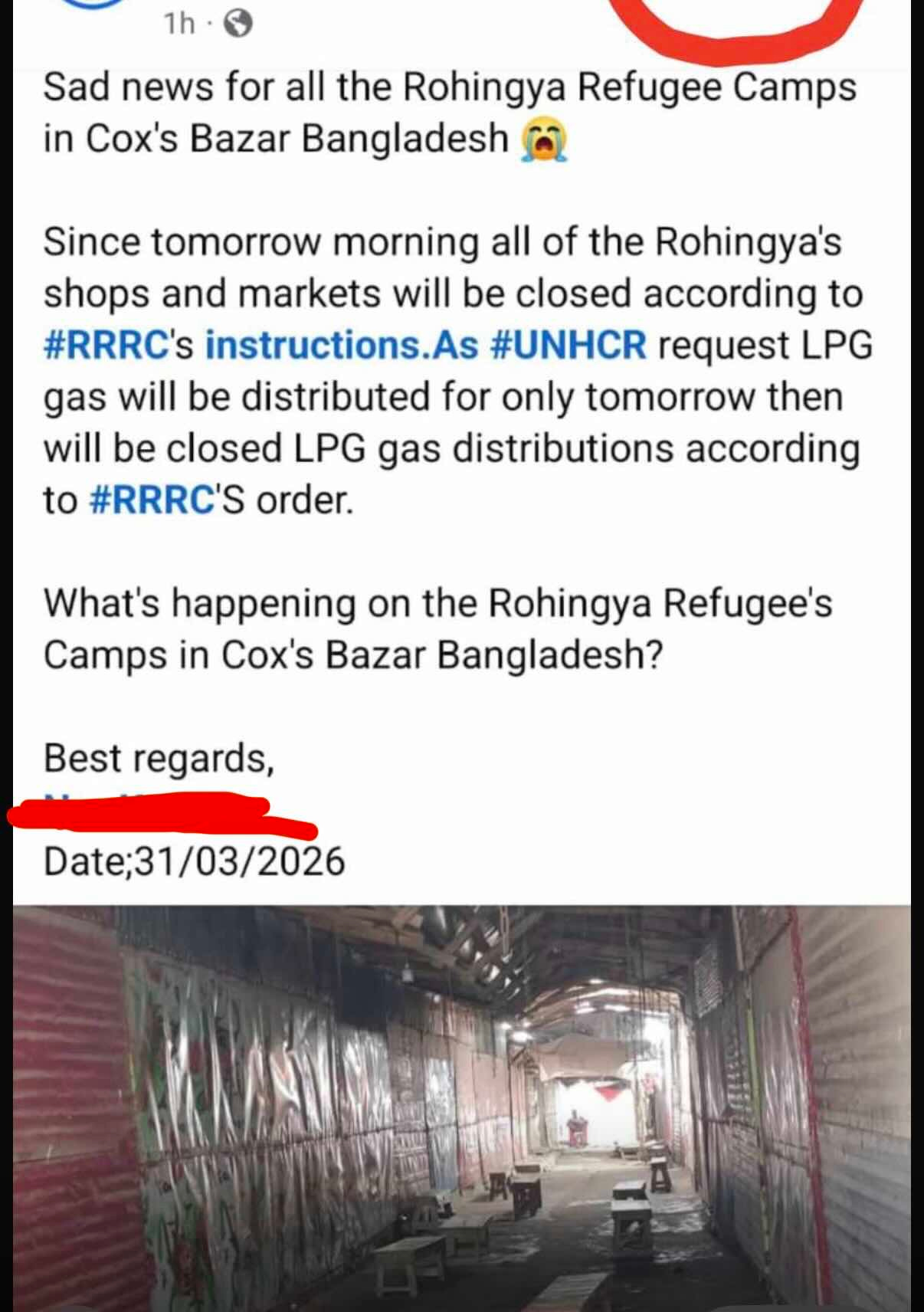
Two Rohingya youths in Cox’s Bazar have been arrested and sentenced to one month in detention for sharing images of shuttered shops. The images were not fabricated. They were taken from a recent report of mine about Bhasan Char, where an entire market had been shut down following a theft. The original post, written by a Rohingya man from Camp 22, mistakenly stated that the closures applied to camps in Cox’s Bazar. Another individual from Camp 09 shared that post. Both were arrested.
They are accused of spreading “fake information against the office of Refugee Relief and Repatriation Commissioner (RRRC).” The error regarding a general order to close Rohingya shops is obvious. The consequence is extraordinary. There is no indication of malicious intent by the youths. No instruction was given to them to correct the information. No warning. No engagement. Instead, the youths were arrested, charged, and sentenced.
In a functioning civil society, a factual error in a social media post is met with a correction or a "cease and desist." Moving straight to a one-month detention suggests the goal isn't to correct the record, but to deter reporting of any kind.
From Screenshot to Arrest
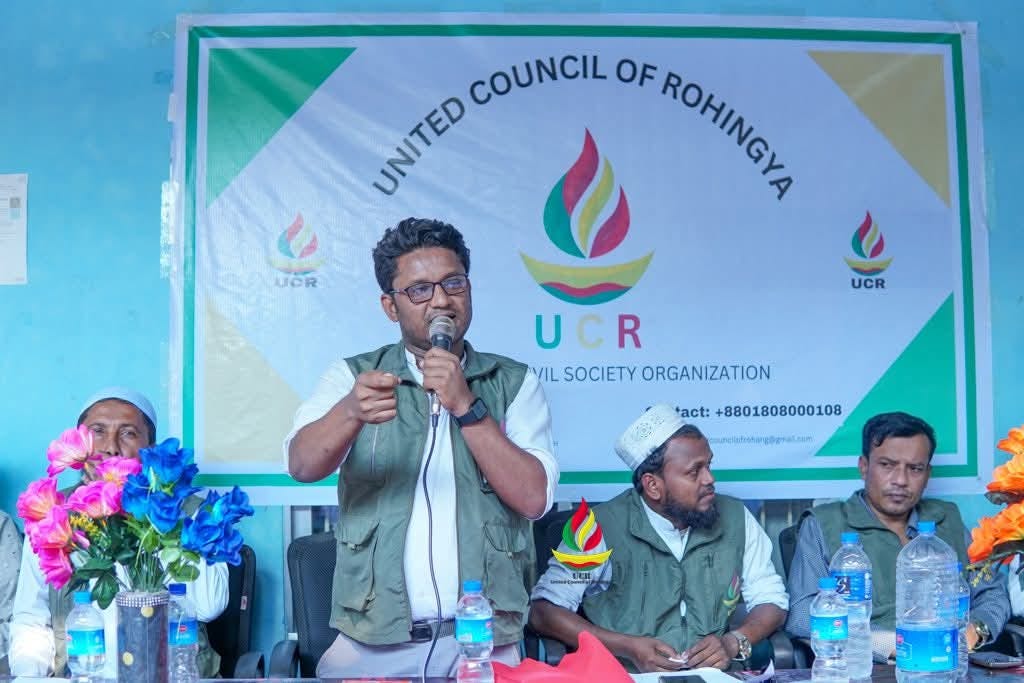
What happened next is more revealing than the arrest itself. According to information obtained from within the camps, the post did not simply circulate organically. A screenshot of it was reportedly forwarded to RRRC HQ by Khin Maung, one of the five rotating presidents of the United Council of Rohingya (UCR).
From there, the image was distributed through camp coordination networks. Rohingya members within those structures saw it. The discussion spread. Shortly afterwards, arrests followed.
The sequence matters. A piece of information moves through a structure, namely UCR, that is presented as community representation, enters administrative channels, and re-emerges as a criminal case!
I asked Khin Maung directly about his role in the arrests. He has not responded - a familiar silence for an individual who habitually avoids uncomfortable questions. The involvement of co-opted figures like Khin Maung in transmitting information to the RRRC blurs the line between community representation and administrative enforcement. Khin Maung has reportedly claimed he only shared the post for "confirmation," a convenient defence that masks his role as a catalyst for the arrests.
The involvement of a UCR official is not surprising. It is consistent with how the organisation has operated since its formation. The UCR was assembled through a tightly controlled process. A small voter base selected a larger congress, which in turn produced an executive committee and five rotating presidents. At every stage, the RRRC shaped participation, approved outcomes, and intervened in membership.
What Was Being Shared
The post that triggered the arrests referred to a real event. On Bhasan Char, an entire market had been shut down after electrical wires and a motor were stolen from a facility used by officials. There was no initial investigation and there was no attempt to isolate responsibility.
Instead, all Rohingya-run shops were ordered closed. Any violation would result in demolition and legal action.
Within 24 hours, the stolen items were reportedly recovered. Four individuals were arrested - two Rohingya and two Bangladeshi nationals. But the response had already done its work. Livelihoods were halted. A message had been sent. This was not policing by any stretch of the imagination. It was collective punishment.
The images shared by the two youths in Cox’s Bazar were taken from this incident. They did not invent the event. They misunderstood its location (where the order to shut shops applied). For that, they were jailed.
After the Closure
The story does not end with the reopening of the shops. In the days that followed, a new structure emerged on Bhasan Char. A 21-member “representative committee,” reportedly formed under RRRC direction. Its stated purpose was to prevent theft, eliminate drug trafficking, stop syndicates, and maintain social order.
But according to multiple accounts from residents, the composition of the committee raised immediate concerns. Teachers and educated individuals were largely excluded. Apart from a small number of “Rohingya market” figures, most members were drawn from a single “organised group” that had long sought to consolidate influence within the camps.
Some individuals reportedly have histories linked to the very activities the committee claims to address. The committee has not remained symbolic. Its members are conducting patrols, accompanied by additional individuals acting as enforcers. They move in a coordinated fashion. Residents report intimidation, surveillance, and fear.
There are concerns that the structure may be used to settle personal disputes, target individuals, and consolidate power through coercion. Even more striking is the ambiguity around its authority. Residents report that the committee may not have been formally approved by the CiC, or at least not in its current composition. It appears to have emerged in the space between official instruction and informal enforcement.
This is where governance becomes most opaque.
A System, Not an Incident
Taken together, these events form a pattern. A collective punishment is imposed without due process. Images of that punishment circulate. Those who share them are identified and arrested. Posts of my original article in Bhasan Char WhatsApp groups are removed.
The suppression of information is coordinated across both digital and physical spaces. This pattern is not isolated. In June 2024, the Committee to Protect Journalists reported that Rohingya refugees detained in Cox’s Bazar were questioned about their links to my work, with some shown my photograph by security officials. The concern is not personal. It is structural. Information, and those associated with it, are being tracked.
Two other things to note:
A leadership structure presented as representative of Rohingya appears to facilitate the flow of information upwards …to RRRC HQ.
A new enforcement body emerges on the ground in Bhasan Char, operating with unclear authority and generating fear.
At each stage, the same logic applies - control without accountability.
The Rohingya are excluded from formal legal systems. There are no independent courts. No effective complaint mechanisms exist. Authority is concentrated in administrative offices, exercised through intermediaries, and enforced through both formal and informal means. When there are no independent courts or complaint mechanisms, "law" is whatever the person in power says it is at that moment.
In such a system, punishment does not need to be proportionate. Nor does it need to be evidence-based. Anything or anybody that escapes control is liable to be punished.
The Question That Remains
The question is no longer whether a mistake was made. The question is what kind of system responds to a mistake in this way and who, within that system, is empowered to turn information into a crime.
The two youths in Cox’s Bazar were not organising protests. They were not inciting violence or fabricating events. They shared images of something that had happened. I repeat again, they got the location wrong. For that, they were arrested, charged, and jailed.
When the cost of a mistake is jail time, the community stops sharing information altogether. This creates an information vacuum that authorities can fill with their own state-sanctioned narratives.
The role of the United Council of Rohingya (UCR) in this sequence is particularly concerning. If a "representative" (Khin Maung) is the one funnelling social media screenshots to the RRRC HQ, the organisation is not acting as a bridge for community needs, but as a vertical extension of the authoritarian RRRC. This turns community “representatives” into informants. It breaks the social fabric of the camps, as residents can no longer trust their own “elected” or appointed representatives.
In sum, this isn't just about two youths and a Facebook post. It is a description of an authoritarian ecosystem where information is treated as a weapon, and the marginalised are denied the basic human right to be wrong without being imprisoned. From Bhasan Char to Cox’s Bazar, a mobile court sentence for a social media post reveals the brutal reality of the CiC’s unchecked "Legal Apartheid."
Join my WhatsApp Channel for news, documents, videos and images.
Read more about UCR here
Explainer: United Council of Rohingya (formerly United Council of Rohang)

The United Council of Rohingya (UCR) is a Rohingya organisation formed in 2025 following a series of refugee camp “elections” in Bangladesh. Until late December 2025, the organisation operated under the name United Council of Rohang, a term it publicly described as carrying “deep historical and symbolic meaning” connected to Arakan, the Rohingya homelan…