

Fortify Rights has built its reputation documenting atrocity crimes, most notably against the Rohingya in Myanmar. It now seeks to extend that authority through a newly formed “Leadership Council,” a group of high-profile parliamentarians, jurists and others. Fortify Rights hopes that they will bring influence, reach and political leverage to the cause of accountability.
On paper, this is a consolidation of moral authority. In practice, it raises a deeper question about what kind of universality is being institutionalised and what happens when the language of “human rights for all” meets the political limits of Western alliances.
The composition of the council itself begins to answer that question.
Fortify Rights putting Lord Alton on a “Leadership Council” to confront atrocity crimes is a study in how Western human‑rights branding can launder selective outrage and erase Palestinians while preaching universality.
Alton’s statement for Fortify Rights is pure abstraction. He says, “Genocide, crimes against humanity and war crimes – mass atrocities – are perpetrated around the world with impunity… It is an honour… to shine a light on the darkest corners of the world.” The problem is not that he talks about genocide and impunity; it is that when Gaza became one of the clearest contemporary test cases, he chose darkness over light.
A detailed investigation into UK Parliament’s genocide analysis apparatus (formal and informal structures around genocide prevention and accountability) notes that, three months into Israel’s onslaught on Gaza, Alton wrote a PoliticsHome piece marking the 75th anniversary of the Genocide Convention without mentioning Gaza once, even as he foregrounded other atrocity situations.
The same reporting records that in a January 2024 atrocity‑prevention roundtable he urged “caution” about using the word genocide for Gaza so as not to “dilute the term,” despite having deployed “genocide” liberally in relation to China’s treatment of Uyghurs.
So when Alton now wraps himself in Fortify Rights’ language about “mass atrocities… around the world,” he is trading on a moral vocabulary he carefully bracketed out when it threatened to implicate a Western ally - Israel.
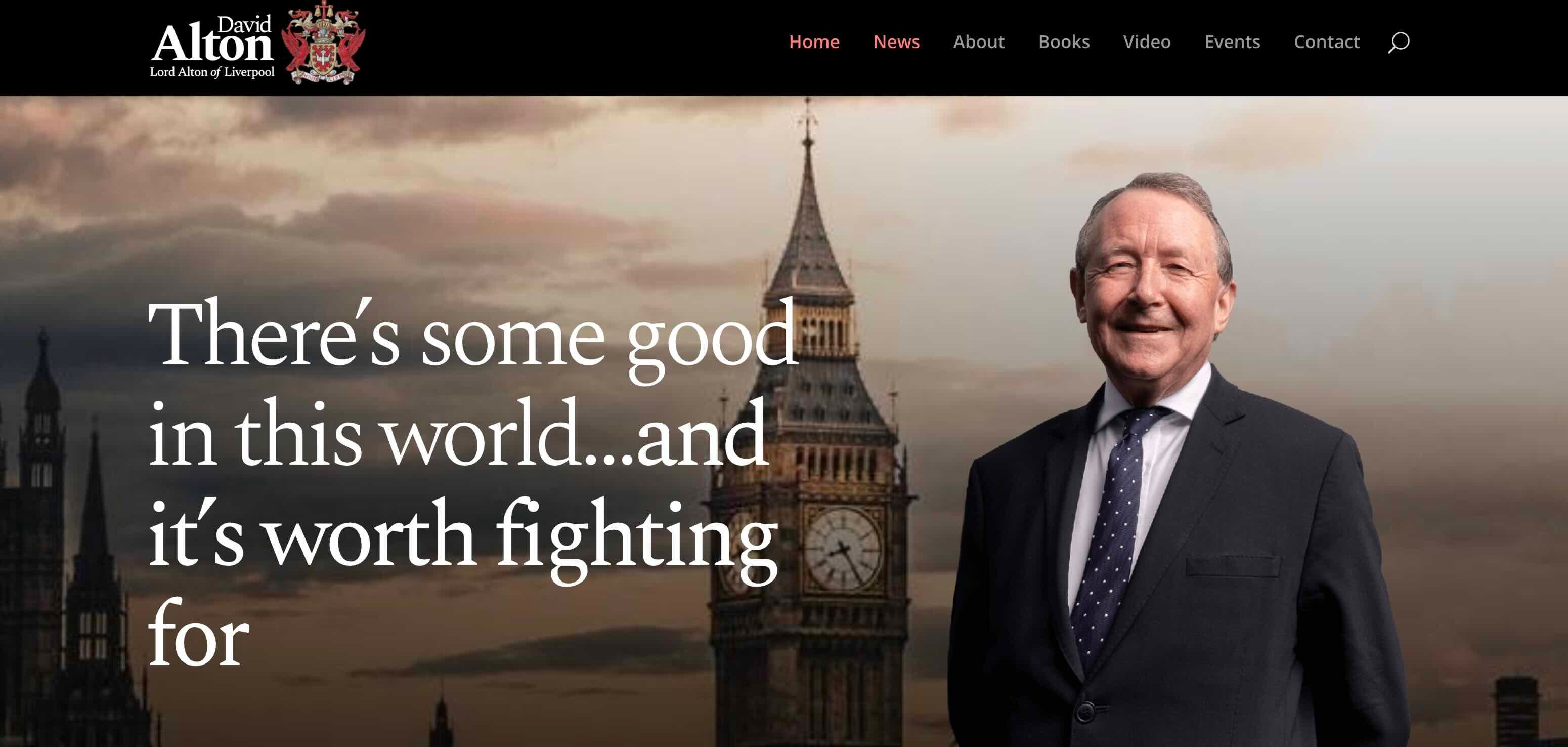
On his website, Lord Alton poses against Big Ben under a Tolkien line: “There is some good in the world, and it’s worth fighting for,” inviting us to see him as a guardian of the persecuted. Yet the same figure could not bring himself to name Gaza in his Genocide Convention anniversary article and urged colleagues not to apply the term genocide there. He faithfully echoed the government’s “we stand with Israel” script in the Lords. The disconnect between the quote and his record is the point - the good that is “worth fighting for” appears to stop where British and Israeli interests begin.
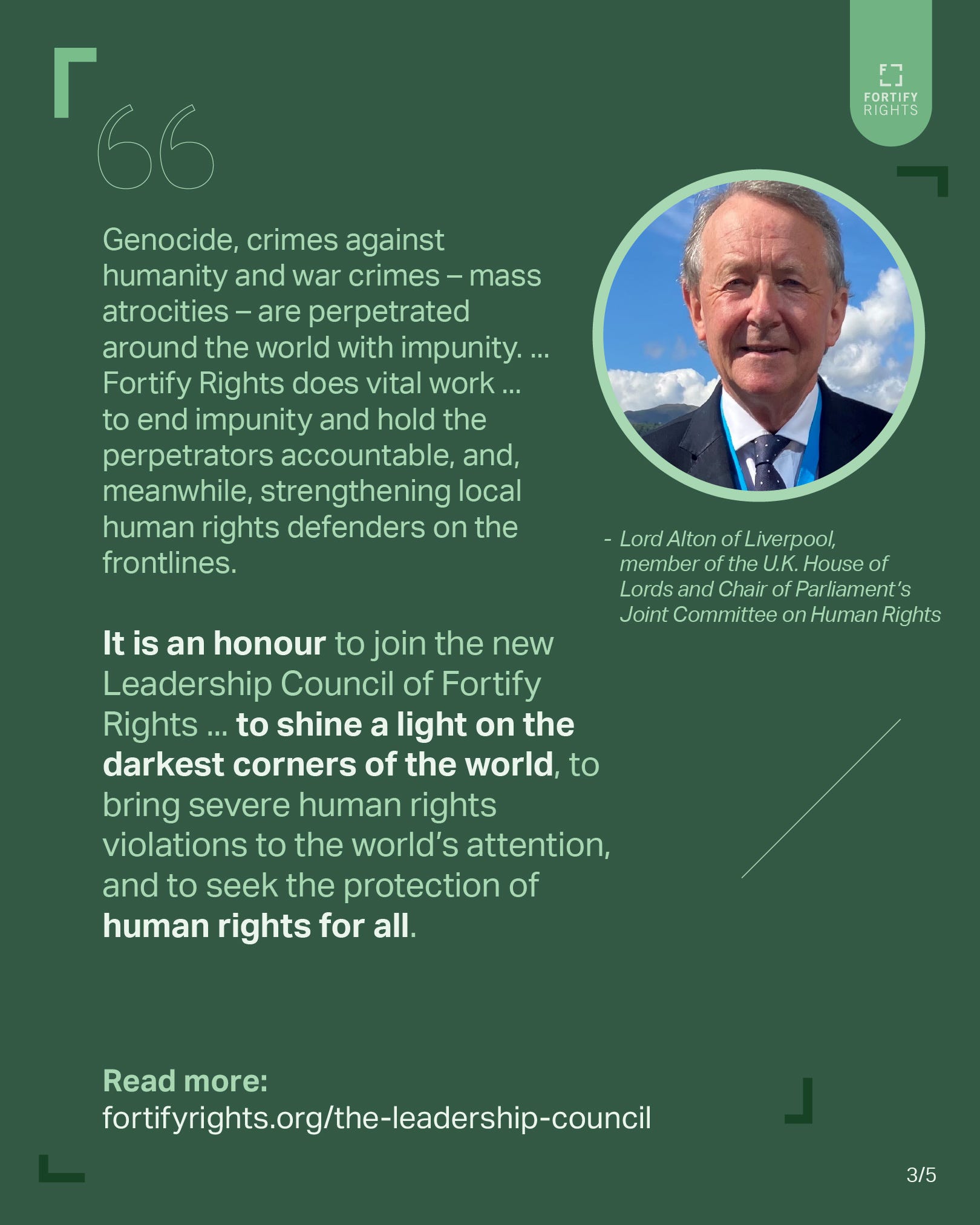
Read Alton’s Fortify Rights full quote in the graphic above against his Gaza record, and it becomes almost obscene. Gaza was not an obscure case. It was the central test of whether the language of genocide prevention would be applied consistently or hedged when a Western ally was involved. On that test, Alton faltered.
Fortify Rights describes the new Leadership Council as a body that will “intervene in moments of crisis” and ensure “perpetrators of atrocity crimes face real consequences.” They cast Alton as “one of the world’s leading parliamentary voices on human rights… and crimes against humanity.” That sales pitch relies on people not looking too closely at where Alton’s voice suddenly drops.
Yet this is the figure Fortify Rights now presents as a guardian against impunity - a watchdog that growls at Beijing and Pyongyang but curls up when the bombs are Israeli.


Some sort of error?
David Alton did not slip through Fortify Rights’ vetting net. His appointment sits comfortably alongside a wider ecosystem of Zionist figures whose careers are built on a language of universal justice that reliably short‑circuits when it reaches Israel–Palestine. Irwin Cotler and Tom Tugendhat are also on the council, and they exemplify the same ecosystem from different angles - one as the jurist who universalises antisemitism to delegitimise scrutiny of Israel, the other as the security hawk who recodes Palestinian claims as a counter‑terrorism problem.
Cotler’s admirers sell his Zionism as a natural extension of his human‑rights pedigree. Critics see something else entirely - a doctrine in which the Nuremberg principles become tools to shelter Israel from accountability by branding most criticism as a “new antisemitism.” Israel is cast as the “collective Jew” whose exceptional vulnerability justifies exceptional immunity.
Cotler argues that while “classical” antisemitism targeted individual Jews, the “new” form targets the “collective Jew” - the State of Israel. In short, criticism of Israel is frequently recoded as antisemitic. In practice, the framework blurs the line between antisemitism and structural critique of Israel, so that a wide range of political and legal challenges can be recast as anti‑Jewish bigotry. He is the primary architect of the theory of "New Antisemitism.”
Tom Tugendhat’s Zionism is less a matter of personal faith and more a rigid application of neoconservative realpolitik, where the "special relationship" with Israel is maintained through a convenient blindness to international law. Detractors, such as former colleague Alan Duncan, have labelled his stance "extremist." Duncan argued that Tugendhat’s refusal to condemn illegal West Bank settlements reveals a selective morality that prioritises the interests of a foreign state over the universal principles of justice he claims to champion.
Tugendhat’s view casts Hamas and other Palestinian actors as little more than the “terrorist acolytes” and “paymasters in Tehran” nexus, rather than movements rooted in a century of dispossession. His view is designed to strip the conflict of its indigenous and colonial dimensions.
In parallel, his focus on banning Palestine‑focused direct‑action groups such as Palestine Action, and including them in the network of domestic extremism, extends that same logic into the UK. Palestinian solidarity is reframed as a security threat to be shut down, rather than a political challenge grounded in claims to anti‑colonial justice.
Together, Cotler and Tugendhat illustrate the ecosystem Fortify Rights has chosen to institutionalise. It is one in which Israel is treated as an exception to the universal standards they invoke elsewhere.
Fortify Rights and the problem of selective credibility
Fortify Rights has built its reputation on extensive documentation of Rohingya persecution and Myanmar military atrocities, and on centering survivor‑led voices. The new Leadership Council is framed as a way to “close the gap between documentation and decision‑making,” bringing in people with “platforms, influence, and expertise” to act when civilian lives are at risk.
Putting Alton et al. in that role undermines their own narrative in three ways.
It signals that you can help “end impunity” while refusing to apply genocide language to Gaza even after multiple UN experts and organisations have warned that Israel’s conduct may amount to war crimes or crimes against humanity, and the ICJ has found a plausible risk of genocide.
It tells Palestinians, and anyone paying attention, that Fortify Rights is comfortable elevating figures whose own records exemplify the “double standard” Declassified UK identifies as leaving Palestinians “short of dependable allies” in genocide‑prevention circles.
It erodes the organisation’s claim to be driven by “community‑based human rights defenders and survivor‑led perspectives,” because the survivors of Gaza are precisely those Alton et al. have been most reluctant to stand alongside in legal and political terms.
When your mission statement says “human rights for all” but your chosen human‑rights champions treat Palestinians as a reputational hazard rather than a constituency, the gap between copy and practice becomes impossible to ignore.
What this says about Fortify Rights “Leadership Council”
To use the language of Declassified UK, there are figures in this space “for whom the idea of holding Israel to account is anathema.” This is not to suggest that every architect of international criminal accountability on the council operates this way; figures like Sir Geoffrey Nice and James Silk have applied the same legal tools to Israel’s siege of Gaza and apartheid structures that they apply elsewhere.
However, Fortify Rights’ decision to flank them with people whose universalism reliably falters at the Green Line reveals a cynical understanding of power. Fortify Rights understands how power works. It is precisely because Lord Alton sits in the Lords and chairs the Joint Committee on Human Rights that he is an attractive appointee. But power that only ever points in one direction is not neutral!
By elevating figures whose advocacy for the Rohingya or Uyghurs exists alongside a conspicuous silence on Gaza, Fortify Rights has signalled the limits of its own universalism. This “Leadership Council” appears comfortable with a model of justice where certain victims deserve maximum solidarity, while Palestinians are reduced to a security narrative that keeps Israel permanently insulated from the standards applied everywhere else.
If Fortify Rights truly wants to “end impunity,” it should be confronting this double standard, rather than embedding it within its own leadership structure.
Join my WhatsApp Channel for news, documents, videos and images.