

Imagine fleeing genocide, surviving military massacres, and being confined to camps for nearly a decade ( and for some, decades), only to be told you now need separate prisons too.
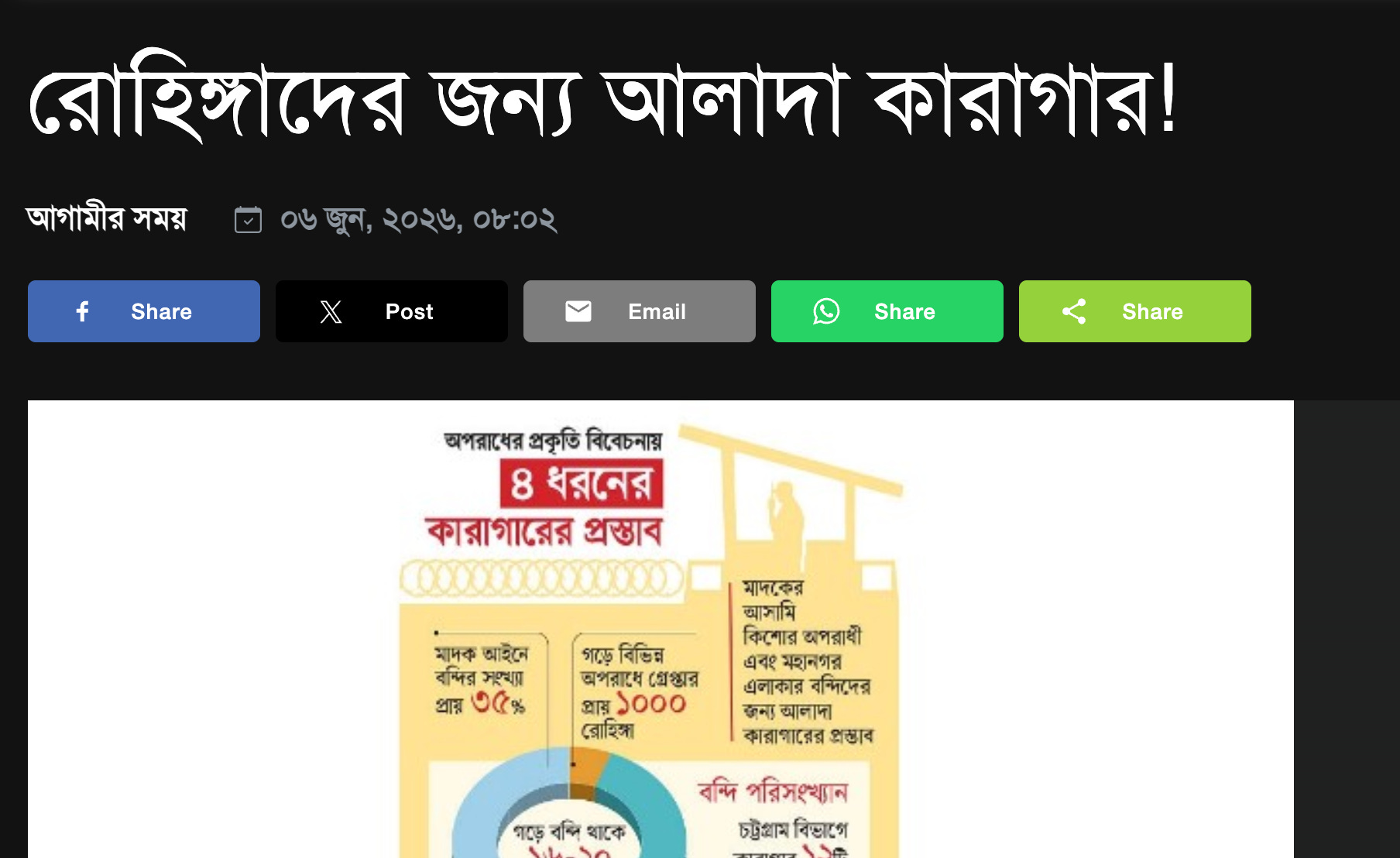
Bangladeshi news outlets are reporting proposals for dedicated prisons for Rohingya detainees. Yes, really.
I found a report saying the Chattogram DIG-Prisons office sent a formal summary on 19 May to the IG-Prisons proposing a separate prison for Rohingya detainees in Cox’s Bazar. It says the proposal would go to the Home Ministry after review, and claims policymakers had already given “in-principle” consent.
According to an earlier Ajker Patrika report, 160 acres of khas land in Paglibil, Haldia Palong, Ukhiya, were allocated for a proposed Rohingya prison. The Forest Department later raised objections.
The linked Ajker Patrika report (see above) is very interesting. It says:
”Sources in the Prisons Department said that the Prisons Department wants to set up a separate and open prison for Rohingya prisoners on the model of Malaysia's CRP. Rohingya prisoners in various prisons in the country, including Cox's Bazar Prison, will be kept there. The prisoners will get leave once a month to meet their families. After the leave, they will have to return to the prison. Prison guards, police and non-governmental organizations will work in coordination there. Infiltrators and refugees in Malaysia are kept in CRP.”
Malaysia’s CRP (Community Rehabilitation Programme) is not a system for refugees. It is a rehabilitation programme for selected prisoners. It allows some low-risk inmates to serve part of their sentence outside conventional prisons while receiving training, work opportunities and supervision. Refugees and undocumented migrants in Malaysia are generally held in a separate immigration detention system. The two are not the same thing.
This makes the Ajker Patrika report all the more troubling. It appears to borrow the language of rehabilitation and “open prisons” from Malaysia while applying it to Rohingya as a refugee population. In effect, a programme designed for prisoner rehabilitation is being invoked to explain the segregation of a stateless minority.
The result is that what sounds benign on paper begins to look like something else entirely - a separate detention regime for Rohingya, administered by prison authorities, police and NGOs, and presented as reform!
The Rohingya already occupy the weakest position in Bangladesh’s legal and political order. Concentrating Rohingya detainees in dedicated facilities would create closed spaces with little scrutiny and immense opportunities for abuse. It is a gift to every corrupt official looking for an easy victim. Who is going to complain? Who is going to investigate? False cases are a big thing in the camps. Can you imagine how those cases will soar?
When a population has no vote, no citizenship, limited access to lawyers and little public sympathy, accountability goes out of the window. In such conditions, corruption and extortion do not disappear. They flourish!
Beyond the extortion and the legal loops lies an uglier truth. To funnel the Rohingya into a custom-built, separate prison system is nothing less than a form of modern apartheid under the guise of bureaucratic management. If Bangladesh actually proceeds with this plan, it will extend the architecture of containment that has defined Rohingya life for decades.
Hat tip to journalist Shahenoor Akther Urmi for drawing my attention to the Ajker Patrika report.
Join my WhatsApp Channel for news, documents, videos and images.