

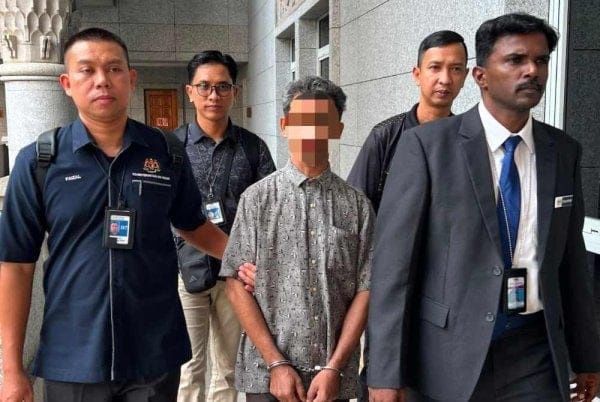
The Registrar of Societies Malaysia (RoS) has said that Zafar Ahmad Abdul Ghani, who identifies himself as president of the Myanmar Ethnic Rohingya Human Rights Organisation Malaysia (Merhrom), was charged under Sections 42 and 48 of the Societies Act 1966.
Malaysia’s Societies Act 1966 says an organisation that should be registered but is not registered is an “unlawful society.” Section 42 then makes it an offence to be an office-holder or to manage or assist in managing it, punishable by up to five years’ imprisonment or RM15,000. Section 48 criminalises acting on behalf of or representing such a society. This again carries up to five years. That is what Zafar is being prosecuted under.
There is a rather nasty Catch-22 here.
Zafar is not simply an undocumented man who invented an organisation yesterday. UN special rapporteurs recorded in 2021 that he sought refuge in Malaysia in 1992. He was recognised as a refugee in 2004. MERHROM says it was founded in 1998 and has operated publicly for decades. Yet now he has been charged because MERHROM is not registered and because he describes himself as its president. The RoS also says its investigation specifically examined MERHROM’s social-media statements and publications.
That is direct retaliation because MERHROM has recently been publicly criticising Malaysia's Rohingya policy. In June asking Anwar Ibrahim and ASEAN to secure safe return, in July opposing the proposed return of 5,000 Rohingya, and speaking publicly about Rohingya evictions. So the timing of Zafar’s arrest can’t be ignored.
The crucial thing is that refugee-led Rohingya organisations appear unable, or at the very least extraordinarily unlikely, to obtain normal legal recognition in Malaysia. How do we know this? A 2022 peer-reviewed study in Refugee Survey Quarterly found that UNHCR recognised more than 25 Rohingya refugee community organisations in Malaysia. None of those refugee-run organisations or learning centres was registered or licensed by the Malaysian authorities. The registered learning centres it found were instead operated by Malaysian NGOs. MERHROM itself has been saying publicly since at least 2019–20 that it “cannot be registered as an organization in Malaysia”, which it says has also prevented it from receiving normal organisational funding.
There is an even more revealing statement from the Malaysian government itself. In 2020, then Home Minister Hamzah Zainudin said the authorities had never registered a Rohingya association in Malaysia. He described associations representing Rohingya as illegal under the Societies Act. That is what is now being used against Zafar.
What makes this especially important is that the Societies Act itself does not simply say “foreigners cannot form associations”. The Registrar’s own current guidance says non-citizens may belong to societies, depending on the constitution, and may serve as office-bearers with the Registrar’s prior permission. It even explicitly permits new societies established by foreign “expatriates”, giving Korean and Japanese associations as examples.
But refugees occupy a very different legal layer. The lowest rung of all. Malaysia has no general statutory refugee status. Malaysian immigration law generally does not distinguish refugees from undocumented migrants. Zafar therefore isn’t in the comfortable category contemplated by the RoS guidance - a Japanese executive or Korean expatriate lawfully resident in Malaysia asking permission to head an expatriate association.
Malaysia is prosecuting a Rohingya refugee for representing an “unlawful society”, when “unlawful” in this case means unregistered. Yet, as we know, refugee-led Rohingya organisations have operated for years, indeed decades, in a legal system that does not recognise refugees as a domestic legal category. In the eyes of the state, Zafar is an undocumented migrant. He is not a lawful resident. So the only route to legality runs through a permission that, as far as the record shows, has never been granted to any Rohingya organisation!
Now the state is criminalising Zafar Ahmad Abdul Ghani for operating in precisely the legal limbo it created. He’s literally being criminalised for not having paperwork the state makes impossible to get.
Join my WhatsApp Channel.