

The other day I wrote about Rajeev Bhattacharyya’s latest piece in The Diplomat on Htan Shauk Khan/Hoyyar Siri, where he tries to push back against Human Rights Watch’s massacre report. He does so by relying on three interviews conducted inside Arakan Army-controlled territory. My point was simple: “from the ground” is not a magic spell. If the ground is controlled by the armed group accused of the atrocity, then access itself becomes part of the story.
Today I want to look back at an earlier piece he wrote in October 2024, also for The Diplomat, on Buthidaung town after the Arakan Army’s takeover. Reading it now, after his May 2026 article, is revealing.
The same method is already there - AA-mediated access, constrained or captive sources, heavy emphasis on ARSA and junta culpability, and a steady effort to soften or complicate findings by the UN, Human Rights Watch and satellite investigators.
The October 2024 piece reveals that Rajeev Bhattacharyya has a deeply entrenched, long-standing pattern of carrying water for the Arakan Army. His journalistic playbook hasn’t changed at all - he has simply recycled the exact same propaganda mechanics over a two-year period. Same script, different date.
Here is an analysis of what Rajeev is doing in the 2024 text, and how it completely reinforces my critique of his later work:
The Same Script, Just a Different Date
In his 2026 piece on Htan Shauk Khan, he tried to dismiss a Human Rights Watch report by relying on three controlled interviews. Look at what he did here in 2024: he attempts to undermine a major United Nations (OHCHR) report that accused both the military and the AA of targeted atrocities, intentional burning of Rohingya homes, and sexual violence.
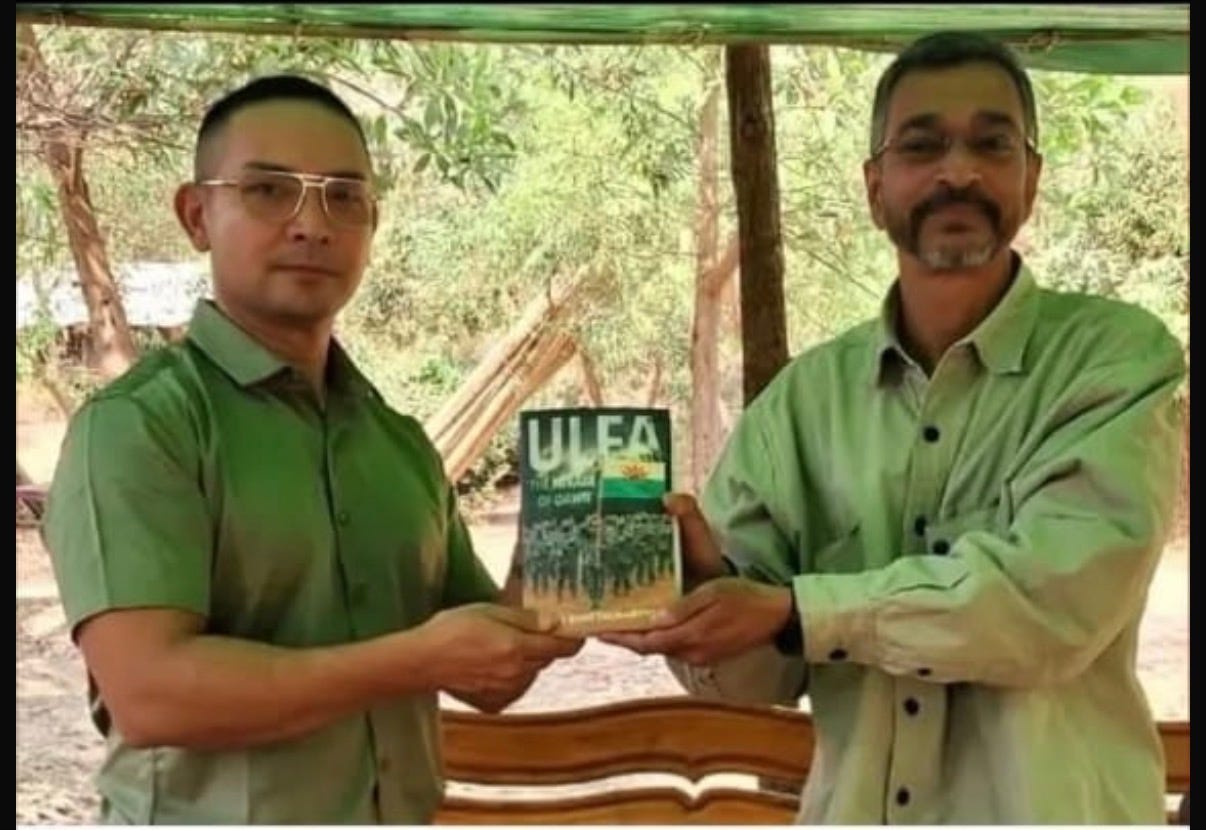
To counter the UN, he uses the exact same trick: he embeds himself with the AA for six days, sits in an environment entirely monitored by them, and uses highly curated interviews to write a piece exonerating the Arakan Army.
Just like in 2026, Rajeev’s primary defence narrative for the AA in 2024 is to shift 100% of the blame for violence onto the junta and Rohingya militants (ARSA).
He quotes “captured” junta officers and “escaped Rohingya recruits” (who surrendered to the AA and are being held in AA custody) claiming they were ordered by the military to burn down Buddhist homes.
He presents testimony from people currently being detained by a rebel army as independent, uncoerced truth. He expects the reader to believe that a captured prisoner or a Rohingya man sitting in an AA-run police station is speaking completely freely.
Absolute Blindness to Retaliatory Arson
When confronted with satellite data and independent analysis from the Australian Strategic Policy Institute (ASPI). .which explicitly accused the Arakan Army of a “systematic campaign of retaliatory arson” against Rohingya neighbourhoods, Rajeev completely folds.
He interviews a Rohingya man named Husan Ahmed, whose house was torched the exact night the AA entered the town. When Ahmed clearly terrified, says it was “too dark” to see who did it, Rajeev notes that the man was “reeling under fear.”
Yet, instead of concluding that the man is terrified of the AA commanders standing nearby, Rajeev uncritically prints an AA coordinator’s claim that “drones or planes” did it, despite admitting the houses showed signs of being manually torched, not bombed. He then muses that if there were retaliatory attacks by the AA, “the victims have long since fled” - completely missing the irony that he is refusing to interview the refugees who fled because they are outside of the AA’s control.
The Arakan Army as Liberators
The final section of his 2024 piece reads like a direct PR pamphlet for the United League of Arakan (the political wing of the AA). He interviews the AA-appointed chief administrator, Aung Thaung Shwe, allowing him to spin a beautiful narrative about “equal rights,” “material support,” and “village security committees.”
He completely ignores the structural reality of ethnic cleansing, framing the mass displacement of 140,000+ people not as a humanitarian crisis driven by targeted violence, but as an orderly, benevolent “evacuation” managed by the AA to save lives.
Rajeev Bhattacharyya is an embedded reporter with systematic access granted by the Arakan Army. He didn’t just stumble into a bad methodology in 2026; he has spent years acting as the AA’s preferred international megaphone, systematically using small, captive sample sizes inside rebel territory to dismiss the findings of the UN, Human Rights Watch, and satellite forensic investigators.
Join my WhatsApp Channel for news, documents, videos and images.