

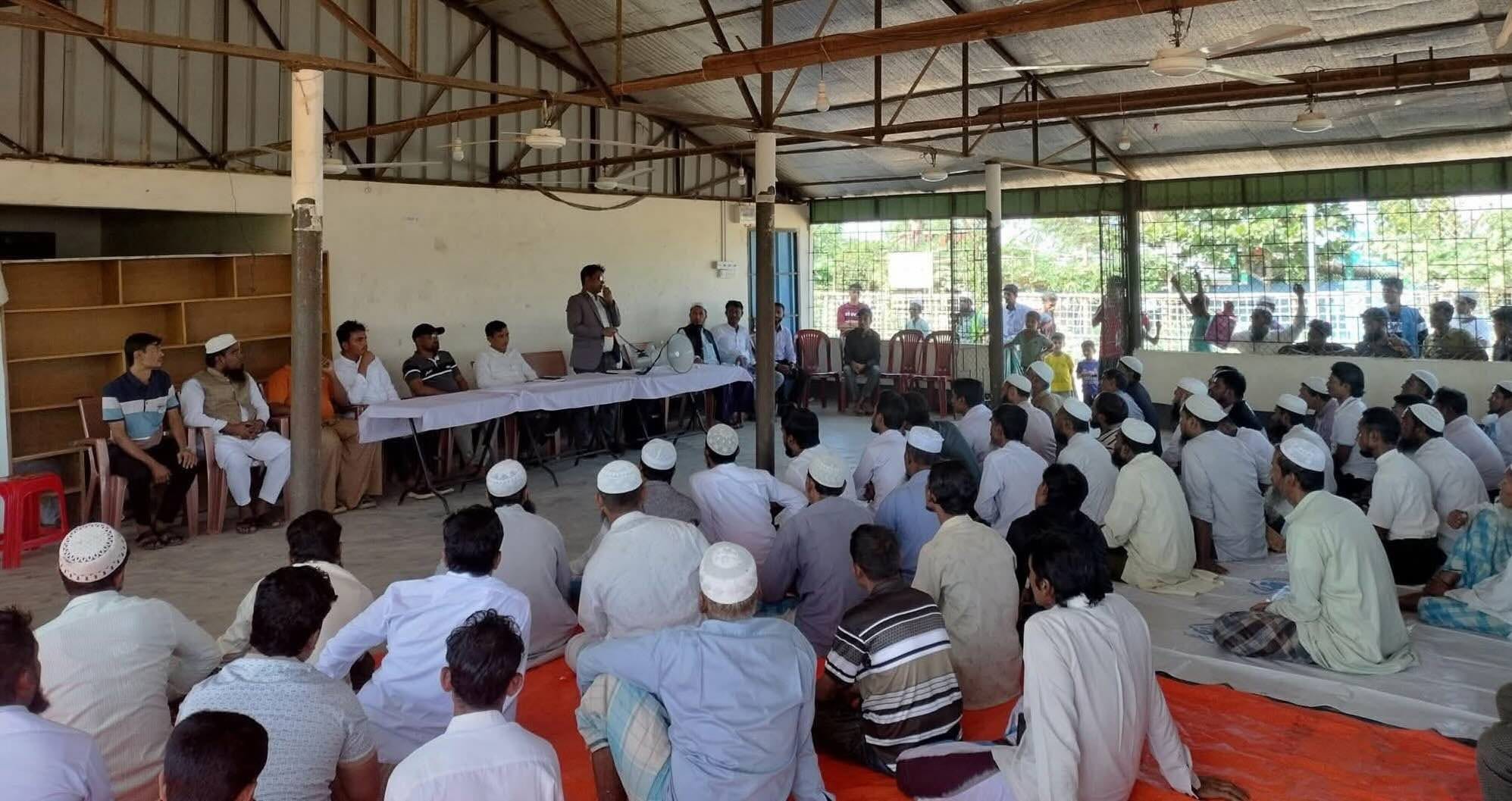
They are no longer pretending. The leadership of the United Council of Rohang (UCR), born from an already compromised “election” process earlier this year, is now actively aligning itself with camp authorities to police which viewpoints are acceptable, reconfigure grassroots structures, and reframe state control as community consent.
What was once framed as a historic step toward democratic self-representation is now functioning as an enforcement tool for the Refugee Relief and Repatriation Commissioner (RRRC). The UCR presidents are not just echoing RRRC policy lines, they are amplifying them, disciplining fellow refugees, and helping dismantle any residual forms of bottom-up accountability. All under the banner of “unity” and “legitimacy.”
Let me give you a very quick recap of what I wrote in the Dhaka Tribune (and The Diplomat) before I give you two empirical examples that happened over the last three days.
Quick Recap
In my original piece for the Dhaka Tribune, I outlined how the UCR was assembled through a narrow, top-down process involving just 3,693 voters in a population of over one million. From that sliver, a Congress of 480–500 selected the 28 executive members and 5 rotating presidents. Even at that stage, the process was already marred by political interference. Ahmed Hussain from the Rathedaung community was removed at the last minute from the executive committee at the RRRC’s instruction. Abdul Hamid, from the registered Kutupalong camp where no election occurred, was parachuted into the same body without consultation. Throughout, the RRRC shaped categories, zones, and participation, approving outcomes and barring individuals here and there.
And now, we are seeing exactly how this structure is being used.
Empirical Example 1: Khin Maung’s post on Camp 6 restructuring
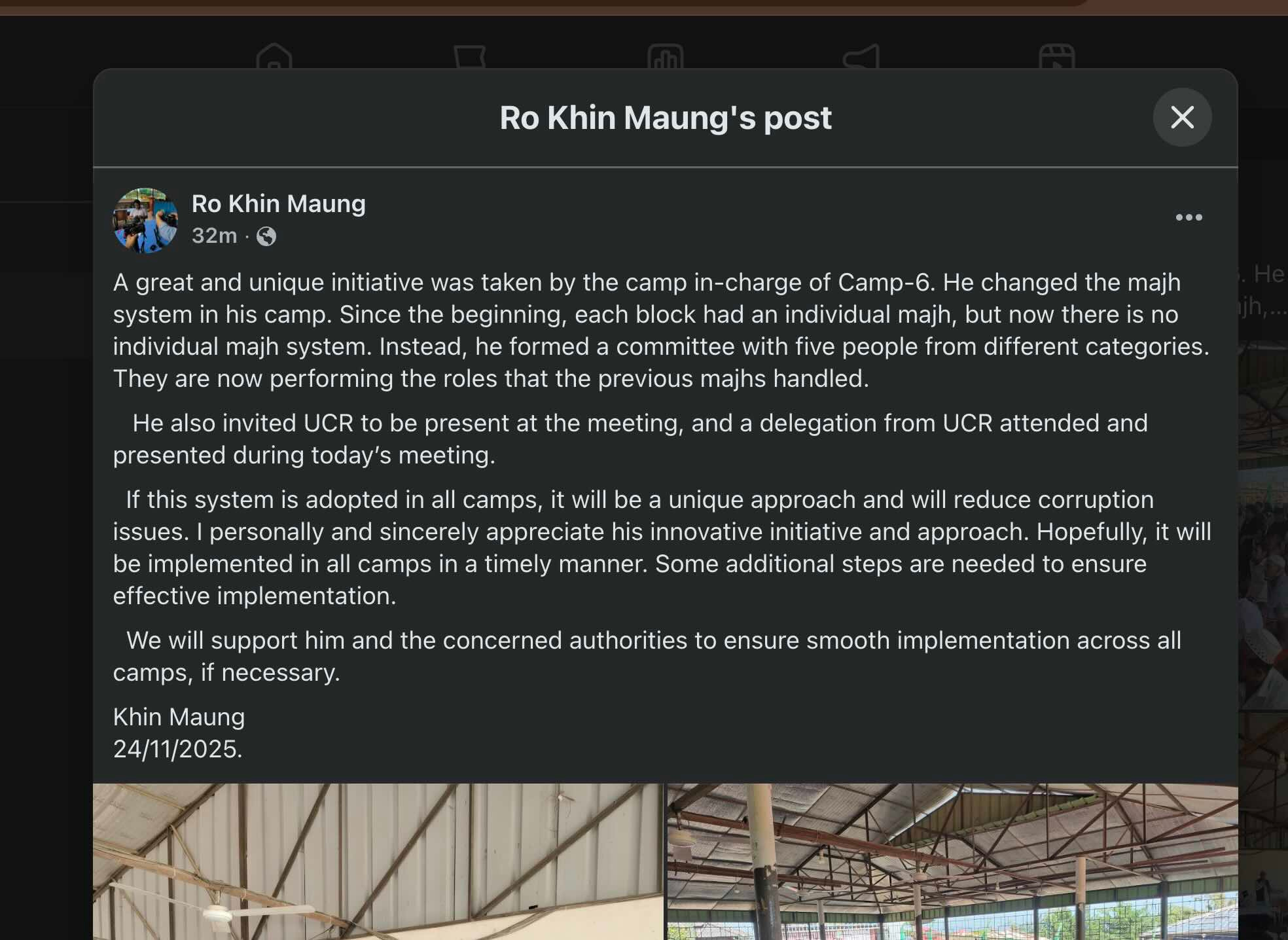
In a now-deleted Facebook post (see above), UCR president Khin Maung celebrated the Camp-in-Charge (CiC) of Camp 6 for abolishing the block majhi system and replacing it with a five-member committee handpicked by the CiC. He wrote:
“A great and unique initiative... Hopefully, it will be implemented in all camps in a timely manner... We will support him and the concerned authorities to ensure smooth implementation across all camps, if necessary.”
But what kind of reform was actually taking place? It simply shifted power from many majhis to a micro committee chosen by the CiC, making the camp easier to control. The UCR’s presence at the meeting made the purpose unmistakable. They were there not to question the change but to bless it, legitimise it, and help sell it to the refugees as if it were in their interest.
Khin Maung uses anti-corruption language, a common RRRC justification, to rationalise the dismantling of an existing community-based system without community consultation. To be clear, I am not defending the current majhi system, which has deep structural problems of its own. My point is that any reform imposed from above, without Rohingya participation, simply replaces one unaccountable structure with another.
Instead of asking what refugees want, Khin Maung praises the authority that executed the change.
Let me repeat his line:
“We will support him (the CiC) and the concerned authorities to ensure smooth implementation across all camps, if necessary.”
This is not the language of an independent civil society body. This is the language of an implementing partner, a subcontracted legitimacy provider signalling readiness to roll out a CiC-designed system across the entire humanitarian operation.
Empirical Example 2: The UCR statement attacking resettlement discourse
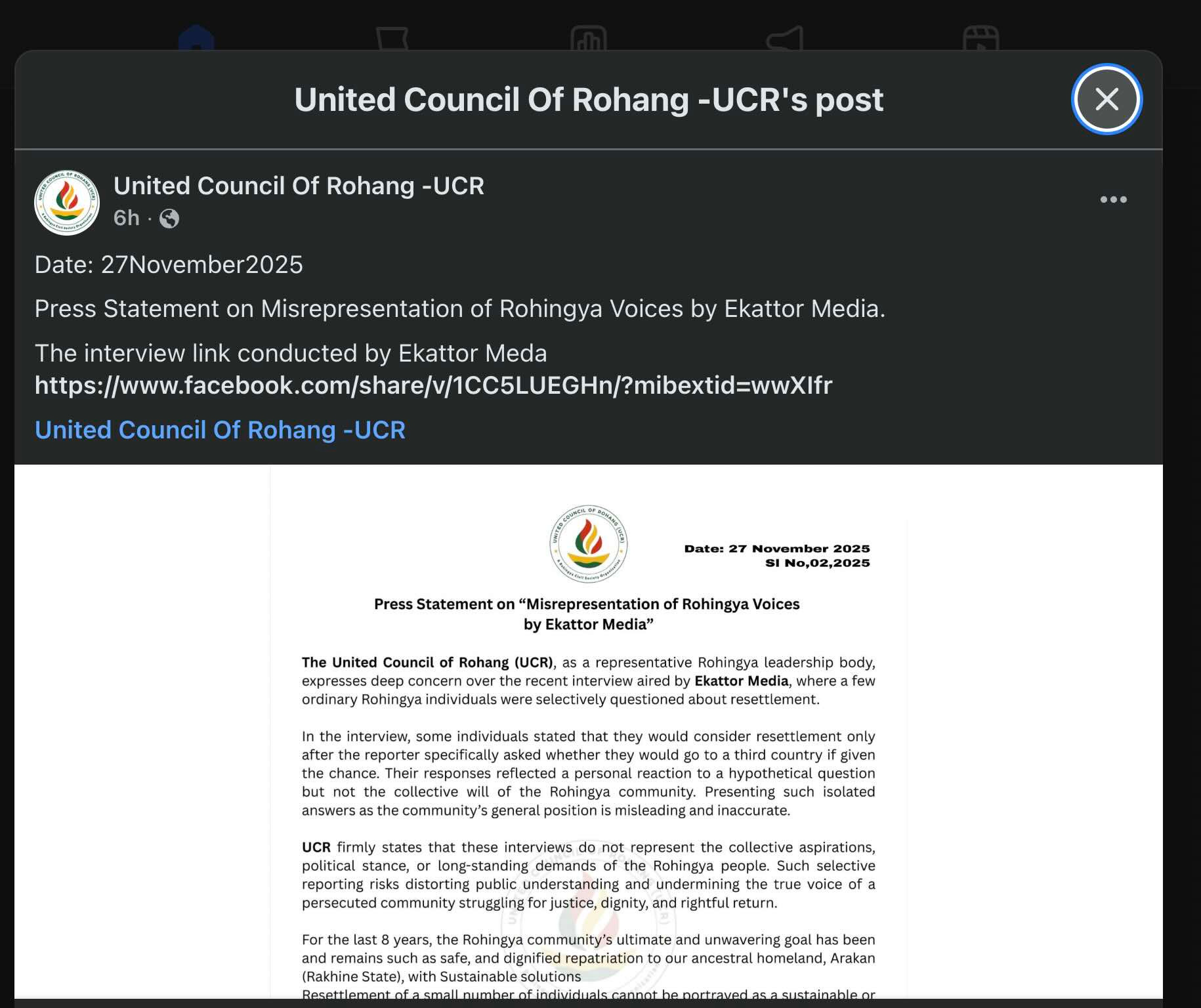
Today, UCR released a public statement condemning a media outlet for including comments from Rohingya refugees who expressed interest in third-country resettlement. The statement reaffirmed repatriation as the only acceptable goal and warned media to consult only with “legitimate leadership bodies” like UCR.
The statement is not merely conservative messaging; it is an open attempt to police thought. It asserts that resettlement talk “misleads the international community” and comes from “individuals who do not represent our collective aspirations.” Alternative futures aren’t only excluded - the UCR treats them as misleading and unacceptable, something that must be shut down rather than discussed. This strikes me as typical RRRC messaging. It is not the language of open debate. It is marking certain topics as unacceptable, inappropriate, or harmful.
The UCR’s statement parrots the state’s line almost word for word. It insists that repatriation to Rakhine is the only “safe and dignified solution,” repeating Dhaka’s diplomatic script as if it were the unanimous view of the camps. By dismissing resettlement as “unsustainable,” the UCR isn’t speaking for refugees; it is defending Bangladesh’s foreign-policy position. And when it tells journalists to consult only with “legitimate leadership bodies,” it is effectively tightening the RRRC’s grip over who gets to speak and what can be said. It is not acting as a body reflecting the diversity of Rohingya opinion but as a gatekeeper deciding which opinions are allowed to exist.
In doing so, the UCR performs a very useful function for the authorities. Internationally, it allows Dhaka to point to a “Rohingya-led” body that conveniently echoes its repatriation agenda. Locally, it discourages media and NGOs from talking to ordinary refugees who may have different hopes for their future. The result is a controlled narrative presented as community consensus, with the UCR making it all look organic.
What this tells us
These two episodes make the UCR’s real role unmistakable. This is not about Rohingya-led anything. It is about Dhaka-led management with Rohingya faces fronting the project.
Perhaps the most telling part of these developments is what has not happened. Diaspora organisations that were once vocal about representation, voice and dignity have said nothing. Some appear relieved by the emergence of UCR because it offers a ready-made platform to engage with and a way to avoid acknowledging the absence of civic space in the camps.
Their silence is not neutral. It amounts to complicity through convenience. The irony is striking. Groups that speak of justice in international forums now endorse a structure that tightens control over their own people in Cox’s Bazar.
The Yunus administration has played a blinder. Photographs with diaspora figures at the UN are only the visible layer. Much more - some of it covert - is on offer to those seeking a future in Rakhine. The result is a familiar one. The diaspora is kept quiet not through coercion, but through calculation.