

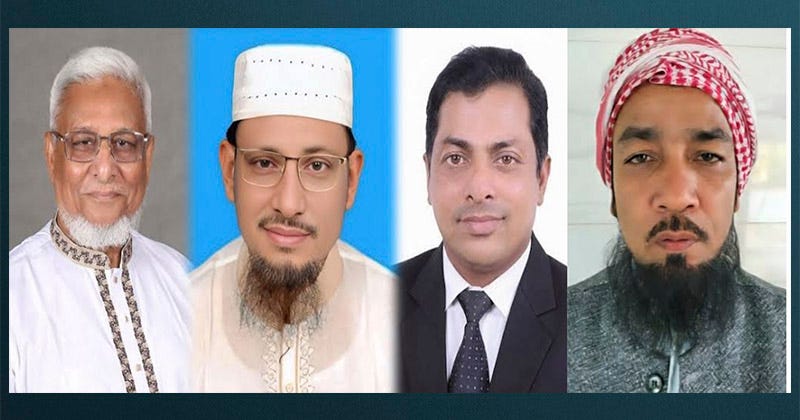
Ukhia–Teknaf, formally Cox’s Bazar-4, is one of the most politically and strategically sensitive constituencies in Bangladesh. It lies along the Naf River on the Myanmar border and includes St Martin’s Island, the Marine Drive coastal corridor, hilly terrain, salt fields and the country’s largest concentration of Rohingya refugee camps. The constituency is shaped as much by geopolitics and security as by local development concerns.
The electorate numbers 375,658 voters across 11 unions and 115 polling centres. Of these, 192,806 are men and 182,852 are women, making female voters an increasingly decisive bloc. Teknaf accounts for 202,781 voters across six unions and 61 centres, while Ukhiya has 172,977 voters across five unions and 54 centres. The demographic balance means turnout patterns and women’s mobilisation could prove pivotal.
The seat is currently contested by two heavyweight candidates. The BNP has fielded Shahjahan Chowdhury, a four-time MP and former parliamentary whip. Jamaat-e-Islami has nominated Principal Maulana Nur Ahmed Anwari, a long-time union chairman and district-level organiser. Smaller parties are also contesting. They are Maulana Nurul Haque of Islami Andolon Bangladesh and Saifuddin Khaled of the National Democratic Movement (NDM). Both are marginal players in the race, with little organisational presence on the ground.
Beyond party rivalry, the constituency is shaped by several overlapping pressures. It hosts around 1.1 million Rohingya refugees in camps near Ukhiya and Teknaf. It sits on a porous international border that has long been associated with cross-border trade, migration and narcotics trafficking. It includes parts of the Chittagong Hill Tracts region, with its own history of militarisation and ethnic tension. Local voters consistently cite border security, employment, drug control, education and healthcare as priorities.
Because of this combination of geography, demography and security politics, Ukhiya–Teknaf is often described as one of the most sensitive constituencies in the country. What happens here is not just a local contest. It reflects how national parties position themselves on the Rohingya crisis, border control, regional security and development at the margins of the state.
If you have been following this newsletter, you will have seen my recent essays on how the Rohingya crisis is framed across Bangladeshi politics. I have argued that “repatriation” is no longer discussed as a rights-based solution but as a political tool.
If you have not read those articles, then watch this short clip from Ukhiya–Teknaf. It crystallises the mindset.
Here is the translation of what he says:
Journalist: Rohingya are a big problem in Ukhiya and Teknaf. What are your plans to resolve the problem?
Jamaat Candidate (Maulana Nur Ahmed Anwari): We have already talked about our plans to solve the Rohingya problem. Some are short-term and some are long-term. The main solution to the problem is to repatriate them with dignity. That is a domestic and international issue. There are some local issues, such as keeping them confined in camps and controlling the terrorist activities they carry out and spending the 25% government allocation for the local population for the welfare of the people. So that the people understand that we are getting some compensation for the damage caused by the Rohingyas and providing jobs for local boys and local men. By doing these things, our Rohingya problem will be solved to some extent in the short term. I hope.
In the interview, the Jamaat candidate says the main solution is to “repatriate them with dignity.” But he immediately pivots to keeping Rohingya confined in camps, controlling what he calls “terrorist activities,” and ensuring that 25 percent of the mandated allocations for the Rohingya go to locals so they feel compensated for the “damage caused by the Rohingyas.” He promises jobs for local men.
Listen carefully to the sequence.
Repatriation is invoked first, as a moral headline. But the substance is about confinement, control, compensation and constituency management.
The Rohingya are framed not as rights-bearing refugees, but as a security risk, an economic burden and a resource to be leveraged for local political benefit. The most revealing line is this: “So that people understand that we are getting some compensation for the damage caused by the Rohingyas.”
That is textbook surplus-population logic. The Rohingya become an externalised cost, a bargaining chip, a justification for redistributing resources to voters. They are governed as a problem to be managed.
What is missing is just as important. There is nothing about citizenship in Myanmar. Nothing about protection guarantees. Nothing about non-refoulement. Nothing about rights inside the camps, inclusion, education access, labour regularisation or political voice.
The word dignity is there. In Bangladesh, this now functions as a moral garnish rather than a rights framework. It is sprinkled everytime “repatriation” is mentioned. Like coriander, it makes everything taste better.
And this is precisely the argument I make in my recent essays. Across parties, repatriation is articulated less as a pathway to justice and more as a mechanism to stabilise domestic politics and reassure voters.
In this video, the BNP candidate, Shahjahan Chowdhury, is promising everything to everyone without any evidence that any of it is within his power to deliver.
Here is the translation:
“We have to think economically. By economic thinking I mean the problem or crisis that has been created between Burma and Bangladesh over the refugees. These refugees have to be sent back. They must be given citizenship there. Arrangements must be made so they can buy land and become landowners. They must be given the opportunity there to study, to do business, and to vote. Once those arrangements are made, they can be sent back.Who can do this? Who did it before? Shaheed Ziaur Rahman did it. Khaleda Zia did it. Now, if anyone can do it, Tarique Rahman can do it, and we can do it, since I am here. First there is Tarique Rahman, below him I am here. There is no problem. We will send them back, and good relations with Burma will be re-established. The corridor will be opened. Bring as many goats as you can.”
I am not sure about the last line! It appears to be a colloquial aside, possibly referring to trade or livestock movement under a reopened corridor.
What Shahjahan Chowdhury says is revealing in a slightly different way, but it sits within the same political grammar.
He frames the Rohingya issue first as an economic problem between Bangladesh and Myanmar. His solution is to “send them back”, but with citizenship, land ownership, access to education, business opportunities and even voting rights in Myanmar. He invokes Ziaur Rahman and Khaleda Zia as proof that strong leadership can make this happen, and promises that under Tarique Rahman it will be done again. He adds that bilateral relations with Myanmar will be restored and a corridor will be opened.
On the surface, this sounds more expansive than the Jamaat candidate’s language. He speaks of citizenship, land and rights in Myanmar. But the critical question is whether anyone in Myanmar has committed to deliver any of this?? I hardly need to remind you that there is no indication that Myanmar’s current authorities, whether the junta or the Arakan Army as de facto power in much of Arakan, have agreed to restore citizenship, recognise land rights or guarantee political participation for the Rohingya!
Like the Jamaat candidate, he does not speak about rights in Bangladesh while the Rohingya remain there. There is no mention of legal status in the camps, labour rights, education expansion, or protection guarantees pending return. The focus is on sending them back and normalising bilateral relations.
What both candidates reveal, in different tones, is the same underlying logic. The Rohingya are not being spoken about as people with rights that bind states under law. They are spoken about as a problem to be removed, a burden to be compensated for, or a diplomatic chip to be traded. One promises confinement and compensation. The other promises citizenship, land and corridors without any evidence that Myanmar is willing to concede any of it. In both cases, repatriation functions as political theatre. It reassures voters. It projects strength. It displaces responsibility. But it does not answer the central question: how will the Rohingya return safely, voluntarily, and with enforceable rights in a Myanmar that still denies them belonging?
Related Reading:
The Rohingya are perennial pawns in Bangladesh’s politics (Himal)
How Bangladesh’s elections won’t solve the Rohingya refugee crisis (DVB English)
Rohingya repatriation as a governance tool in Bangladesh (Frontier Myanmar)
Join my WhatsApp Channel for news, documents, videos and images.