

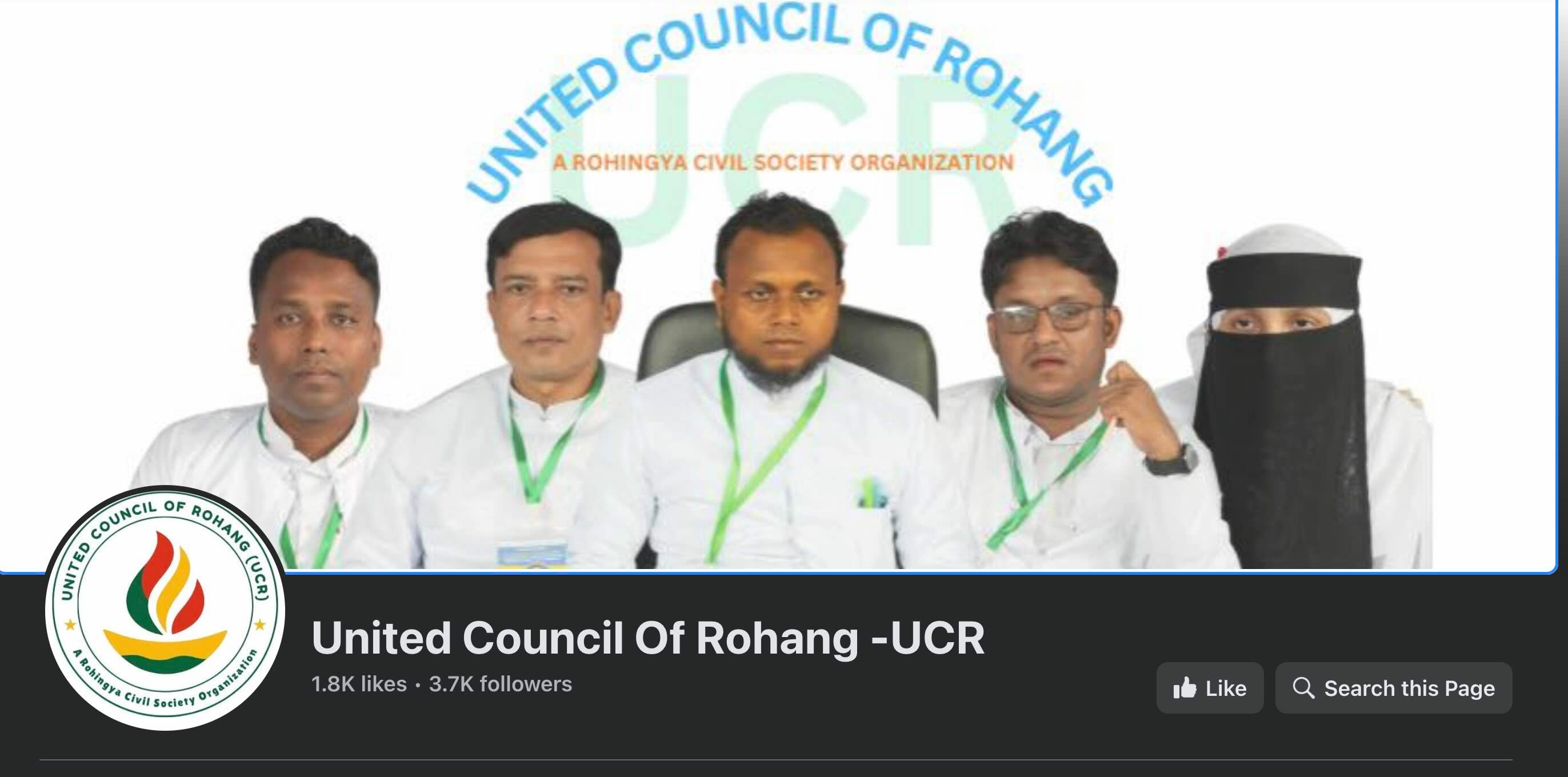
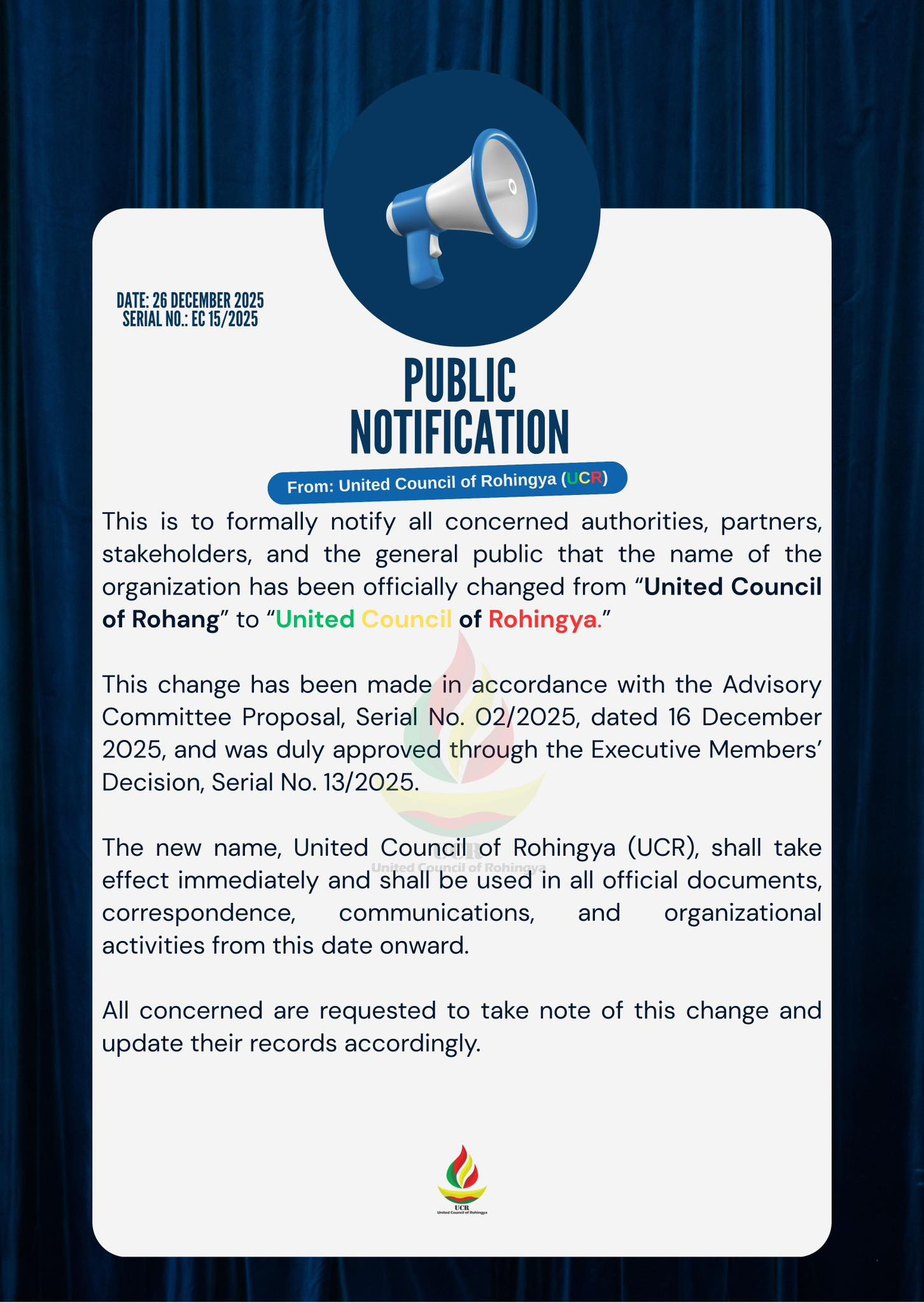
On 26 December 2025, the United Council of Rohang announced that it had officially changed its name to the United Council of Rohingya (UCR). The decision, approved through a series of internal serial numbers and executive resolutions, was presented as a procedural update, effective immediately, to be adopted across all documents and communications. What the notice did not explain is why an organisation that had only weeks earlier invested Rohang with “deep historical and symbolic meaning” now found the term dispensable.
This was the text used by UCR on 23 October, 2025, regarding the name “Rohang”:
This name carries a deep historical and symbolic meaning. Rohang refers to the ancient name of Arakan, the ancestral homeland of the Rohingya people. By adopting this name, the organization reaffirms the community’s enduring connection to its homeland and its rightful place in history. United reflects the shared strength of Rohingya communities inside Myanmar, in refugee camps, and across the global diaspora, while Council represents the collective commitment to consultative, accountable, and principled leadership.
One is tempted to ask the obvious question - did the RRRC finally get tired of explaining to donors, officials, and visiting delegations what Rohang is supposed to mean? Did the burden become too heavy? If Rohang was central to asserting historical continuity and self-representation, how does abandoning it help?
The timing is not incidental. At the time of the name change, the first two Google search results for “United Council of Rohang” were detailed critical articles examining the council’s formation and the RRRC-supervised camp elections.
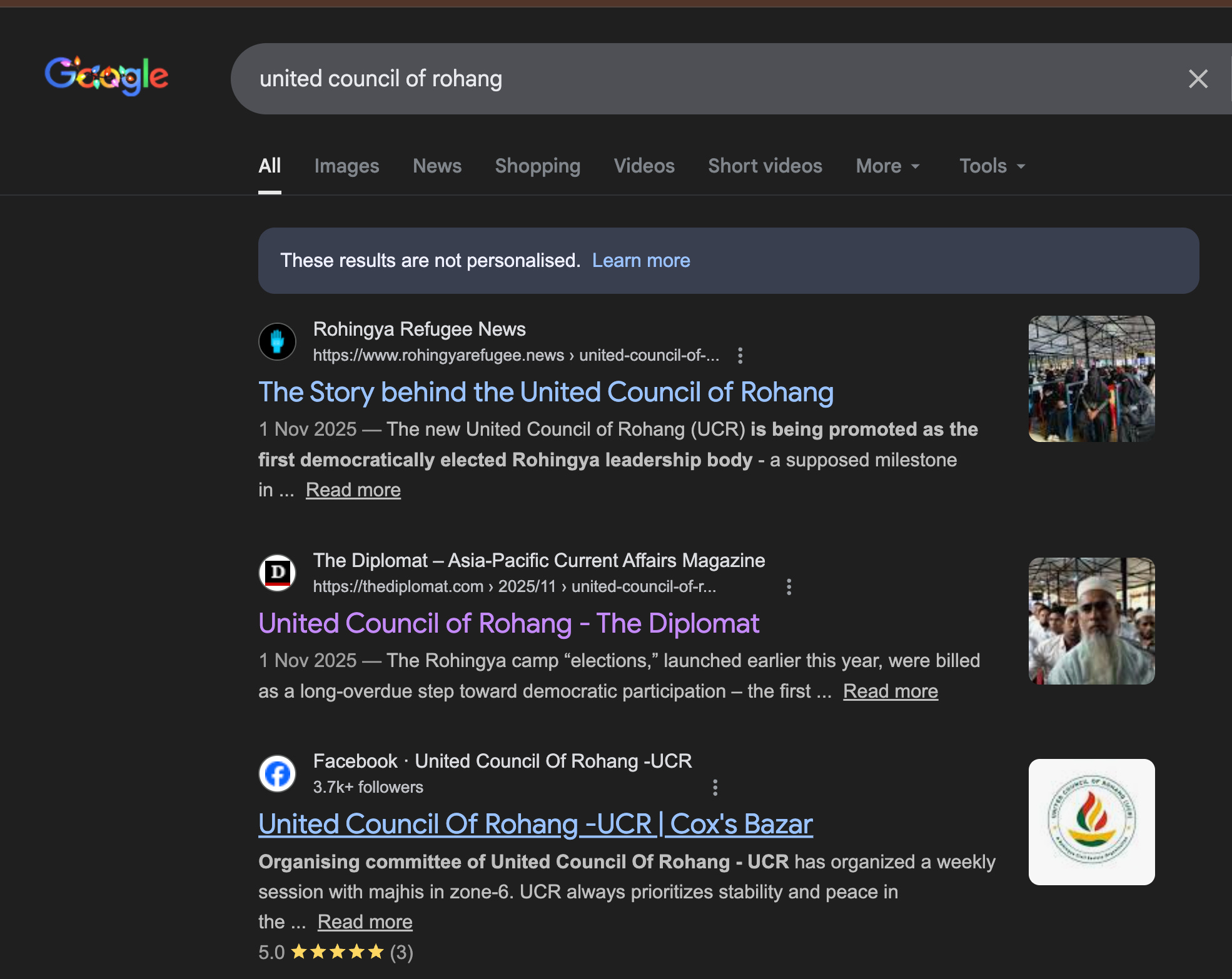
Those articles documented a process shaped by Bangladeshi authorities: fewer than 0.3 percent of refugees identified as voters; executive members inserted, removed, or replaced at the RRRC’s discretion; entire camps boycotting or excluded; and individuals barred without explanation. In that context, renaming begins to resemble not clarification but evasion.
If United Council of Rohang has become too Google-search inconvenient, too closely associated with critique and exposure, then dropping it is a neat way to bury an unwanted paper trail. Reset the name, reset the search results, reset the narrative. Which is why “United Council of Rohingya replaces United Council of Rohang” is not merely a descriptive headline for this article but an accurate one. It is a cosmetic rebrand designed to outrun criticism, while leaving the underlying politics, loyalties, and power arrangements entirely untouched.
This is how the RRRC operates. It does not merely rename organisations; it curates them. Certain groups are elevated when they are useful and when they echo the right language, perform the right rituals, and pose no inconvenience. Then, once they have served their purpose, they are quietly eased into irrelevance and replaced by a newer, more compliant vehicle.
We have seen this cycle before. ARSPH, FDMN-RC, RCPR, and now the United Council of Rohang (oops, I mean Rohingya) - each, at one point, presented as representative, consultative, or indispensable; each later sidelined without explanation, accountability, or reflection. This is governance by rotation! Not representation.
Read more about UCR here.