

Editor’s note: This guest post by Rohingya human rights defender Razia Sultana responds to the Malaysian petition demanding the “removal” of Rohingya refugees. Razia Sultana writes from the perspective of a Rohingya activist and researcher, and connects the petition to a wider regional history of refoulement, trafficking, land loss and erasure.
I am a Rohingya human rights defender, founder of Rights of Women Welfare Society, and member of the UN Women Civil Society Advisory Group. I am the author of Kill Them All, Unravelling the Maungdaw Exodus, and My Nightmare Passage.
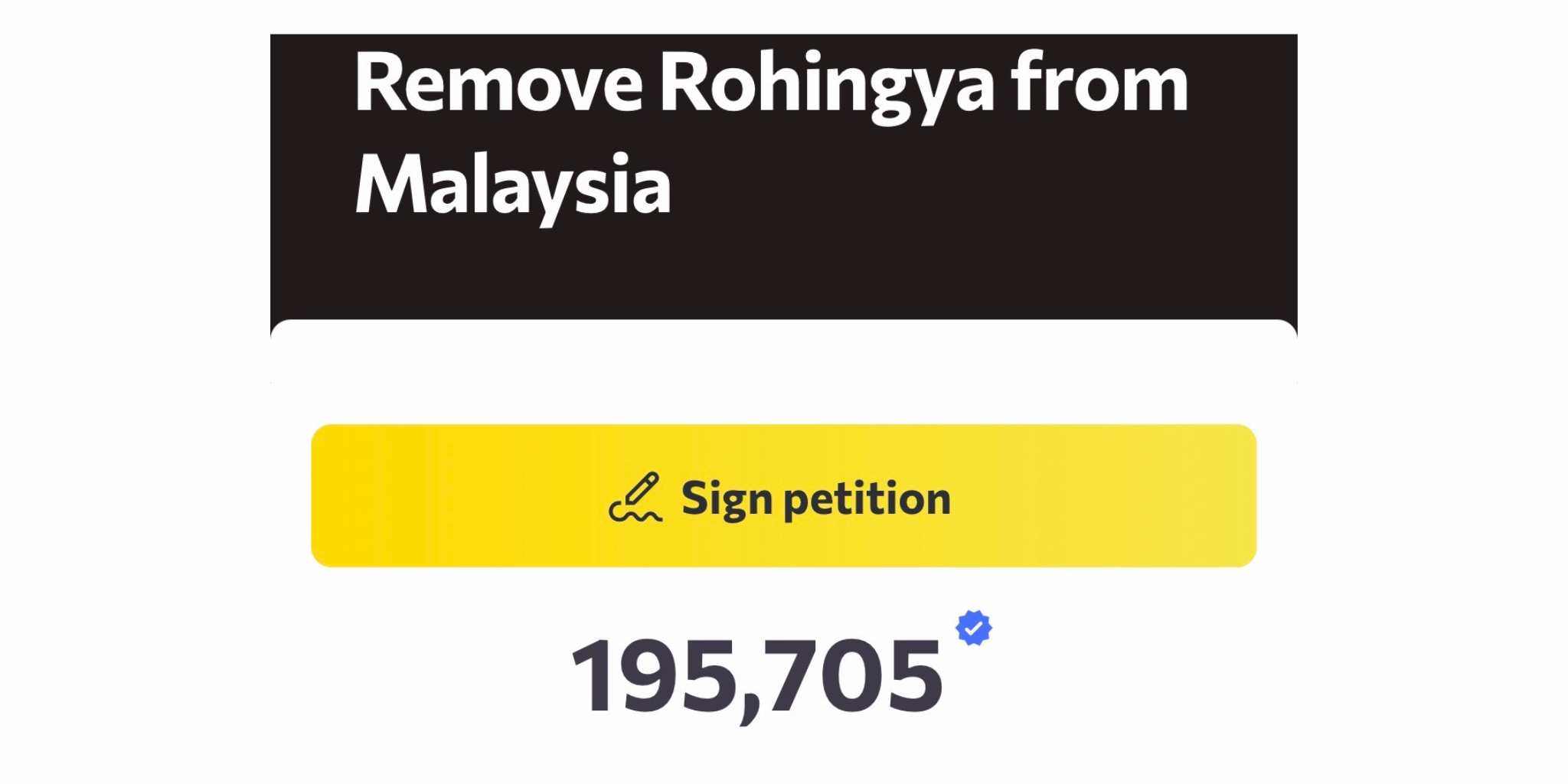
Asking for our rights is not seeking sympathy. It is claiming what we deserve. This is not about empathy. It is about equality. I am writing because 190,000 people (and counting) in Malaysia signed a petition to “remove” my people.
They did not use slurs. They used spreadsheets. They called expulsion “alternative solutions” and “humane”.
But for Rohingya, the word “removal” is never innocent. I documented in Kill Them All and Unravelling the Maungdaw Exodus how the language of removal has accompanied violence against our people. It was there before the villages burned. It was there before people were killed. It was there before families were forced to run again.
“Removal” is not a simple word. It is part of the plan to destroy a people who are now running from country to country to save their lives.
Malaysia’s media broadcasts videos of Rohingya children begging, their faces shown. But it does not ask who organised a 190,000-signature petition to expel genocide survivors. It does not ask why the language of removal keeps returning wherever Rohingya seek shelter.
This is not just civilian anger. Rohingya activists have long warned that anti-Rohingya narratives circulate through regional networks, including extremist and nationalist actors. These campaigns repeatedly label Rohingya as a security threat, as outsiders, as invaders, as people who do not belong.
For Rohingya, this petition is not only a Malaysian issue. It is part of a regional pattern.
A Rohingya-less Rakhine
For decades, the process of vanishing the Rohingya has not been Myanmar’s decision alone. It is a collaborative process.
It was clear in the 2012 Sittwe massacre. Where are the Rohingya of Sittwe now? Our land and coastal resources were taken for deep-sea ports and energy pipelines. Did anyone investigate why it happened? No.
Then came the 2017 exodus from Rakhine. Where are those people? In Bangladesh camps. And their land in Rakhine? Under construction for tourist zones, industrial parks, and resource extraction projects backed by foreign investment. Is there any investigation? No.
So what is happening?
A Rohingya-less Rakhine is a huge project.
It is not just a land grab. It is also a religious cleansing project. Our people will either die or live as slaves because Rakhine is being remade into a Buddhist ethnostate. The Arakan Army now controls much of the territory, but the ideology comes from decades of 969 monk sermons: that Arakan belongs to Buddhists, that Muslims are “invaders”, that a “pure” Rakhine means an “Arakan without Muslims”.
That slogan is now policy. Our land, offshore gas and deep-sea ports fund it. But the goal is religious: erase Islam from Arakan’s soil. Rohingya lives are the price of Buddhist domination.
That is why Malaysia’s petition is a warning. For Rohingya, it feels like a death sentence. Anytime, anywhere Rohingya take shelter, the massacre starts again in the name of national security, border security, or by blaming us as terrorists.
It is very simple mathematics.
In Unravelling the Maungdaw Exodus, I documented how the Arakan Army used the same language of “removal” in operations that burned Rohingya villages between November 2023 and February 2024. The perpetrator changed. The vocabulary did not.
Now Malaysia’s petition speaks that word.
This is not a coincidence. This is the export of a plan.
Wang Kelian, written on paper
Malaysia already has a precedent for “removal”.
In 2015, the mass graves of Wang Kelian exposed the bodies of Rohingya trafficking victims. It showed the human cost of ASEAN’s refusal to grant us legal status.
“Removal” does not end at a border. It ends in an unmarked grave.
This petition is not new policy. It is Wang Kelian, written on paper.
My report My Nightmare Passage documents the chain: when ASEAN states call us “illegal”, traffickers call us cargo. Wang Kelian is where that cargo was buried. I documented survivors who were beaten for ransom in jungle camps, watched others die of starvation, and buried the bodies themselves.
This is what “removal” delivers when states refuse legal protection.
This chain is already moving. In December 2023, mobs in Aceh, Indonesia, attacked Rohingya shelters, dragged refugees from buses, and demanded their deportation. The violence was organised online, then executed in the streets. After Aceh, anti-Rohingya incitement spiked in Cox’s Bazar. Bangladesh contained it, but the pattern is clear: each local attack tests the next country.
Malaysia’s 195,000-signature petition is Aceh scaled up. This is not only public opinion. It is a transnational campaign, one country at a time.
ASEAN’s policy of non-existence
Malaysia’s administration should investigate how this happened. Malaysia is a Muslim-majority country and the current chair of the OIC. How did 130,000 signatures appear to demand the expulsion of genocide survivors?
This is not an issue about Malaysia alone. This is ASEAN’s policy in practice: not non-interference, but non-existence.
ASEAN states do not want to discuss Rohingya. They do not care if Rohingya live or die. They will not admit we exist. Our erasure is their consensus.
The project to erase us is transnational. From India to Sri Lanka to Thailand, well-funded campaigns label Rohingya a “security threat”. The Malaysia petition is not isolated. It is the Malaysian branch of a regional operation with one goal: a Rohingya-less Rakhine.
Yet watch what happens at high-level events, meetings, conferences and UN conversations. Rohingya are the poster. Our photos are used for fundraising. Our suffering is a panel topic. Millions are raised in our name.
But no state is eager to say the root of the issue: Rakhine is our land. We are the people of Arakan. And a transnational project — driven by religion, resources and geopolitics — is erasing us for profit and purity.
We have no voice in those rooms, only our faces on banners. The same governments that host “Rohingya dialogues” deport us, detain us and debate our “removal”.
Malaysia calls us PATI- illegal immigrants - with no right to work, school or healthcare. Thailand pushes boats. Indonesia pushes papers. Both push Rohingya to death: one by water, one by bureaucracy.
There is no humane deportation for genocide survivors. Refoulement is a crime.
We are not new victims. For 250 years, Rohingya have survived cycles of colonialism — British, Burmese, and now a Rakhine power claiming our land. Each era tried to make us slaves or graves. We are still here.
“Removal” is just the latest word for an old crime.
What must happen now
Therefore, I demand:
Malaysia must publicly reject the petition, investigate who organised this incitement to refoulement, and enact refugee protection law.
ASEAN must put Rohingya citizenship and restitution of Rakhine land and resources on the summit agenda. It must suspend Myanmar until it complies with the ICJ provisional measures.
The OIC must audit member states’ treatment of Rohingya and sanction governments using “security” or religion to justify erasure. The Ummah is not a conference theme.
The UN and donors must condition all funding on political solutions in Rakhine, not endless camp maintenance. Stop using Rohingya as posters if you will not defend our right to return.
This is not a Malaysia issue. This is the regional blueprint for our extinction.
Rakhine without Rohingya is not peace. It is conquest — for religion, for resources, for power.
We are not a fundraising prop. We are not a security threat.
We are native to Arakan.
And we will not be erased.

Note: The Problem Is Not Refugees. The Problem Is 10 Years of No Policy in Malaysia.
You’re right about one thing: from the beginning, Malaysia took no clear steps for Rohingya refugees.
No proper direction. No awareness programs. No legal pathway to work or school. No plan for how 108,000 Rohingya can live as refugees and outsiders in Malaysia.
This is not an accident. Malaysia has immigration policies. But for Rohingya, they’re not implemented because of political fear and no binding international policy through the UN.
Look at Turkey. Turkey gave 3.6 million Syrian refugees legal status, work permits, school access. Now many Syrians are doctors, business owners, taxpayers. They are assets, not “parasites.” First-world countries like Germany and Canada do the same.
What about the 108,000 Rohingya in Malaysia? If we got proper opportunity and treatment, we would never be forced into survival choices. Yes, bad people exist in every community. But you cannot punish 108,000 genocide survivors for the actions of a few. And you cannot ignore how traffickers and local syndicates exploit our vulnerability because we have no legal protection.
Malaysia calls us “PATI” for 10 years, bans us from jobs, then blames us for “illegal shops.” This is not a refugee crisis. This is a policy crisis.
The 130,000-signature “removal” petition happened because the state refused to give policy, so mobs filled the gap with hate.
Give Rohingya legal status, work rights, and education like Turkey did for Syrians — and watch us become assets. Keep us illegal, and traffickers, gangs, and extremist petitions will keep using us.
The solution is not “removal.” The solution is policy. And it’s 10 years overdue in Malaysia.
— Razia Sultana
Free speech means you can make a petition. It also means I can call it out when it’s based on recycled lies.
Malaysia doesn’t “owe” Rohingya. But ASEAN owes itself honesty. An election that runs on hate in Myanmar creates refugees. That does become Malaysia’s problem.
“Not a permanent burden”? Exactly. So let’s talk about legal work, resettlement, and safe return. Scapegoating is the opposite of a solution.