

The Norwegian Refugee Council’s press release on the 20 January fire in Camp 16 is careful, factual, and incomplete. It describes what happened.
It does not explain why this keeps happening.
At 3:00am, 335 shelters burned down. Over 2,000 people lost everything. Latrines, water points, learning centres and mosques were destroyed. This is not unusual. Between 2018 and 2025, more than 2,400 fires have torn through the camps, affecting over 100,000 people.
At this scale, fire is no longer a “risk.” It is inevitable. It is structural.
The fiction of “temporary” shelters
Humanitarian agencies continue to describe Rohingya homes as “fragile” or “makeshift,” as if this were a regrettable technical flaw. It is not. Shelters remain flammable because permanence is politically prohibited.
For more than eight years, Rohingya refugees have been prevented from building durable homes, making their own safety upgrades, using fire-resistant materials at scale, expanding, or spacing their shelters.
This is not a funding oversight. It is a policy choice, enforced by the Bangladeshi state and quietly absorbed by the humanitarian system. Temporary shelters are not temporary anymore. They are permanent temporariness, designed to last just long enough to justify not improving them.
Overcrowding is not natural!
It is enforced. The NRC statement points to “densely packed structures” as if density were an environmental condition. In reality, refugees are confined to camps where movement is restricted and livelihoods are blocked. Relocation outside the camps is prohibited.
Therefore, overcrowding is not accidental. It is the architecture of containment. The camps function less as humanitarian spaces and more as zones of warehousing a surplus population where risk is externalised onto refugees.
When shelters burn, people are not rehoused. They are displaced sideways, into relatives’ huts, further increasing density and risk. Fire does not reset the system; it tightens it.
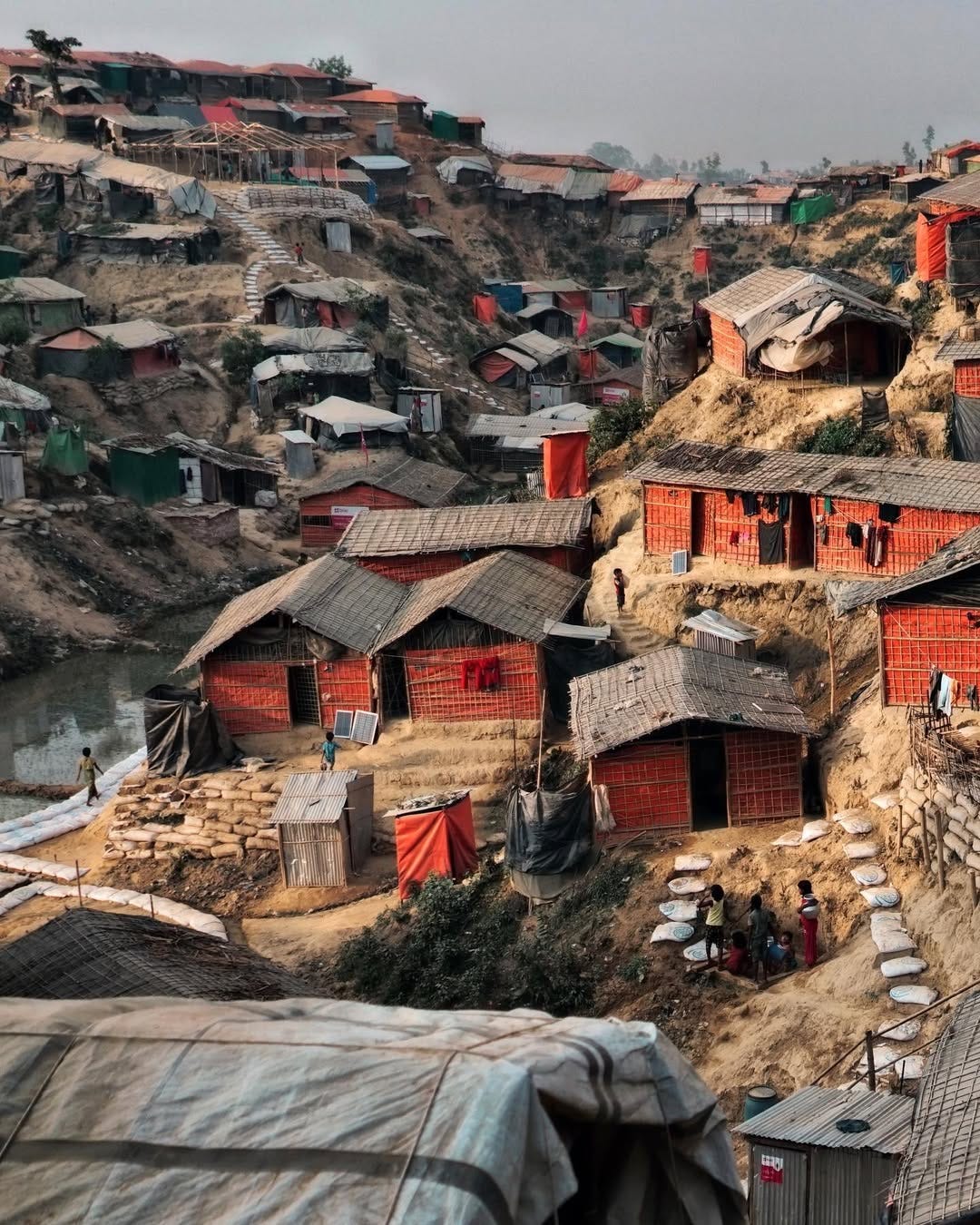
I posted the above photograph on Instagram in September 2020, along with others like it. Nothing here is accidental. This hillside camp is densely built, with shelters cut into steep slopes and packed along narrow footpaths. The structures are made from bamboo and plastic sheeting, leaving no buffer against fire and no clear routes for escape. Such layouts were permitted and maintained year after year. Fires in the camps are therefore not isolated incidents but structural consequences.
Fire is the predictable outcome of this arrangement, not an unforeseen disaster. What burns is not just shelters, but the fiction that this is a humanitarian failure rather than a policy choice. Aid agencies, like Care, speak of fire prevention and awareness, but this is the environment in which refugees are expected to stay safe. Training cannot compensate for a system that refuses permanence. Until that changes, the camps will keep burning.
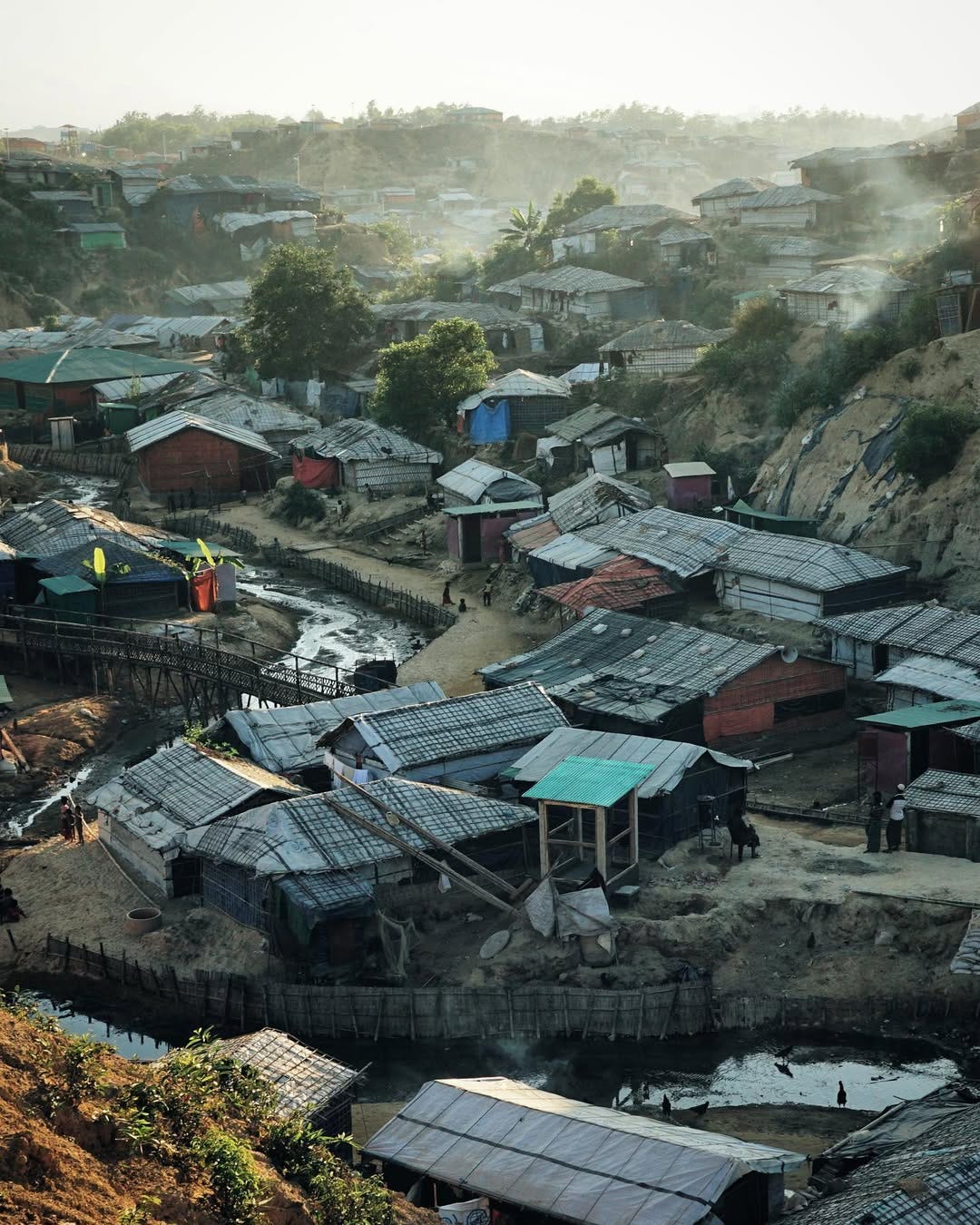
If the hillside shows how density is forced uphill, this image shows how it is forced downward. Shelters fill the drainage channels and low ground, leaving no buffer against water, fire, or collapse. The camp expands into every available space because people are not allowed to build differently. Risk is not accidental here; it is cumulative.
The funding crisis as excuse
The press release repeatedly invokes the 2025 funding cuts, suggesting that safer shelters would exist if only donors had paid. But this framing obscures a deeper truth. That is, donors fund containment, not resolution. Aid sustains biological survival, not safety or dignity. Shelter is underfunded precisely because it signals permanence
Only 19.6% of required shelter funding was delivered in 2025. This is not an accident. It reflects an international consensus, unspoken but rigid, that Rohingya lives must be maintained cheaply and temporarily, not rebuilt properly.
Humanitarian funding does not fail randomly. It follows political priorities. I am not saying funding crises don’t matter. Funding crises matter because aid substitutes for rights.
Approval of semi-permanent shelters?
The approval of three semi-permanent shelter designs in December 2024 was presented as progress. But approvals without funding timelines are not solutions. They are gestures. The result is familiar. Designs are approved. Construction is stalled. Fires continue. Appeals are repeated.
This cycle allows all actors to express concern while nothing structurally changes.
What to call all this?
We have a situation where shelters are flammable by design, density is enforced by policy, movement is criminalised, and rebuilding is delayed indefinitely. In this situation, then, fire is no longer a disaster.
It is structural violence - predictable, recurring, and tolerated.
The Bangladeshi state has systematically restricted permanence to avoid any signal of settlement. Shelters are kept intentionally temporary to preserve the repatriation fiction.
Rohingya refugees are not merely victims of flame. They are victims of a system that accepts burning as a manageable cost of containment. Fires recur because risk is cheaper than reform.
The real question is not how do we respond to the next fire? It is, why are Rohingya refugees still forced to live in conditions where fire is inevitable Until that question is answered honestly in political, not humanitarian, terms, Camp 16 will not be the last camp to burn.
Join my WhatsApp Channel for news, documents, videos and images.