

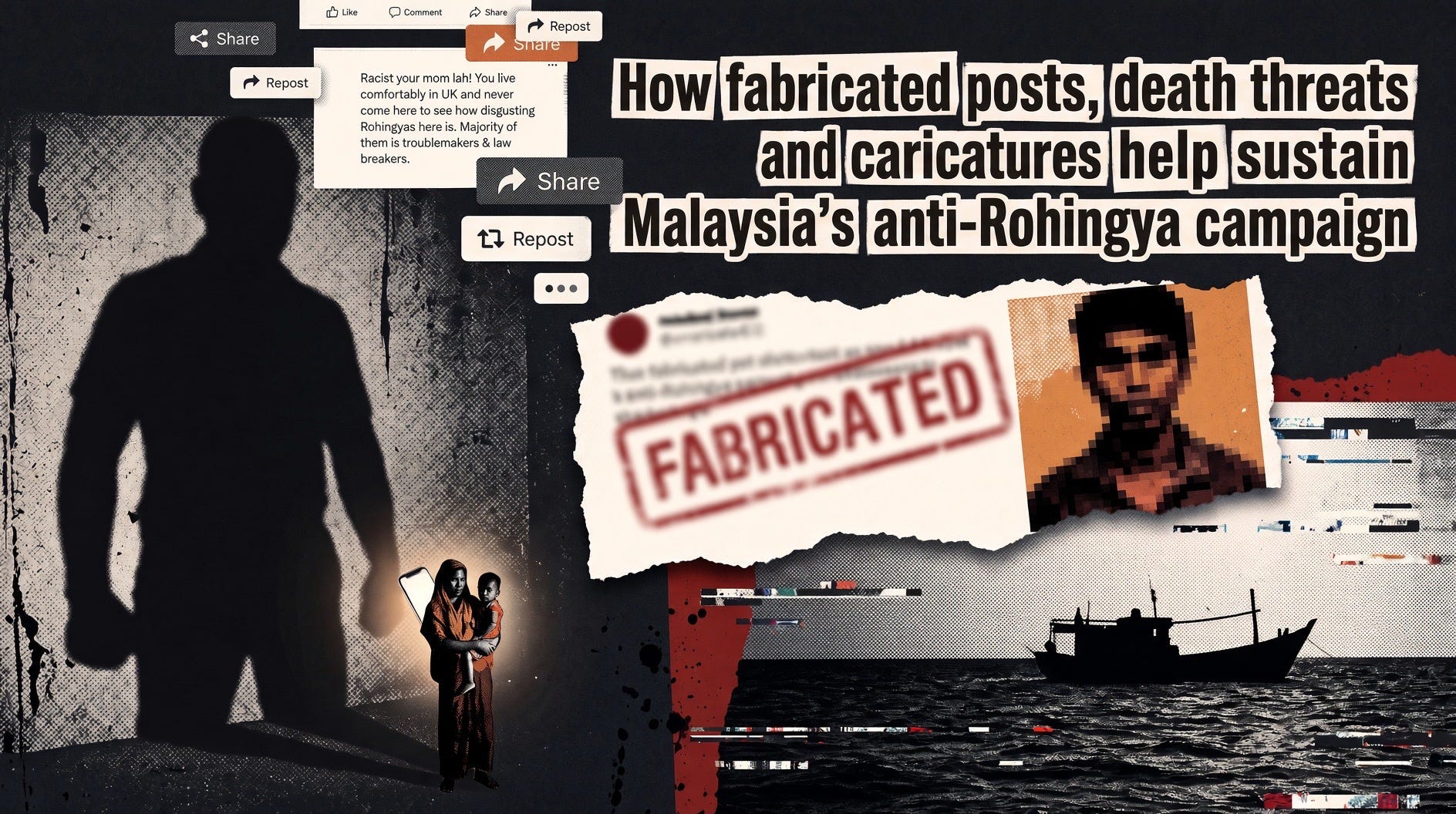
Malaysia’s anti-Rohingya hate campaign increasingly depends on manufacturing enemies. Someone makes up an inflammatory quote or a fake political demand. Then a real person’s name is attached to it ( usually a person, not an organisation), setting off a wave of outrage against both the individual and the wider community. Here is my experience of it.
Last Sunday, someone contacted me by DM on X to say that Malaysian social media users were accusing me of making inflammatory remarks about Malay rights on Threads. I had some inkling about this. There had been a few strange posts on my X in replies to my posts. I followed the link he sent and found a post circulating with a screenshot of what purported to be a tweet from my X account.
It had attracted thousands of likes. According to the screenshot, I had declared that Malay and Bumiputera special rights were racist, that they prevented Rohingya from enjoying full rights in Malaysia, and that I intended to take the matter to the United Nations to have those rights abolished. Here is the post - posted by someone whose handle is drkrum.
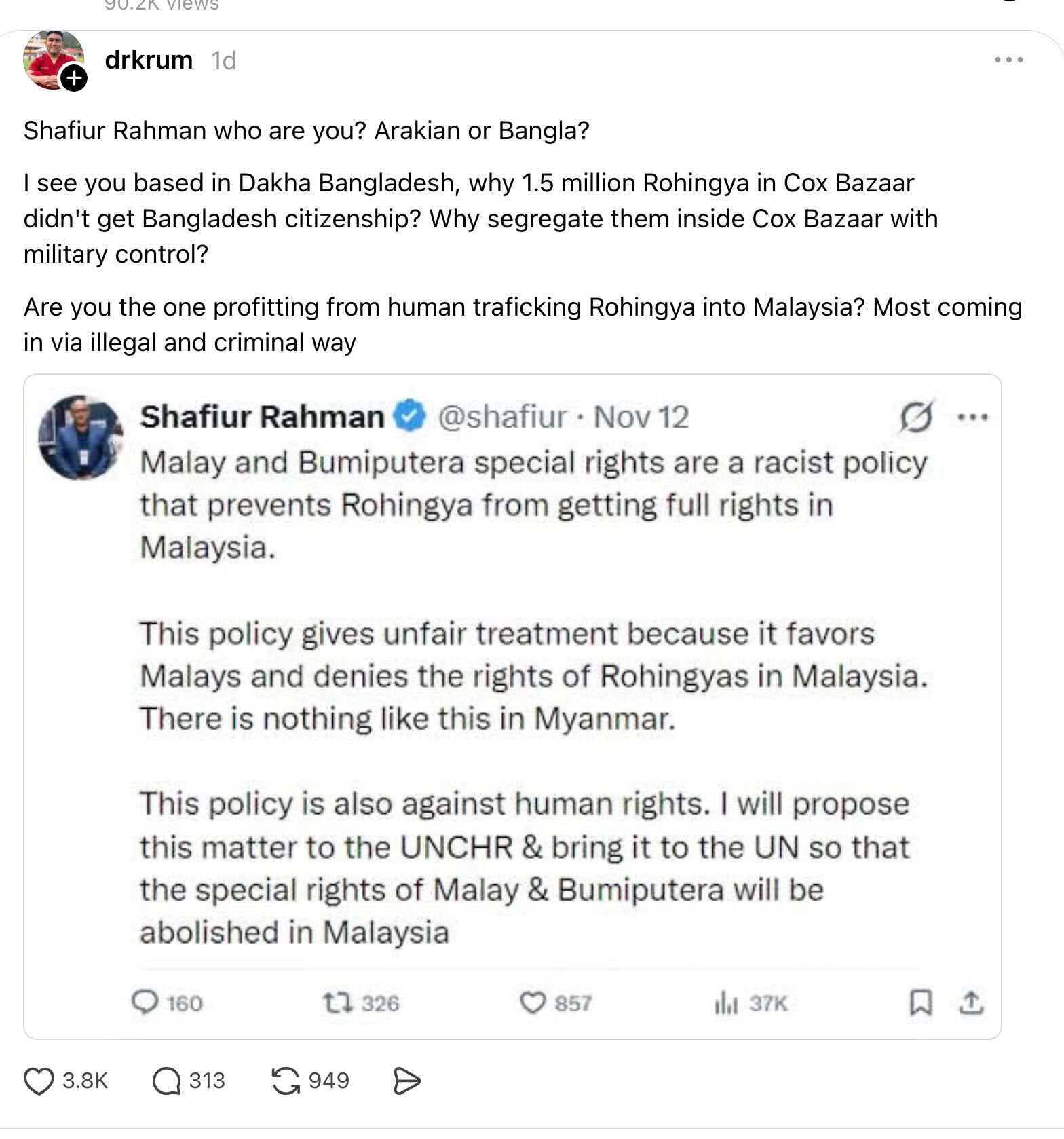
There was just one problem. I had never posted any such thing.
The fabrication was ridiculous on several levels. For a start, the English was not mine. They used American spelling, which I never do. They also misspelt the UN refugee agency as “UNCHR” and made it sound like I have enough pull at the UN to abolish constitutional privileges in Malaysia! Anyone who follows my reporting or knows about my tense relationship with UNHCR would laugh at the idea.
On top of that, the fake tweet claimed Myanmar has no comparable discriminatory policies. Having spent years talking about Myanmar’s persecution and systematic exclusion of the Rohingya, I can’t think of a more absurd claim to pin on me. But absurdity is no obstacle here. They just need the intended audience to work themselves up into a lather and get angry. This is the main objective of the fabrication.
Another feature about the fabricated X post of mine - there is a revealing connection between it and something I actually did. In June, I publicly challenged a Change.org petition that was calling for Rohingya refugees to be removed from Malaysia. I wrote to the platform demanding that it take down the petition, which had attracted hundreds of thousands of signatures. And I posted that I had done so on X.
My intervention generated considerable attention in Malaysian mainstream and social media. That was enough to unleash a torrent of racist abuse. I was told to mind my own business because I lived abroad. I was called a bastard, a dog and worse. One X user wrote, “We will kill you Shafiur Rahman.” Another ordered me to shut up because I was not Malaysian. The screenshots accompanying below are a small sample. There were also attempts to hack my instagram and Facebook.
Notice the trick in the new fabrication. My real complaint to Change.org about an anti-Rohingya petition is used as a template. It gets transformed into an imaginary campaign to abolish Malay privileges through the UN. Basically, they put the exact demand in my mouth that anti-Rohingya groups have been falsely pinning on refugees for years.


Before I go further, I do not pretend that the threats against me compare with what Rohingya advocates themselves have endured. Zafar Ahmad Abdul Ghani, who heads the Myanmar Ethnic Rohingya Human Rights Organisation Malaysia (MERHROM), has faced years of harassment and false accusations. In September, Malaysian authorities went further, charging him under the Societies Act over his involvement in an unregistered refugee organisation. Then there is Noor Azizah, the Rohingya activist now living in Australia, who faced an extraordinary and vicious wave of abuse after speaking publicly about the treatment of Rohingya refugees in Malaysia. Her testimony was treated by many as an insult to the Malaysian nation.
The message to refugees in Malaysia is blunt - stay quiet and be grateful. Speak up about basic rights, and you are suddenly a threat to national dignity.
None of this needs to be centrally organised to make it dangerous. We need to record how the current hostility is being manufactured and sustained. One person fabricates a claim. Others circulate it, and soon a completely invented accusation is being treated as established fact.
We are watching petitions call for expulsions while rumors spread that Rohingya seek Malaysian land or political entitlements. At the same time viral posters label undocumented migrants a "cancer", and politicians excuse violent pushbacks at sea as legitimate border control. Not only public figures, but even so-called Malaysian human rights organisations.
The fabrication attributed to me comes straight out of the same playbook. It gives people fake "proof" that the Rohingya and their supporters are conspiring against Malaysia. That proof doesn't actually have to hold up under scrutiny. As I mentioned earlier, it just needs to spread fast and feed into existing prejudices. Fact-checks always arrive too late. The abuse and deportation demands have already started.
Rohingya and Israeli Settlers
One of the strangest tactics in this campaign is comparing Rohingya refugees to Israeli settlers. Across Malaysian social media, believe it or not, users are framing the Rohingya as colonisers out to steal land and displace locals. In reality, the Rohingya have had their citizenship stripped and are facing the exact kind of dispossession Malaysians rightly condemn in Palestine. Yet many of the same people championing Palestinian rights have no problem demanding that Rohingya refugees be driven out of neighbourhoods, denied housing and jobs, beaten up or turned back at sea.
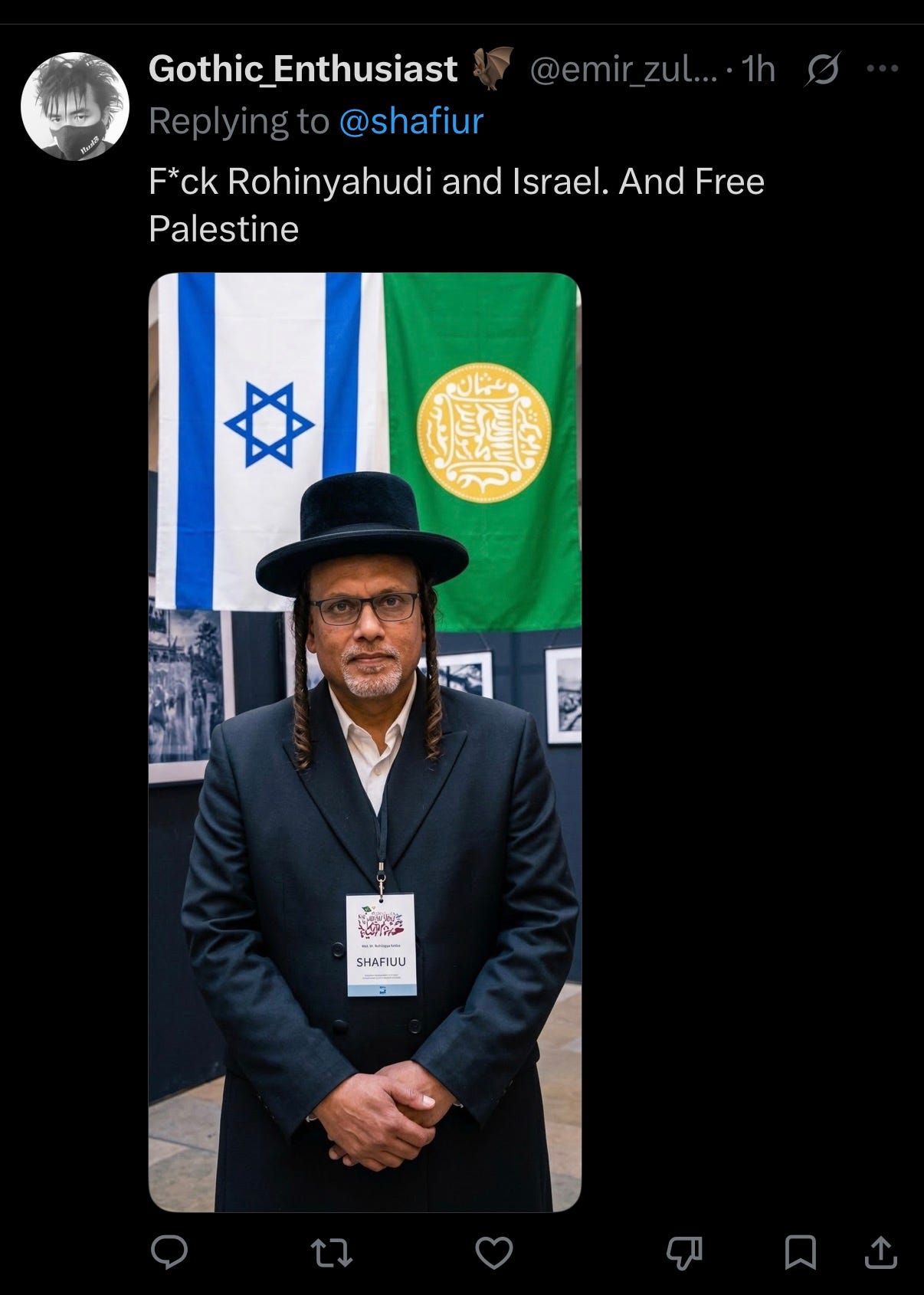
Naturally, the next step was to turn me into some sort of Jewish or Zionist conspirator. One particularly grotesque response used the expression “Rohinyahudi,” a fusion of Rohingya and Yahudi, the Malay word for Jew. See the image above. There I am depicted as a caricatured Orthodox Jew, complete with hat and sidelocks. I am posed before an Israeli flag and the Rohingya flag (well, commonly understood as a Rohingya flag). Jewish religious appearance is imposed on me as a means of ridicule and discrediting my work.
There is nothing inherently objectionable about Orthodox Jewish dress, of course. The antisemitism lies in using that appearance as an insult. Jewishness is made into something sinister, something to expose and condemn.
The accompanying message declared hostility towards “Rohinyahudi and Israel” while proclaiming “Free Palestine.” Apparently, showing solidarity with one oppressed group means attacking another and, of course, dressing their supporters up in Jewish caricatures. And there is a reason for that.
Naked racism against destitute refugees looks ugly and un-Islamic, especially in a country that prides itself on humanitarian solidarity. By recasting stateless refugees as "Israeli settlers," perpetrators launder ordinary anti-migrant hostility into a noble, anti-colonial act of self-defence. It allows them to attack the vulnerable while feeling like they are fighting powerful dark forces.
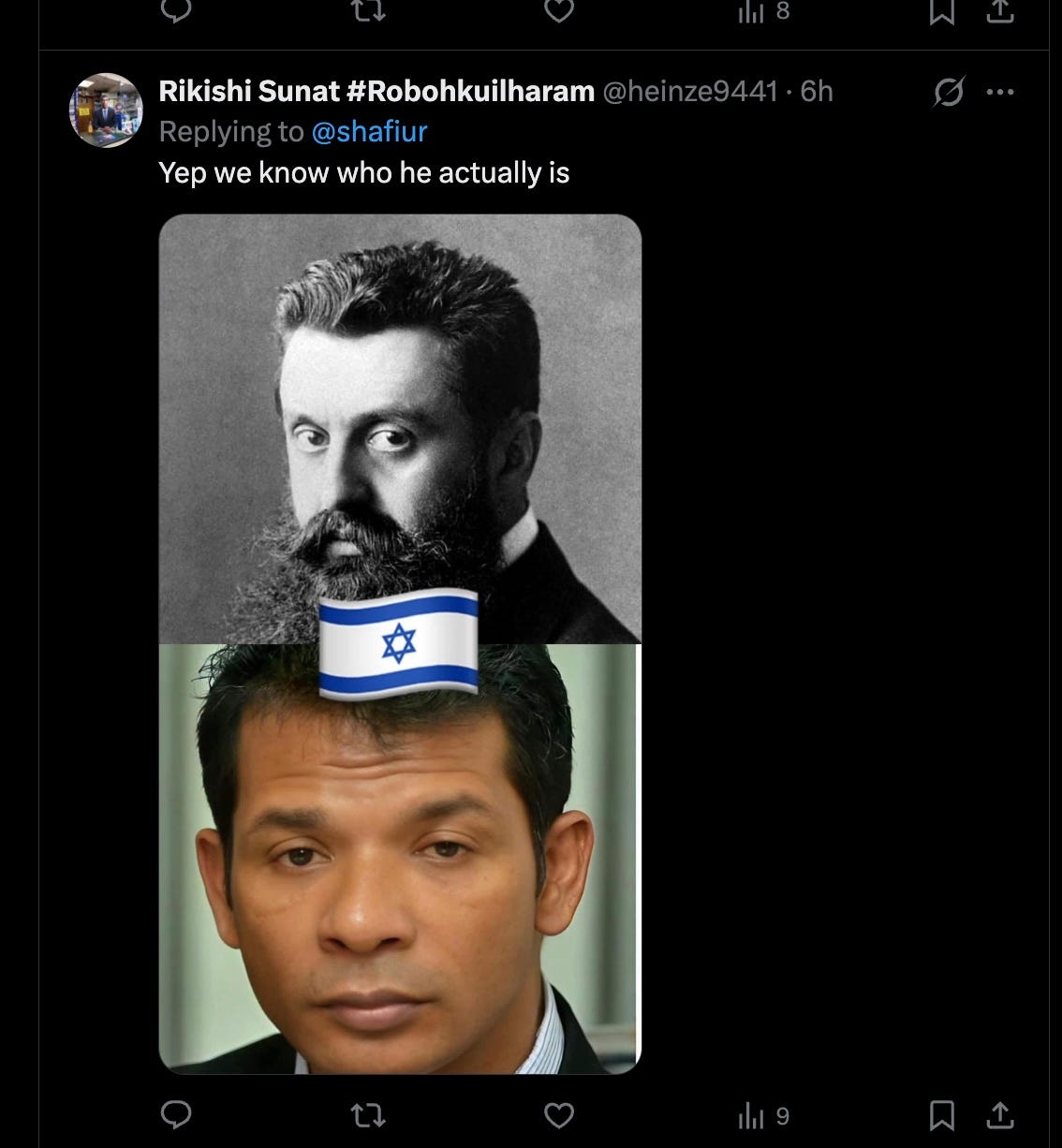
Zafar has already had this kind of treatment. See the image above. The meme's meaning is quite explicit. It puts the historical figure of Theodor Herzl above Zafar. It attaches an Israeli flag to Zafar's head, and accompanies it with “Yep we know who he actually is.” It is portraying Zafar as a kind of Rohingya Herzl - not simply a refugee advocate but the supposed architect of a settler project inside Malaysia. This is worth noting because it helps explain what the frequently observed posts saying “Malaysia will become another Gaza” mean within this particular anti-Rohingya discourse. The Rohingya are being assigned the role of Zionist colonisers, Malaysians the role of the indigenous population threatened with displacement, and Zafar the role of Herzl.
Together, they show how the rhetoric moves between anti-Zionism, antisemitic stereotyping and anti-Rohingya hostility.
The Real Danger of an Invented Threat
The larger problem is not that someone has fabricated a tweet of mine. I have the platform to call it out and move on. Also, I don’t live in Malaysia. Rohingya refugees in Malaysia have no such protection. They have to live with the real-world fallout when the false accusations start to drive demands for their expulsion.
None of this - not the fake post or the grotesque caricatures - is just random social media noise. There’s a clear pattern at work - conjure up a dangerous Rohingya or Rohingya advocate to scare the public. Once people are scared, cruelty toward ordinary refugees starts looking like national self-defence or some badge of honour. The individuals sharing this material may convince themselves they are protecting the country. In reality, they are just demonstrating how cheaply a vulnerable minority can be scapegoated.
Join my WhatsApp Channel