

The United Council of Rohingya (UCR) has been holding a series of meetings in the camps in recent weeks. (Should you need a reminder of what UCR is - here is an explainer). Photographs circulated on social media show large gatherings of men seated inside bamboo halls while speakers address the audience from a long table. The organisation says the meetings involve “strategic discussions regarding the safety and dignified return of Rohingya people to Arakan.”
But the images themselves tell another story.
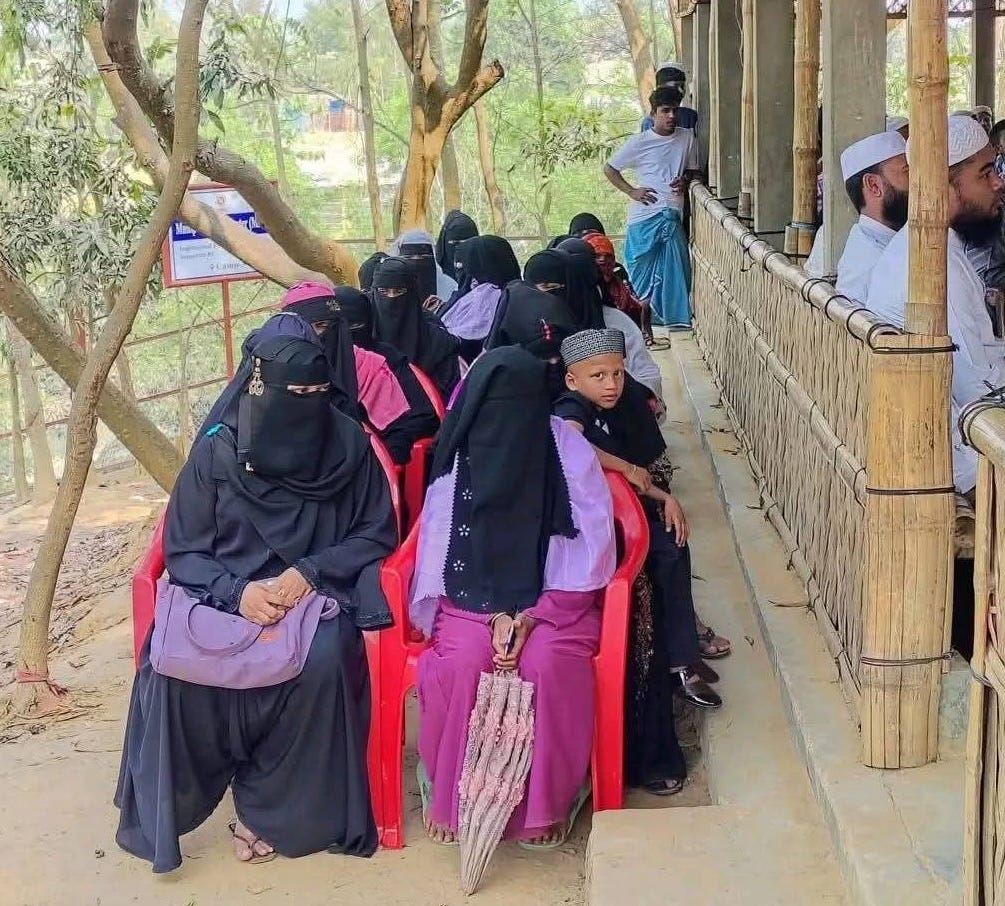
In one widely shared photograph, dozens of men sit inside the meeting venue listening to speeches. Outside, along the edge of the building, a group of Rohingya women sit in a row of plastic chairs under the trees. They appear to have been invited to attend the meeting but were not given space inside. They are also seated perpendicular to the meeting, not facing it.
The contrast is difficult to miss. The discussion about the future of an entire people takes place indoors, while the women sit outside.


One Rohingya youth, Mohammed Fahad Ali, posted a blunt comment beneath the image:
“If you cannot provide them enough space inside, why did you call them to attend the meeting? The whole world gives women a front seat in meetings and conferences. What kind of behavior is this?”
The photograph of the women later disappeared from the UCR page. I asked Khin Maung, one of the presidents of UCR what this was all about. He has not answered as yet.
Deleting the comments
The complaints did not stop there.
Several Rohingya who attempted to question the organisation in the comment section say their remarks were removed. One commenter wrote:
“UCR deletes if you mention the truth.”
He said he had suggested improvements and asked questions about the meeting, but his comment was deleted instead of answered.
For some observers, the issue is not simply about one meeting or one photograph. It raises a larger question - how an organisation claiming to represent more than a million Rohingya handles criticism from its own community.
“If we cannot give suggestions or speak honestly,” the commenter wrote, “who gave them the authority to represent 1.2 million Rohingya people?”
UCR signs off its statements with the slogan “For Unity, Accountability, and Community Strength.” For many Rohingya observers, the question remains who exactly is being unified, who is accountable to whom, and where the community sits in that arrangement.
The familiar pattern of camp politics
Another criticism relates to the selection process for representatives. According to community members, UCR asked block-level leaders, known as majhis, to nominate five individuals from each block.
But some refugees say the process quickly reproduced the same problems that already exist in camp governance.
In Camp-5, community members reported that certain majhis selected relatives, sons and close associates instead of holding a broader consultation.
One Rohingya woman, Alisha Noor Aziz, wrote publicly to the UCR leadership asking them to review the process:
“Many vulnerable families feel they were not given a fair opportunity and that power is being misused.”
The complaint echoes a familiar criticism of camp governance structures - that is, representation often circulates within small networks of influence rather than emerging from open community participation.
Meetings without results
Others have raised a more fundamental question - what do these meetings actually achieve.
One Rohingya commentator put it bluntly:
“Years continue to pass, meetings increase, but meaningful results are rarely seen.”
Photos are taken. Statements are issued. Speeches are delivered. But for ordinary refugees, daily life in the camps remains largely unchanged.
The criticism reflects a growing frustration inside the camps. Many Rohingya say they see a constant stream of gatherings in the name of advocacy, consultation or coordination, yet very little visible progress on the issues that matter most to them - protection, rights, and a credible path to return.
Representation or performance?
The controversy also touches on a deeper question about the role of organisations like UCR inside the humanitarian system.
In earlier reporting, I noted how UCR leaders publicly supported changes introduced by Camp-in-Charge officials, including the replacement of the traditional majhi system with small committees selected by the authorities. You can read that post here:
The United Council of Rohang's New Role in the Rohingya camps

They are no longer pretending. The leadership of the United Council of Rohang (UCR), born from an already compromised “election” process earlier this year, is now actively aligni…
At the time, UCR joint president, Khin Maung, praised the initiative and promised to support its implementation across the camps.
That language sounded less like independent community representation and more like an organisation helping to legitimise administrative decisions already made by the authorities. (After I asked Khin Maung if it will further concentrate power - he deleted his post…notice the pattern?)
The latest meeting photos, and the complaints that followed them, reinforce a similar impression. The meetings are well organised. The gilets and banners are printed. The speeches are delivered. The photographs circulate.
But for many Rohingya watching from the camps or, in the case of the women in the photograph, from just outside the meeting hall, the exercise increasingly looks less like representation and more like performance.
More about UCR HERE.
Join my WhatsApp Channel for news, documents, videos and images.