
The United Council of Rohingya (UCR) is a Rohingya organisation formed in 2025 following a series of refugee camp “elections” in Bangladesh. Until late December 2025, the organisation operated under the name United Council of Rohang, a term it publicly described as carrying “deep historical and symbolic meaning” connected to Arakan, the Rohingya homeland.
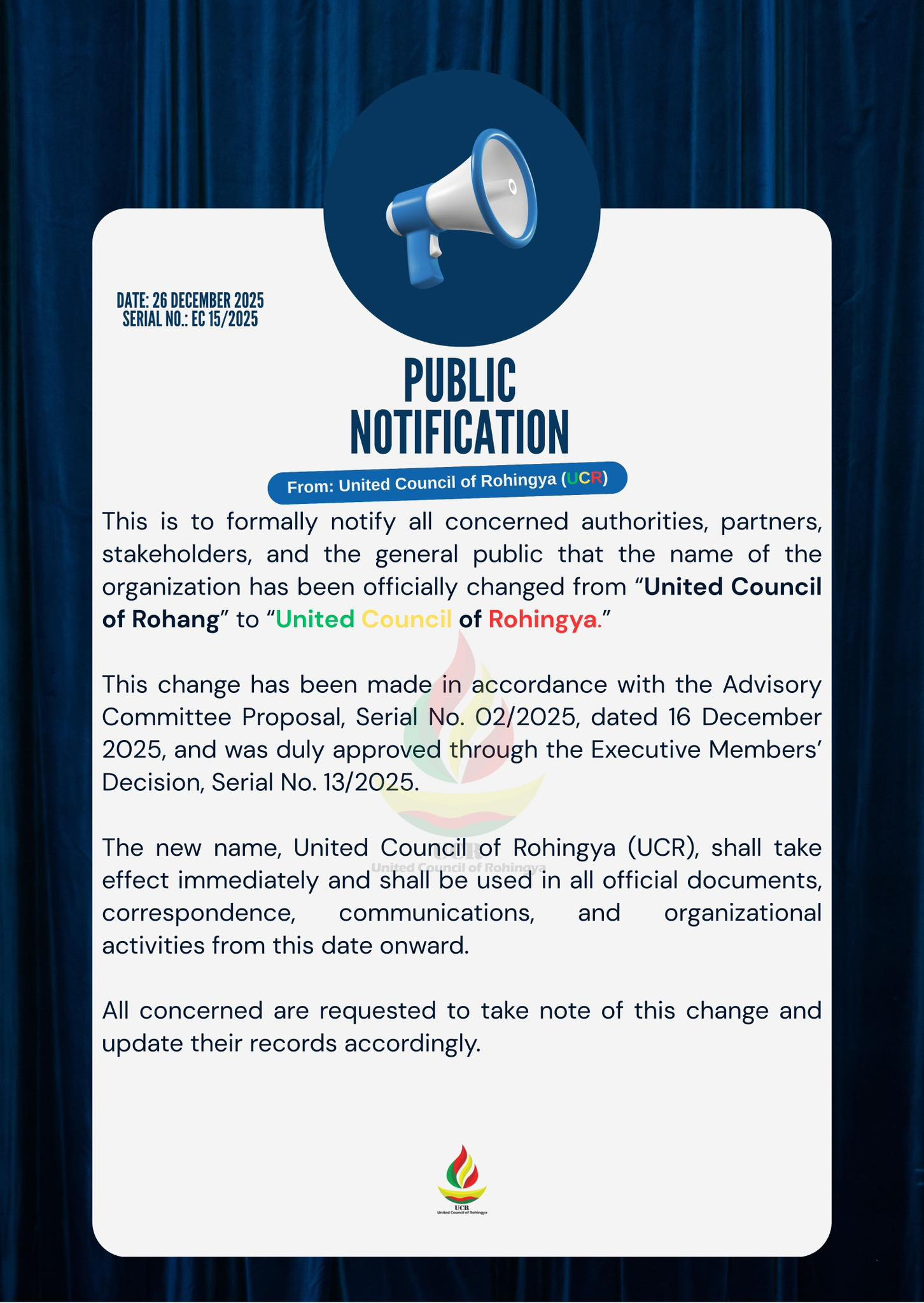
On 26 December 2025, the organisation issued a public notification announcing that it had changed its name from United Council of Rohang to United Council of Rohingya, with immediate effect. The notice cited internal advisory and executive decisions but offered no public explanation for why a name so recently defended as historically significant was abandoned.
How the council was formed
The council emerged from a camp-level electoral process that was formally approved and overseen by the Refugee Relief and Repatriation Commissioner (RRRC). The process was presented as a milestone in Rohingya self-representation. However, figures released by the organising committee showed that fewer than 0.3 percent of the Rohingya population in Bangladesh were identified as voters.
From this limited pool, several hundred counsellors were selected, who then chose a small executive body. Multiple refugee communities reported boycotts, exclusions, and last-minute interventions, including the removal or insertion of executive members and the barring of elected representatives. No elections were held in some locations, including Bhasan Char.
Oversight and constraints
The RRRC described its role as that of an “observer”. In practice, the environment in which the elections took place was highly securitised, with meetings, movements, and assemblies requiring official permission. In such conditions, oversight effectively shaped the process itself.
Following the council’s formation, its leadership held meetings with aid agencies and international organisations, positioning the body as a legitimate interlocutor for “Rohingya-led engagement” and localisation initiatives.
The name change
When the council adopted the name United Council of Rohang in October 2025, it explicitly framed the choice as a reaffirmation of history, identity, and principled leadership. Just over two months later, the term Rohang was dropped without explanation.
Some Rohingya commentators quietly noted that the term Rohang has been popularised in certain militant-aligned circles in recent years, and questioned whether a historical geographic label was an appropriate name for a representative body claiming to speak for the entire Rohingya community.
At the time of the rebrand, public searches for the organisation’s former name prominently surfaced critical reporting examining the legitimacy of the elections and the degree of administrative control involved in the council’s creation. The organisation has not addressed whether these concerns influenced the decision to rename.
Why the rebrand matters
Names do not confer legitimacy, but rebrands can reshape visibility. The change from Rohang to Rohingya did not alter the council’s structure, leadership, or relationship with authorities. It will, however, reset how the organisation appears in public records and search results.
The episode fits a broader pattern in which Rohingya representative bodies are endorsed, curated, and later sidelined within a tightly controlled governance framework. Previous groups promoted as interlocutors have included ARSPH, FDMN-RC, and RCPR.
The core issue
The central question is not what the council is called, but who it represents and who it answers to. Genuine representation requires the freedom to organise, dissent, and hold leaders accountable. Those conditions do not currently exist in the camps in Cox’s Bazar.
Until civic space is enabled and participation becomes meaningful rather than curated, changes in name or structure will amount to administrative rotation rather than democratic representation.
All related reporting can be found here.
Key Reporting:
The Story behind the United Council of Rohang
The United Council of Rohang’s New Role in the Rohingya Camps
How the United Council of Rohang is Planning to Police Rohingya Thought
United Council of Rohingya replaces United Council of Rohang