

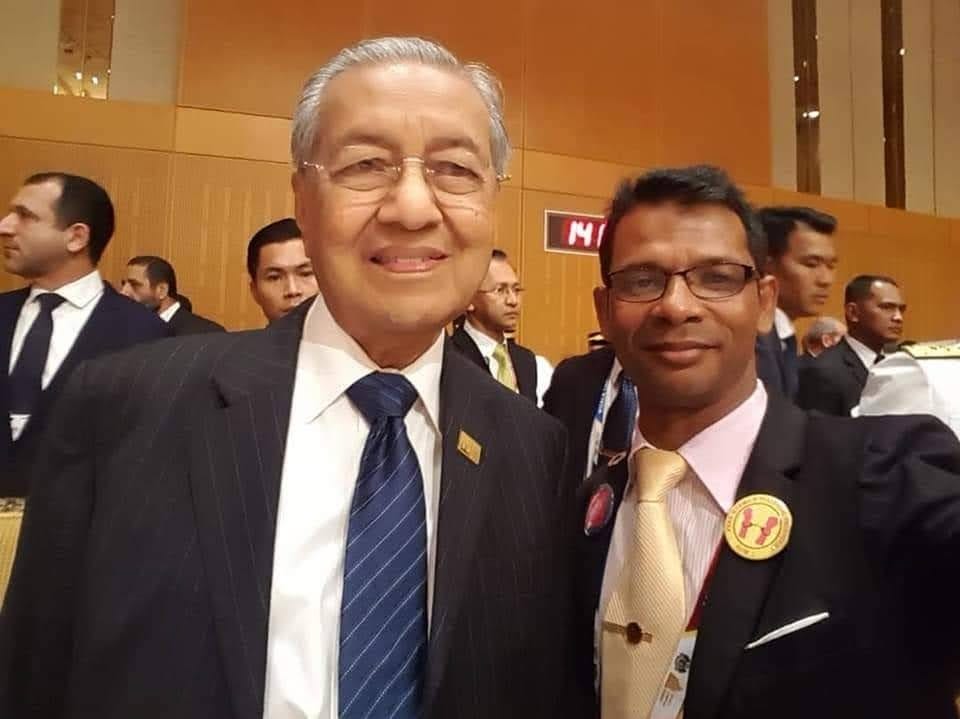
On 2nd October, I received an email from Shwe Maung, Chairperson of the Arakan Rohingya National Congress and former Member of Parliament (2010 – 2015) for Buthidaung Township, Arakan State, Myanmar.
It was a strange email. His media release is a plea to the Malaysian government, basically capitulating on behalf of Zafar Ahmad Abdul Ghani, the Rohingya human rights defender in Malaysia who has recently been charged under Malaysia’s Societies Act 1966 in connection with an unregistered organisation.
Shwe Maung does not challenge the absurdity or proportionality of the prosecution case. He does not ask why a long-established Rohingya activist is suddenly being criminalised for running an “unregistered” organisation. Nor does he demand that the charges be dropped. There is no defence of Zafar’s right to continue doing the work he has done publicly for decades - in the course of which he crossed paths with three Malaysian Prime Ministers, many ministers and other dignitaries. He does not ask why MERHROM’s public advocacy was tolerated for years if it was such a crime. He does not pushback against the state suddenly treating that work as criminal.
Instead, Shwe Maung carefully genuflects to Malaysian law and the judicial “process,” if it can be called that, then skips straight to some pathetic pleading - please don’t deport him to Myanmar; if Malaysia won’t keep him, let UNHCR find another country. Shwe Maung would rather that the central injustice is left untouched and, in Zafar’s case, makes banishment sound like an acceptable solution to prosecution.
Meanwhile, the man himself, Zafar, has pleaded not guilty and presumably intends to fight the case!
That is the same pattern I observed in the 2020 statement of a couple of Rohingya organisations I recently found: be deferential, reassure the government, praise and thank the government, avoid confrontation, and seek protection through accommodation. Take a look at the statement:


You will see that RWDN and ELOM bend over backwards to reassure Malaysians. The statement was signed by two very high profile Rohingya activists - Sharifah Shakirah and Sujauddin Karimuddin. Let me summarise the statement briefly - Rohingya do not want citizenship, they do not want rights beyond what Malaysian law permits, they have no intention of settling permanently, they are grateful guests, they respect the law, they pray for Malaysia’s wellbeing. They even go out of their way to distance themselves from Zafar, calling him a “self-proclaimed leader” and stressing that he is not an elected representative of the Rohingya community.
The striking thing is that, based on the contemporary record, Zafar does not appear to have actually done the thing for which those organisations were distancing themselves from him.
The immediate trigger was 21 April 2020, in the middle of the Covid lockdown and a furious Malaysian backlash after the navy had turned away a boat carrying Rohingya. MERHROM issued a statement calling on the UN, ASEAN and world leaders to protect Rohingya and act against human traffickers. According to a later communication by four UN Special Rapporteurs, an unknown Facebook account then circulated the statement while urging Malaysians to attack Zafar online; another account posted his photograph and falsely claimed that he was demanding full Malaysian citizenship for Rohingya. His contact details circulated and his Facebook account was inundated with roughly 20,000 comments, threats and abuse.
The claims metastasised very quickly. Posts attacking Zafar went viral. They alleged that Zafar had said Malays were “stupid,” demanded equal rights, full citizenship, and criticised Malaysia for refusing Rohingya boats permission to land. He had even broken Covid rules according to the allegations. (Notice, the false claim that he had demanded citizenship circulates to this day along with other fanciful allegations).
Zafar publicly denied every one of those allegations on 24 April. Contemporary reporting by Malaysiakini and FMT treated the citizenship posts as fake or falsely attributed to him. Reuters later described the episode straightforwardly as misinformation that he had demanded citizenship.
There was some real advocacy behind the distortion. MERHROM had previously written to Malaysia’s Human Resources Minister about the position of working Rohingya. It sought things such as permission to work, employer-provided insurance, more affordable medical treatment and humanitarian treatment rather than detention of working refugees. Those demands were subsequently circulated online as though MERHROM had produced a much more sweeping list, including the false Malaysian citizenship demand.
(In fact, Zafar had been focussed on advocacy for his people right from the start. I found a report from 2008, when he wrote to the Badawi government (Zafar met him personally) and asked him to cease the arrest and detention of refugees seeking protection, release refugees currently held in detention centres across the country, grant refugees temporary legal documentation so they could reside in Malaysia legally and halt the dangerous use of tear gas against refugees at the Thai border).


And then came the distancing. On 26 April, the RWDN/ELOM statement you see above actually acknowledges that Zafar had denied demanding citizenship and equal rights, but immediately says that he is not an elected representative or “ambassador” of Rohingya in Malaysia. A separate coalition of 17 Rohingya organisations went further, saying he was not their leader and apologising to Malaysia for statements attributed to him. Indeed, they wanted the authorities to take action.
That makes the episode considerably uglier. They were not distancing themselves from some documented outrageous demand Zafar had made. They were distancing themselves from a man caught in a xenophobic misinformation storm. The Rohingya organisations were clearly terrified of the backlash - understandably so - and their statements were essentially saying: we don’t want citizenship, we don’t want equal rights, we know we are guests, we are grateful to Malaysia, and this man, Zafar, does not speak for us.
The bitter part is what happened to Zafar. The falsehood did not disappear because other Rohingya organisations appeased the mob. He and his family received death threats; his children stopped attending school; MERHROM suspended aid work; and Reuters found him still effectively confined to his house a year later because he was frightened to go outside.
At the height of an anti-Rohingya panic, Zafar became the designated bad Rohingya. Other Rohingya organisations tried to establish themselves as the good Rohingya by disowning him, even though the explosive claims against him were false. Six years later, Malaysia is prosecuting the man they sacrificed. Six years later, the Malaysian state is finishing what the mob started.
If you are unsure why the charges are absurd, read my piece here below. Very briefly, charging Zafar under Sections 42 and 48 of the Societies Act 1966 for running an “unregistered” organisation amounts to administrative fiction. Malaysia does not permit non-citizens or stateless refugees to register societies in the first place. The state is criminalising him for failing to obtain a status it legally bars him from acquiring!
The Absurd Prosecution of a Rohingya Activist by Malaysia

The Registrar of Societies Malaysia (RoS) has said that Zafar Ahmad Abdul Ghani, who identifies himself as president of the Myanmar Ethnic Rohingya Human Rights Organisation Malaysia (Merhrom), was charged under Sections 42 and 48 of the Societies Act 1966.
There is a deeper problem here. In Rohingya politics, deference to power has become an institutional instinct. We see it in the careful accommodation of the NUG, in Rohingya organisations praising powerful political actors, in refugee camp bodies shaped around what authorities will permit, and in some cases curated by the authorities. We also see diaspora groups forever grateful to governments and forever calibrating their language so as not to offend the governments/UN organisations who control access or recognition. The logic is understandable - a stateless people learn very quickly that survival often depends on staying in the good books of these powerful outfits.
But what goes down when that survival instinct hardens into a political culture? And then the question is no longer simply why Rohingya organisations so often kowtow to power. The Rohingya who challenges power openly can find himself/herself isolated not only by the state, but by his/her own community’s institutions. Perhaps that is the most corrosive consequence of prolonged powerlessness.