

A major Bangladeshi newspaper, New Age, has published a report based on an internal United Nations audit from headquarters, identified as OIOS Report 2025/084. The investigation examines UNHCR operations in Bangladesh between 2023 and 2024 and reveals extensive mismanagement of funds intended for Rohingya refugees.
According to the audit’s findings, millions of dollars in aid failed to reach those in need, instead being lost to poor planning, significant inefficiencies, and contracts awarded to questionable companies. The report paints a damning picture of systemic failures within the operation.

The audit’s findings are not merely a matter of bad bookkeeping. In a refugee camp, administrative failure quickly becomes material harm. When facilities are built but left unused, medicines are poorly managed, health systems are allowed to decay, and epidemics are met without preparedness, the cost is paid by people who have no alternative provider and no freedom to leave. Nowhere is the scandal clearer than in the health sector.
The Medical Scandal
While the UNHCR’s public relations team spins narratives of health and well-being, the internal audit trail reveals a disregard for human life.
On the ground, the agency’s total lack of an epidemic preparedness plan left the camps utterly defenceless against a massive public health crisis in 2024, including 1.7 million cases of acute watery diarrhoea and rampant outbreaks of scabies affecting 40 percent and head lice 35 percent of the population..
Yet, amid this suffering, the UNHCR’s financial choices were jaw-dropping:
The agency awarded a massive $1.82 million contract to a previously blacklisted vendor that was caught actively altering and forging the expiration dates on medical needles.
The agency built a $1.5 million specialised hospital in Ukhiya and a 20-bed facility on Bhasan Char (fitted with $140,000 in solar equipment and a $74,301 X-ray machine). Both facilities sat entirely empty and unused, abandoned to dust due to weak planning and a failure to coordinate with local authorities (see below for more details).
Purchased $24.2 million in LPG refills when actual camp needs were $18.7 million, unnecessarily burning $5.5 million.
They invested $165,650 into a digital Health Information System meant to link stakeholders and streamline care. It has been completely non-operational since 2018, forcing staff to use chaotic, parallel systems that obliterate data quality.
Buying Favour and Indulging the Bureaucracy
While refugees were subjected to delayed distributions, clogged camp drainage, and unvetted, substandard construction, the UNHCR was busy ensuring its own comfort and maintaining political compliance from local authorities:
“The weak review of partner budgets resulted in large amounts not having sufficient details for monitoring, resulting in unnecessary expenditures, such as $85,000 paid as monthly allowances to government officials and $95,000 paid as biannual festival allowances.”
When they weren’t paying out “festival allowances” to local bureaucrats, the cash flowed inward. The agency spent $18,000 on corporate “honour boards,” $23,000 on staff uniforms, and $27,000 on a promotional documentary.
The 4 x 4 lifestyle was equally lavish. UNHCR maintained a fleet of 52 programme vehicles and 48 administrative vehicles, managed by 29 drivers. Ten of these vehicles sat entirely broken down and non-operational for extended periods, yet the agency mindlessly shelled out $80,000 in rental fees to keep them sitting idle.
Join my WhatsApp Channel for news, documents, videos and images.
Incompetence
For a system that routinely blames “declining global donations” for refugee camp shortfalls, the sheer volume of money thrown into a logistical black hole is staggering. According to the auditors, the potential losses from poor planning and corrupted procurement frameworks are systemic:
Construction Monopoly: Between 2021 and June 2025, the UNHCR bypassed its own compliance and channeled $25 million to a single construction contractor. This contractor’s prices were 26% above market rates, locking in $6.5 million in potential losses. Four alternative vendors who were vetted and selected in 2024 and whose prices were up to 43% cheaper were never awarded a single contract.
Tax Forfeiture: Because the agency completely lacked a comprehensive procurement plan, it delegated purchasing to local partners without executing its mandatory VAT-exempt status. The result? $6.5 million in completely irrecoverable taxes thrown directly out the window.
The Motel: The agency paid $126,000 annually for eight consecutive years (totaling over $1 million) to rent an unused motel primarily for parking and storage, completely ignoring a larger, alternative space directly next door available for just $36,000 a year.
Vanishing pressure cookers: The logic of procurement was entirely absent. In a single year, the UNHCR recorded the purchase of 95,609 pressure cookers but could only account for the distribution of 84,725. 10,884 pressure cookers simply vanished between the warehouse ledger and the camps. The agency cannot explain where they went.

The Bhasan Char Solar & Energy Fiasco
According to the internal audit report, the solar and energy intervention on Bhasan Char Island was a multi-layered disaster of wasted money, terrible planning, and unnecessary duplication of work.
Wasteful Duplication: UNHCR spent $528,528 on energy projects on the island, completely ignoring a formal agreement that assigned all infrastructure development to the government. Because they didn’t coordinate, the UN paid to put solar panels on three facilities that the government had already completed at a cost of $80,000, and threw away an additional $25,000 on unnecessary voltage regulators.
Solar Power: The agency spent $140,000 on solar equipment specifically to power a 20-bed in-patient medical facility on the island. The entire medical facility, including an expensive $74,301 X-ray machine, was left entirely empty and completely unused.
Paid Supervisors for Broken Projects: Multiple energy projects on the island (totalling $337,142) sat completely idle and broken down. An internal review exposed shoddy workmanship, a total lack of backup battery storage, and zero training for operators. Shockingly, these systems were left abandoned for over ten months, even though UNHCR was paying a supervising partner $200,000 just to oversee them.
The audit also exposes the emptiness of UNHCR’s language around “durable solutions”. Eight years into the crisis, 67 percent of funds were still being spent on immediate relief, while only 17 percent went towards empowerment and long-term solutions. In other words, the emergency has not been a temporary phase; it has become the operating model.
Humanitarian Gloss
When asked by Solaiman Salman of New Age, the UNHCR response was predictably sterile. Their spokesperson, Shari Nijman, claimed that “regular audits are important tools for assessing and improving our work.” Nijman also pointed out their formal acceptance of the recommendations and the promise of adjustments in their upcoming 2026–2029 strategy.
But the auditors themselves expose the lie in this defence mechanism. The report explicitly notes that although prior audit recommendations had been closed based on “documentary evidence” provided by management, the underlying structural issues were never actually resolved on the ground. The agency has mastered the art of correcting its paperwork while leaving the grift perfectly intact.
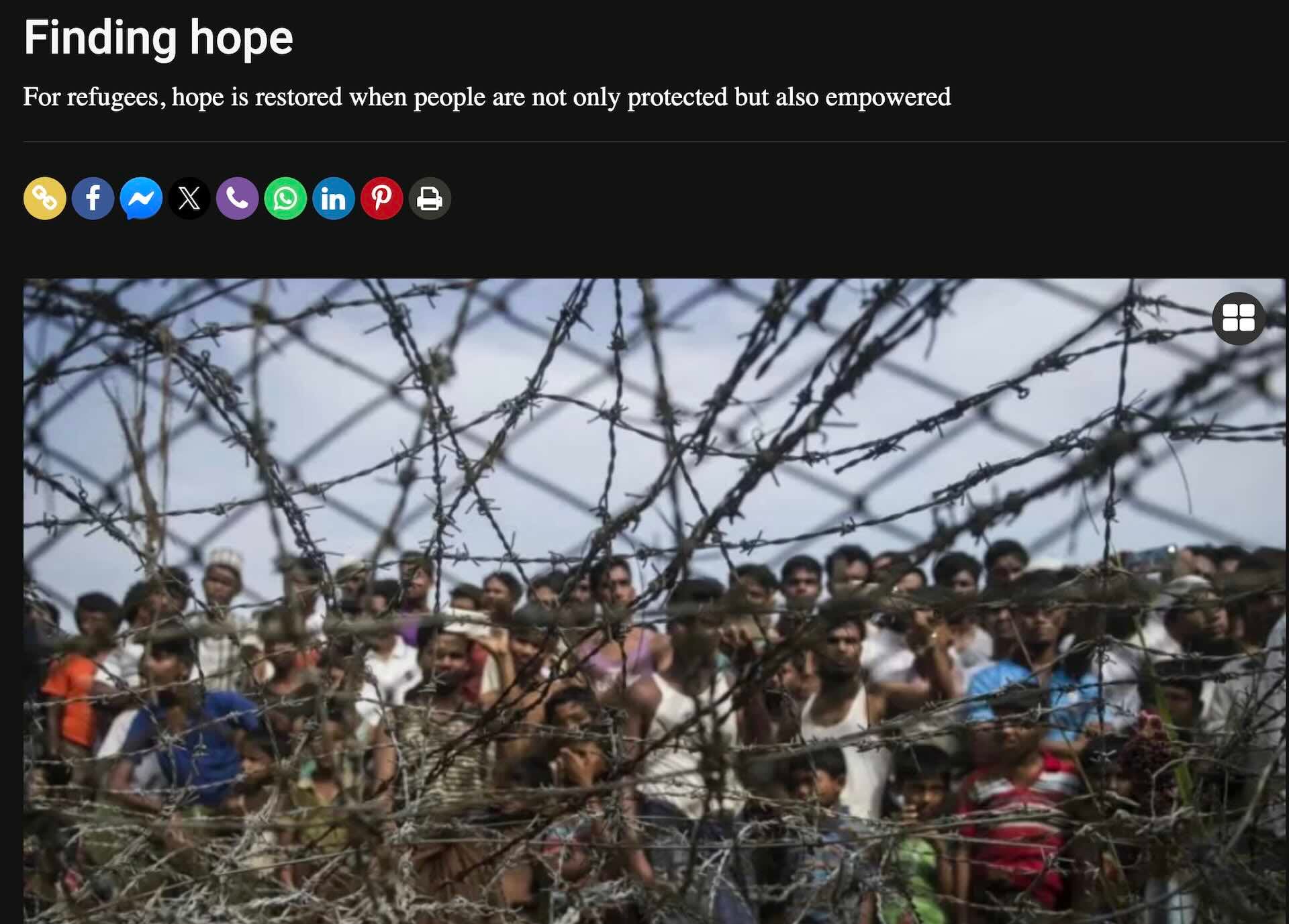
More than that, as we know UNHCR is very much invested in “story telling.” Look no further than a recent World Refugee Day op-ed titled “Finding hope,” penned by Juliette Murekeyisoni, the UNHCR Deputy Representative in Bangladesh. Murekeyisoni opens with a familiar bureaucratic move. She deploys her personal biography as a former refugee to construct an instant wall of moral authority. It is a calculated shield. By filtering the current Rohingya crisis through her own history of survival, she immunises the agency against external critique. The piece carefully converts the brutal reality of the Rohingya condition into a sentimental sermon on emotional resilience and eventual return. She deliberately obscures how the very agency she helps command is actively administering their permanent containment.
The visual layout of the article, captured in the hero image of the article (see above) exposes this institutional gaslighting. Kudos to the Dhaka Tribune picture editor for selecting that image. Directly beneath the bold, uplifting headline “Finding hope” and text that prattles on about “empowerment” and “investing in possibility,” the accompanying photograph reveals the unvarnished truth. Rohingya men and boys staring blankly out from behind heavy, choking coils of razor wire. The text asks the reader to look directly at a carceral cage and see a launchpad into the future for these people. The razor wire is the structural reality; the language of “uplift” is the administrative wallpaper Murekeyisoni uses to hide it.
In her narrative, “hope” is weaponised as a tool for management. It functions as a disciplinary promise of a future return to Myanmar that never arrives, turning a decade-long structural abandonment into a comforting interval. As I have long argued, this fiction serves everyone but the refugees. Bangladesh can insist the camps are temporary, international donors can evade long-term political responsibility, and UNHCR can maintain the highly lucrative funding cycles required to sustain its sprawling bureaucracy. While millions of dollars are sucked into the logistical black holes exposed by the OIOS auditors - enriching blacklisted needle vendors and padding the pockets of local officials with “festival allowances” - the Rohingya are told to feed on abstract hope behind barbed wire. Murekeyisoni’s text proves that for UNHCR, “empowerment” without political rights is nothing more than containment with a human face.
This is humanitarian containment at its most clinical. It is a self-perpetuating bureaucracy that treats human suffering not as a tragedy to resolve, but as a permanent, appreciating asset to be managed for corporate survival.
Further Reading
How Bangladesh is Exploiting the Rohingya Refugee Crisis
Rohingya repatriation as a governance tool in Bangladesh
The Myth of Rohingya Aid Dependency
The Architecture of Rohingya Exclusion
UNHCR’s Biometric Standoff with the Rohingya

In a UN podcast published last year, Juliette Murekeyisoni, the new interim head of UNHCR-Bangladesh, shares her experience of fleeing Burundi on the back of a lorry and discusses her commitment to displaced people. In response to a question about what she might say to t…